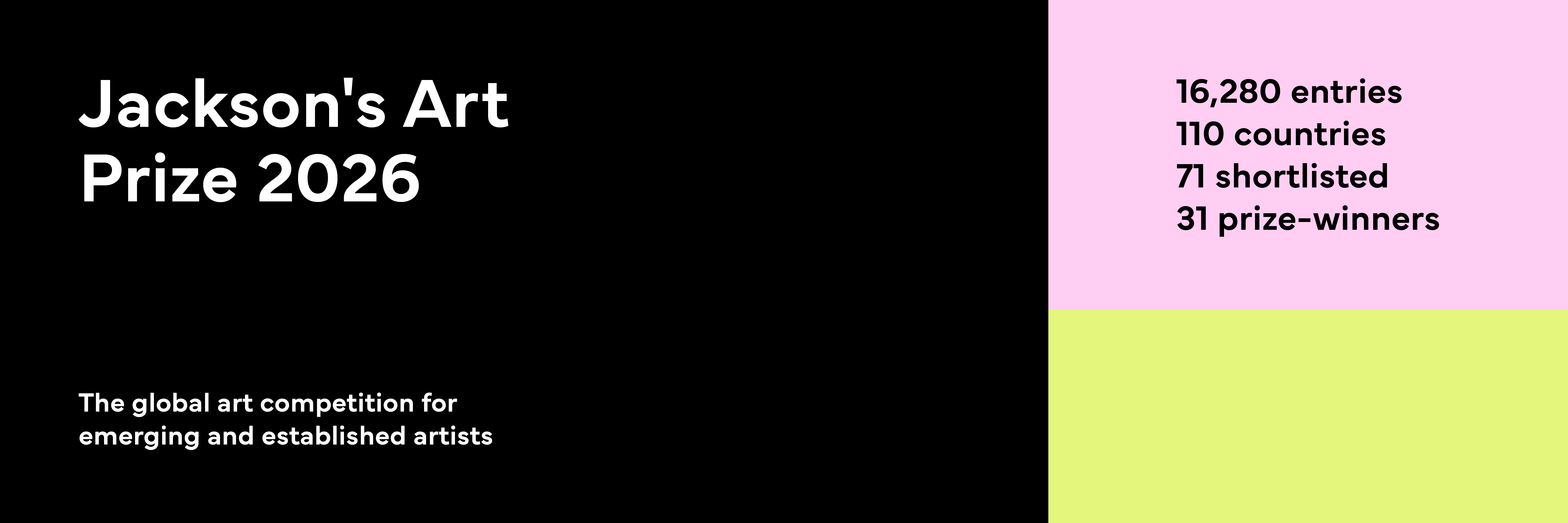
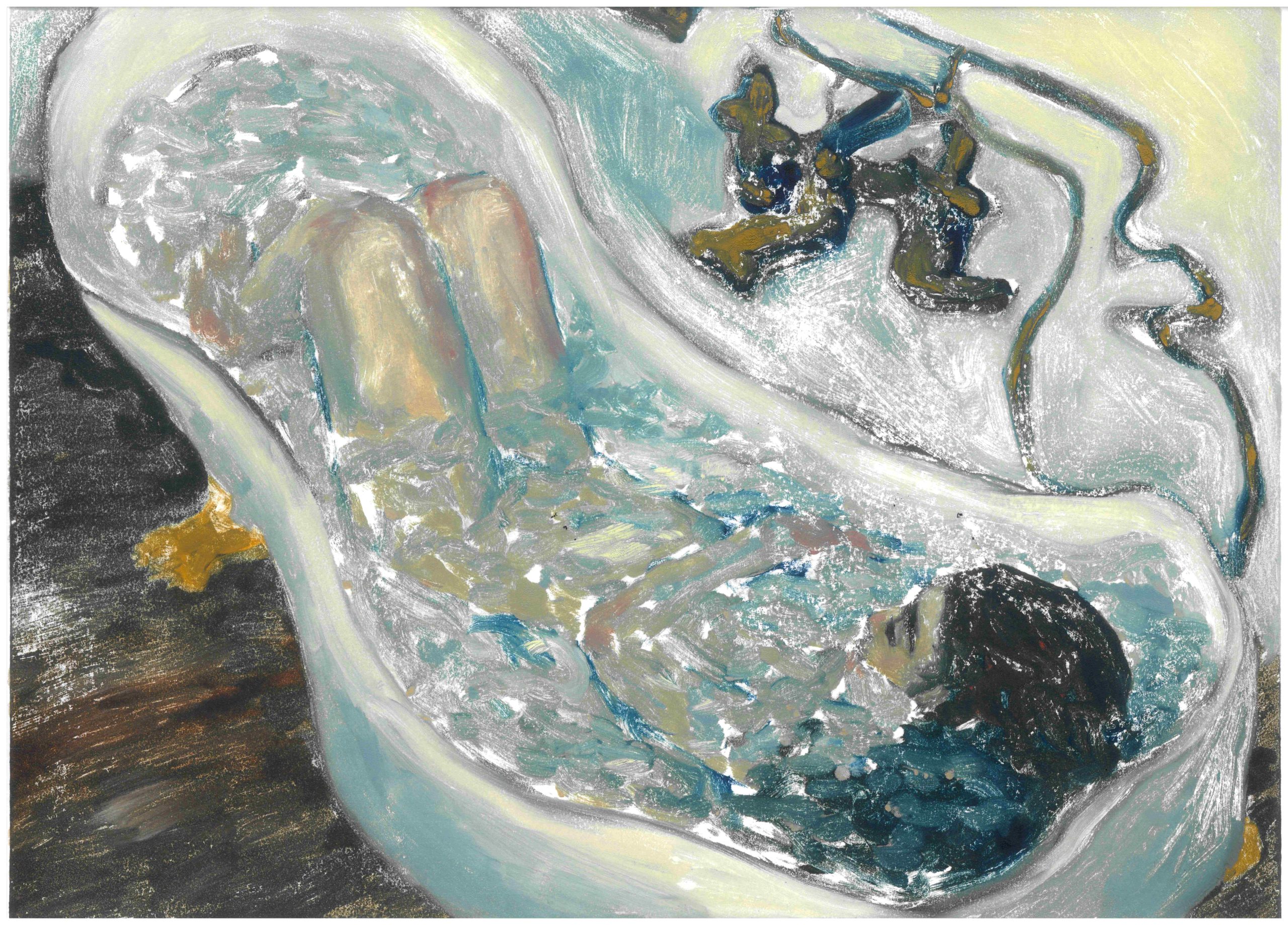
Georgia Fielding won the Planographic Print Award in Jackson’s Art Prize this year with her work In the Bath. In this interview, she discusses the importance of drawing, the relationship between a woman and her own space, and growing into creative courage.
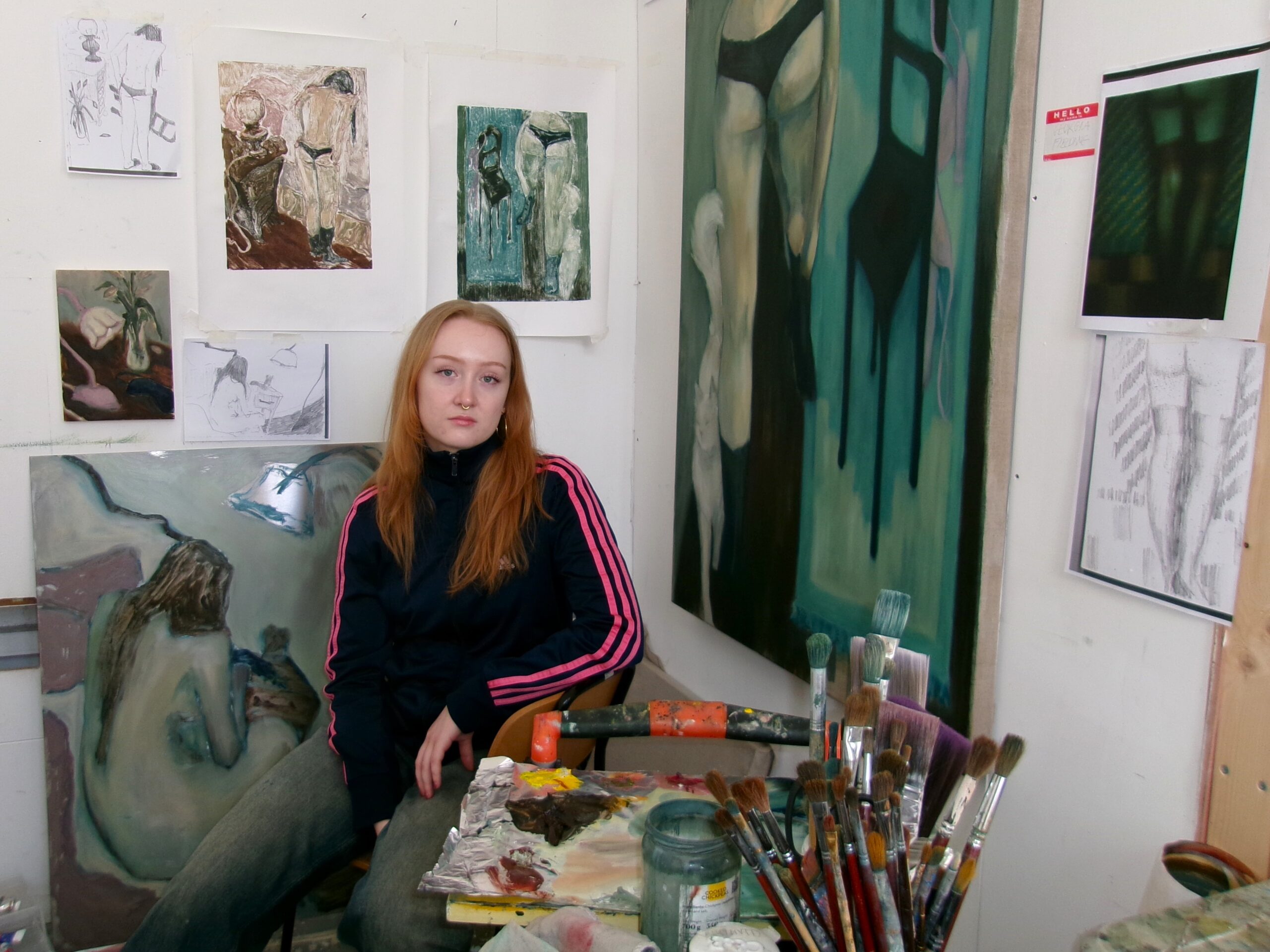
Above image: Georgia Fielding in her studio
Georgia Fielding
Oil monotype on paper, 36 x 48 cm | 14.1 x 18.8 in
Josephine: Could you share the story of how you became an artist and tell us more about your artistic background?
Georgia: I don’t come from a creative family, but from a young age I have always been drawing and making things. And my love for art, specifically painting, has just grown and grown as I have gotten older. Now, I am entering the final year of my undergraduate degree in Fine Art Painting at Camberwell College of Arts, working across both painting and printmaking.

Josephine: What does a typical working day in the studio look like for you? Do you have any important routines or rituals?
Georgia: I am a night owl in general as well as in the studio, typically starting my days in the afternoon and working until my studio closes at 9 pm. I work best when I am alone in the studio. That is part of the reason I go in later, as I share a studio at uni; that and I have a tendency to sleep in.
I often start thinking through ideas by sketching or looking over old sketchbooks before settling on a composition I think needs to be more than a sketch, either to be painted or printed. I stick to the same base palette every time: Prussian Blue, Alizarin Crimson, Cadmium Red, Cadmium Yellow, Burnt Umber, and Titanium White on a tinfoil-covered piece of cardboard. A tutor once told me I use quite an old-fashioned colour palette, which I think is quite funny. Sometimes I use more colours when in the middle of a painting if I feel I can’t achieve my idea with my base palette.
I like being self-sufficient when I work. I am most drawn to using materials and techniques I can use by myself in the privacy of my own space. So I will try to do as much as possible in the studio before branching out to the print studios or wood workshops. Doing as much as I can with my own hands is important to me – making my stretchers when I can, stretching and priming canvases myself. I think these are all basic but invaluable parts of painting that sometimes people neglect since prestretched and primed canvases are so accessible. But that’s me being a bit of a snob.

Josephine: Which materials or tools could you not live without?
Georgia: I work almost solely in oil paint, but I would have to say I couldn’t live without Prussian Blue oil paint specifically; it’s my all-time favourite blue, and I quite passionately dislike using any other blue. It’s so dark, inky, and beautiful it’s, the only blue I really use. I also don’t think I could live without a 4B pencil. If I need to draw something or write something, it’s the first thing I want to grab. And my guilty pleasure is using white spirit to thin down my paint to sheer washes.

Josephine: Do you work from a reference? Tell us more about your process.
Georgia: I work from drawings from small sketchbooks I keep. These drawings are formed from rooms, objects, actions, and figures I have imagined and actually seen in my life or in photography, painting, or online. The drawings are amalgamations of all these influences.
I don’t like working from pictorial references. For some reason, I feel as if I have to draw it to call the image my own, even if I am the one who has taken it. Drawing also helps me think through a composition, evaluating whether it will be successful in paint. I feel I am quite traditional in the importance I put on drawing; it’s important to me, and I think it should be to everyone. It strengthens an artist’s work across all mediums, giving us the skills to fully understand what we are seeing or imagining and trying to create.

Georgia Fielding
Oil on linen, 120 x 90 cm | 47.2 x 35.4 in
Josephine: Do you regularly draw or keep a sketchbook? If so, how does this inform your work?
Georgia: Yes, or I try to. I usually work in them at home in private. This is probably one of the reasons my work is the way it is. I try to always carry my sketchbooks with me wherever I go, but I don’t particularly like drawing or working in front of people. That is something I have to constantly remind myself: that my work isn’t being observed and that it doesn’t matter if something fails or looks ugly to me. My sketchbooks are the heart of practice and the beginning of everything I make. Any time I think of something or get even half an idea, I draw it out to begin to visualise it properly.

Josephine: Have you ever had a period of stagnation in creativity? If so, what helped you overcome it?
Georgia: Definitely, I can get quite bogged down with my work; I have quite a love/ hate relationship with anything I make. The most significant time I hit a wall with my practice was in my first year at university. I had been painting from my own flash photography in a colourful, true-ish to life style, focusing on women interacting and the framing and cropping of these moments. But I hit a wall, and was deeply unhappy with everything I painted, even though the paintings were technically successful. This frustration made me reflect on what I actually wanted to paint; why was I painting what I was painting? How do I actually want to paint? What don’t I like about my work? What would be more interesting? and so on.
At the same time, I was struggling with my sleep, so I started sketching all the exaggerated poses and positions you make while tossing and turning in the night. And this became the start of some new work. Funnily enough, this new branch in my practice started with monoprinting. I felt freer when working with monoprinting, when my source material was much less concrete than before.
With stagnation in creativity, I think it is most important not to put pressure on making and producing work. You can’t force it, no matter how badly you want it to. Taking some time away to think about the work, or not think at all, helps, I find. And after I am away from the work for a little while, I find myself itching to be back in the studio making and painting and printing again.

Georgia Fielding
Oil monotype on Norfolk paper, 36 x 48 cm | 14.1 x 18.9 in
Josephine: Are there any specific artists or mentors who have inspired you?
Georgia: Some artists I always come back to and love include the French photographer Sophie Calle, painters like Jennifer Packer and Edvard Munch, and Katherine Allen’s monoprints.
As for mentors, one of my art teachers from school, Ms Cagnino, was a great mentor and teacher to me as a painter. And she was an artist herself. She was always so incredibly supportive and got me through the last few years of being in school. I remember a passing comment she made that an artist has to be brave, and at the time I thought I could never be a proper artist because I didn’t feel brave at all. I think about that a lot and understand it more and more as I keep producing work.

Georgia Fielding
Oil monotype on Somerset paper, 42.5 x 52 cm | 16.7 x 20.4 in
Josephine: What were you thinking about or exploring at the time you made In the Bath? What inspired it, and how did it come to be?
Georgia: While making In the Bath, I had completed a number of monoprints where I was trying to construct these distorted bathrooms. Playing with the inclusion or exclusion of the figure, how I can distort the space with angles and brushstrokes. These were relatively successful, done quickly, just trying to get ideas out of my head.
Over a couple days in the studio, I produced many prints, gradually becoming more detailed and thought through, each building off the last. The final print I made in this burst was In the Bath, which felt like a natural end to the series.
I was obsessing over these bathroom compositions because of their inherent intimacy – how bathrooms become a completely private space. I was thinking about quiet moments I have experienced when you’re half submerged in the bath. And I was thinking about how this atmosphere is created and comes across. Is it a lonely, uneasy atmosphere, or is it content, quiet, and peaceful? I find this relationship between a woman and her own space very interesting.

Georgia Fielding
Oil on steel, 100 x 75 cm | 39.3 x 29.5 in
Josephine: What made you submit this piece to Jackson’s Art Prize?
Georgia: I submitted to the prize the night before the deadline, and at the time, this print was one of the only pieces of work I was happy with. I felt like this print was the most successful of the collection. It took many prints, learning, and tweaking things in each composition until I reached this one, so I felt like it could stand on its own.

Georgia Fielding
Oil on steel, 100 x 75 cm | 39.3 x 29.5 in
Josephine: You mentioned in your submission statement that the monotype was created in one pull, and that it was not built in layers. How important is it to you that the process maintains that degree of immediacy?
Georgia: The immediacy of monoprinting helps me think clearly. I love oil painting; the nature of the medium can be slow. Things are built up in layers and passes; you can paint over something completely and cover it up like it was never there. But this nature can easily lead me to overthink and overwork an image. The immediacy and directness of monoprinting lets me, for a short period of time, be completely focused on building an image to completion. I am basically in direct contact with the paint as it glides onto the piece of acrylic in use.
I can build up a printing plate and complete the image very quickly. I try to work under slight time pressure as I don’t want to let the paint dry. It is also quite freeing that I don’t know what the final image will look like. I know the image will be reversed and the brushstrokes will distort when printed, bleeding into each other or sometimes not printing at all. These factors help me not get caught up in worrying about whether what I am doing is ‘right’. I never feel the need to work back into the prints either, as I really enjoy the flatness monoprints have when the ink is pressed into the paper, and I enjoy knowing it was created in this concise moment.

Josephine: The image is incredibly painterly. Can you describe what the monotype process contributed to this idea, and why you chose to monotype it over simply painting it directly on to a substrate?
Georgia: Often, I use monoprinting as a fast way to get my ideas out of my head onto paper. They are closer to paintings than drawings are, so it bridges the gap between my sketches and my paintings. I find that when printing, I try to paint as I do normally, and when painting, I am trying to emulate my prints. I think I am always trying to find a place between these two styles. There are some techniques I can’t create in monoprinting and equally things I can’t seem to do in painting. Monoprinting gives a distinct energy and directness to the prints that I find quite hard to replicate when painting.
I can’t really say why I printed the image instead of painting it; I had been sketching it over and over again then moved on to printing a few variations until In the Bath was made. But this is where the image felt most complete, so I didn’t move on to painting it on linen or steel or wood. Part of the slow progression into painting is to do with nervousness with the image. If I am not confident in the composition, I don’t feel confident to go straight into painting it. So I keep working on it through print and drawing.

Josephine: Are there any new techniques or ideas you’re excited to explore using the materials from your prize?
Georgia: I’m excited to use all the new printmaking tools and materials I received from the prize. Before, I just used whatever I have on hand and only printed with oil paints in my studio, but I am excited to play around with the professional oil-based printing inks. As well as keeping up my monoprinting, I am thinking about trying some woodblock printing.

Georgia Fielding
Oil monotype on Norfolk paper, 48 x 36 cm | 18.9 x 14.1 in
Josephine: How did it feel to move through the stages of the competition and win the Planographic Print Award?
Georgia: It was quite surreal, I try to keep my expectations quite low with prizes and open calls in general so when In the Bath got shortlisted I really didn’t expect it. Funnily enough I was on a plane when the material prizes got announced, so when i turned off airplane mode my friends and family all knew before me, it was a bit overwhelming to think about.

Josephine: What’s coming up next for you?
Georgia: In September, I will enter the final year of my undergraduate degree at Camberwell College of Arts with an external show at Southwark Park Galleries in January and the degree show at Camberwell in June. In the meantime, I will continue working in my shed at home as my inbetween studio.
Follow Georgia on Instagram
Visit Georgia’s website

Further Reading
Meet Angela Lizon, Winner of Jackson’s Art Prize 2026
Jackson’s Art Prize 2026 First Prize Winner Announced
How We Collaborate With Artists
Expert Advice on Making Your Way as an Artist
Shop Oil Painting on jacksonsart.com
Shop Printmaking on jacksonsart.com