

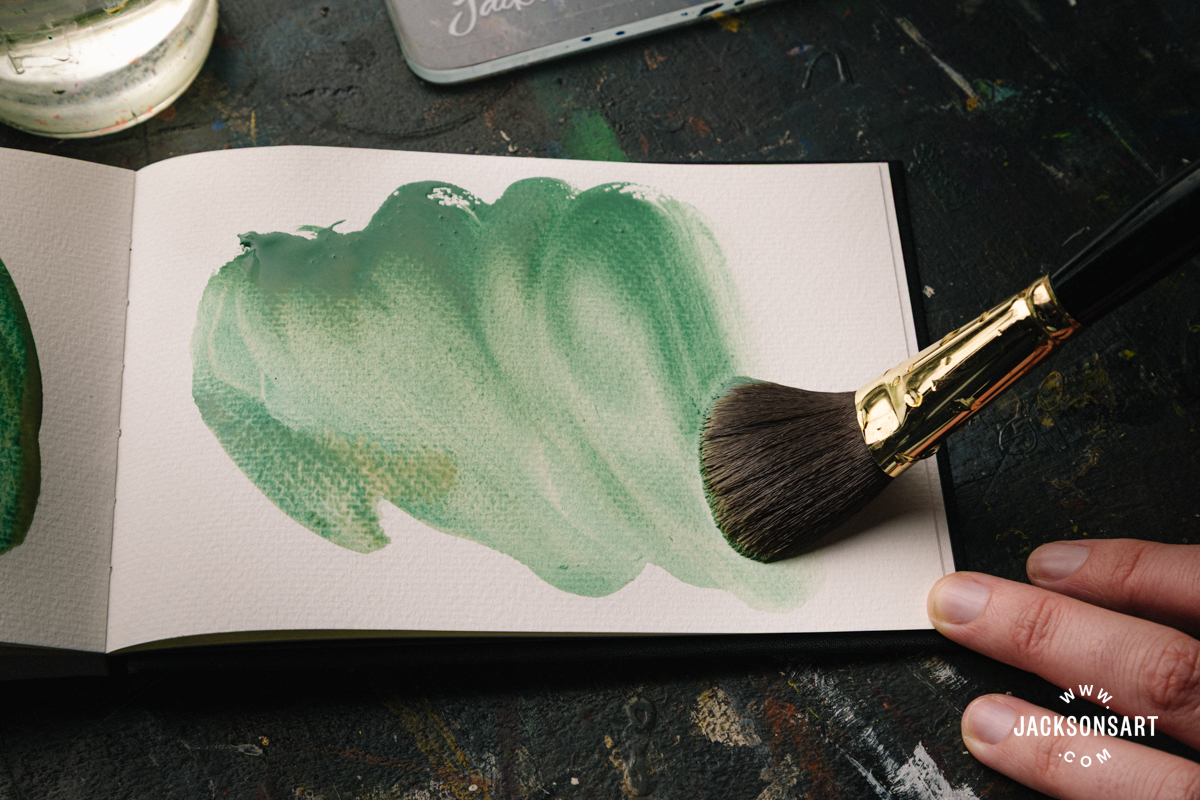
Malachite, a green copper carbonate mineral, has been used as a pigment for thousands of years. This article explores the history of Malachite as an artists’ pigment, tracing its use across different painting traditions. From its connections to fertility and rebirth in Ancient Egypt to its role in Chinese Blue-Green landscapes and European painting, Malachite’s history reveals the remarkable journeys that pigments can take through art and culture.

From Mineral to Pigment
Malachite is a copper carbonate hydroxide mineral that forms through the weathering of copper deposits. Found in regions such as Egypt, the Ural Mountains, the Democratic Republic of the Congo, and the American Southwest, it has long been valued as an ornamental stone as well as a source of pigment.

China
Rock and stand, 22.9 cm x 33.2 cm | 9 x 13.1 in
Metropolitan Museum of Art
To make a pigment, the mineral is crushed and ground into a fine powder. The appearance of Malachite pigment depends partly on particle size. Coarsely ground particles produce a darker, more saturated green, while finely ground Malachite appears paler and more subtle.

Malachite in Ancient Egypt
Some of the earliest evidence for the use of Malachite as a pigment comes from Ancient Egypt, where green carried powerful associations with fertility, growth, regeneration, and rebirth.
These ideas were closely connected to the mythology of Osiris, one of the most important gods in the Egyptian pantheon. According to Egyptian myth, Osiris was murdered and dismembered by his brother Set, who scattered the pieces of his body across Egypt. Osiris’ wife, Isis, searched for the fragments, reassembled his body, and embalmed him. Through this process, Osiris was resurrected, becoming ruler of the underworld and the first mummy.

Nina de Garis Davies and Hugh R. Hopgood, from the Tomb of Nebamun and Ipuky
Tempera on paper, 78.5 x 81 cm | 30.9 x 31.9 in
The Metropolitan Museum of Art
The story of Osiris was closely tied to the rhythms of the natural world. His death and rebirth echoed the annual flooding of the Nile, which deposited fertile silt across the floodplain and renewed the agricultural land. Just as the land was regenerated each year, Osiris became a symbol of renewal and rebirth. In Egyptian art, he is often depicted with green skin, a colour associated with fertility, vegetation, and regeneration.

Egyptian
Cast bronze sculpture, 8.8 x 2.2 cm | 3.5 x 0.9 in
Detroit Institute of Arts
The significance of green helps explain the importance of Malachite in Egyptian visual culture. Alongside other green pigments, including Green Earth and Egyptian Green, it was used in decorative painting and funerary contexts. Malachite was also ground into a fine powder, combined with waxes, and applied around the eyes as a cosmetic. Like many ancient cosmetics, its use likely combined aesthetic, ritual, and practical functions.

Malachite in European Art
Malachite also had a place within the painting traditions of Medieval and Renaissance Europe. Around 1400, the Italian artist and writer Cennino Cennini described the pigment in his famous treatise Il Libro dell’Arte. He referred to it as verde azzurro, literally ‘green azure’. Malachite appeared in panel paintings, manuscript illuminations, and fresco wall paintings.

Austrian
36 x 25.5 cm | 14.2 x 10 in
The Metropolitan Museum of Art
However, Malachite was not the brightest green available to artists. Verdigris, a copper acetate pigment, was capable of producing deeper, more intense greens. In The Virgin and Child, Andrea del Verrocchio used rich Verdigris (now darkened) in the Virgin’s cloak and the gentler Malachite in the landscape behind.

Andrea del Verrocchio
Gemäldegalerie, Staatliche Museen zu Berlin
Malachite performs well in fresco and egg tempera, where it can be used in relatively coarse particles that retain the pigment’s green colour. Oil painting presented a greater challenge. Oil painters generally required pigments to be ground more finely to achieve smooth blends and transitions, but as Malachite is ground down, its colour becomes progressively paler and less saturated. As oil painting became the dominant medium in Europe during the 15th and 16th centuries, Malachite gradually declined in popularity.

Malachite in Chinese Landscape Painting
Malachite’s decline in Europe was partly tied to the rise of oil painting. In China, where artists traditionally worked with water-based paints on silk and paper, the mineral continued to occupy an important place in the painter’s palette. Malachite was frequently paired with the blue pigment Azurite. The connection between the two pigments is chemical and geological. Azurite and Malachite are closely related copper carbonate minerals and are often found together in the same deposits. In fact, blue Azurite can gradually transform into green Malachite over long periods of weathering.
Both pigments were central to the Blue-Green landscape tradition, which flourished during the Tang dynasty and was later revived during the Ming and Qing periods. These paintings used brilliant mineral pigments to depict mountains, rivers, and forests in vivid blues and greens. Rather than serving as straightforward records of the natural world, they often presented idealised landscapes shaped by philosophical, spiritual, and poetic ideas.
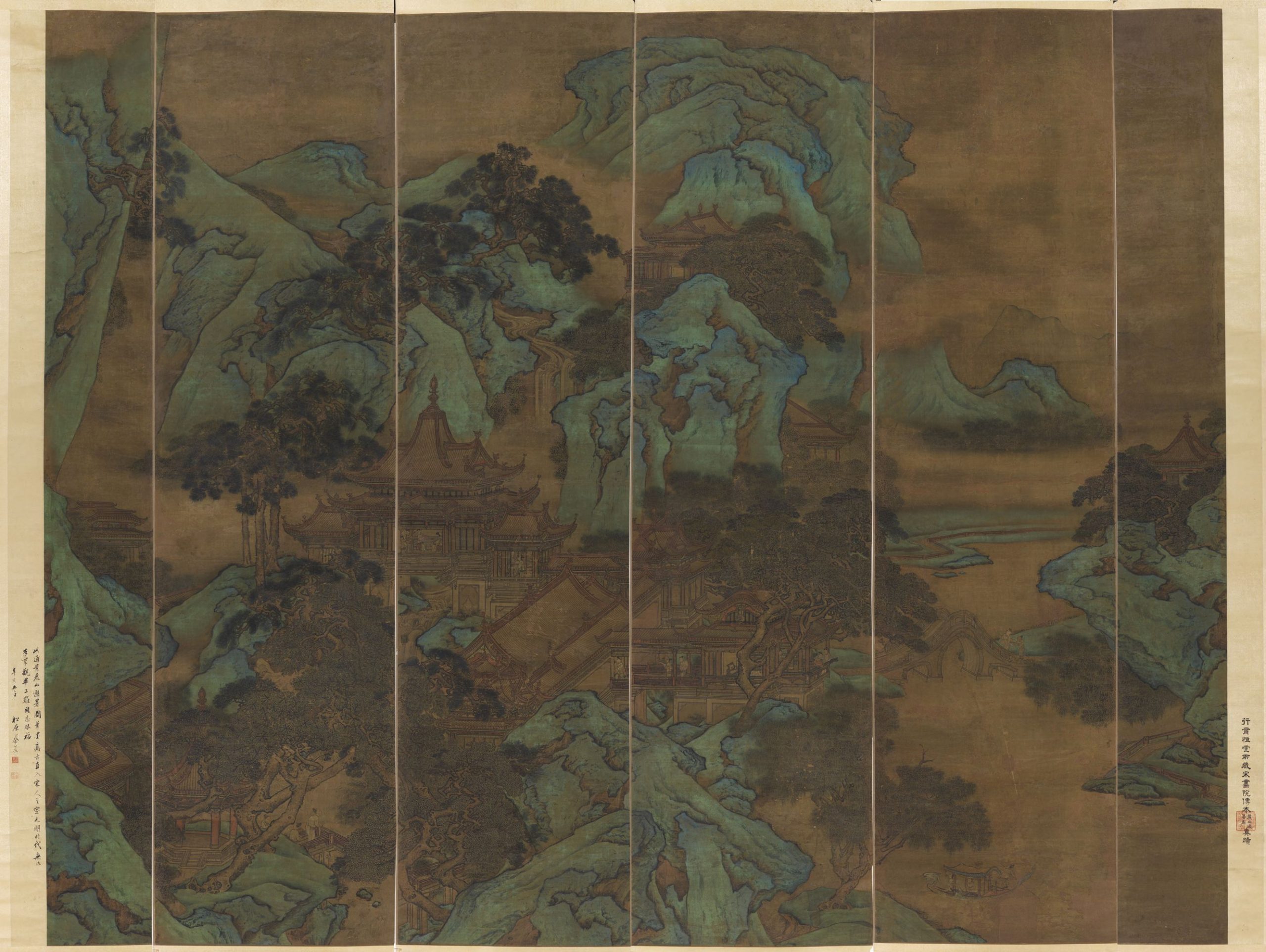
School of Yuan Jiang
Ink and colour on silk, 223.5 x 26.3 cm | 88 × 10.4 in
Princeton University Art Museum
Azurite and Malachite also had lives beyond painting. Both minerals were used in traditional Chinese medicine and, in some contexts, were associated with longevity and immortality. These wider cultural associations enriched their role within landscape painting. Azurite and Malachite helped create landscapes that resonated with broader ideas of transcendence, retreat, and the search for harmony with nature.
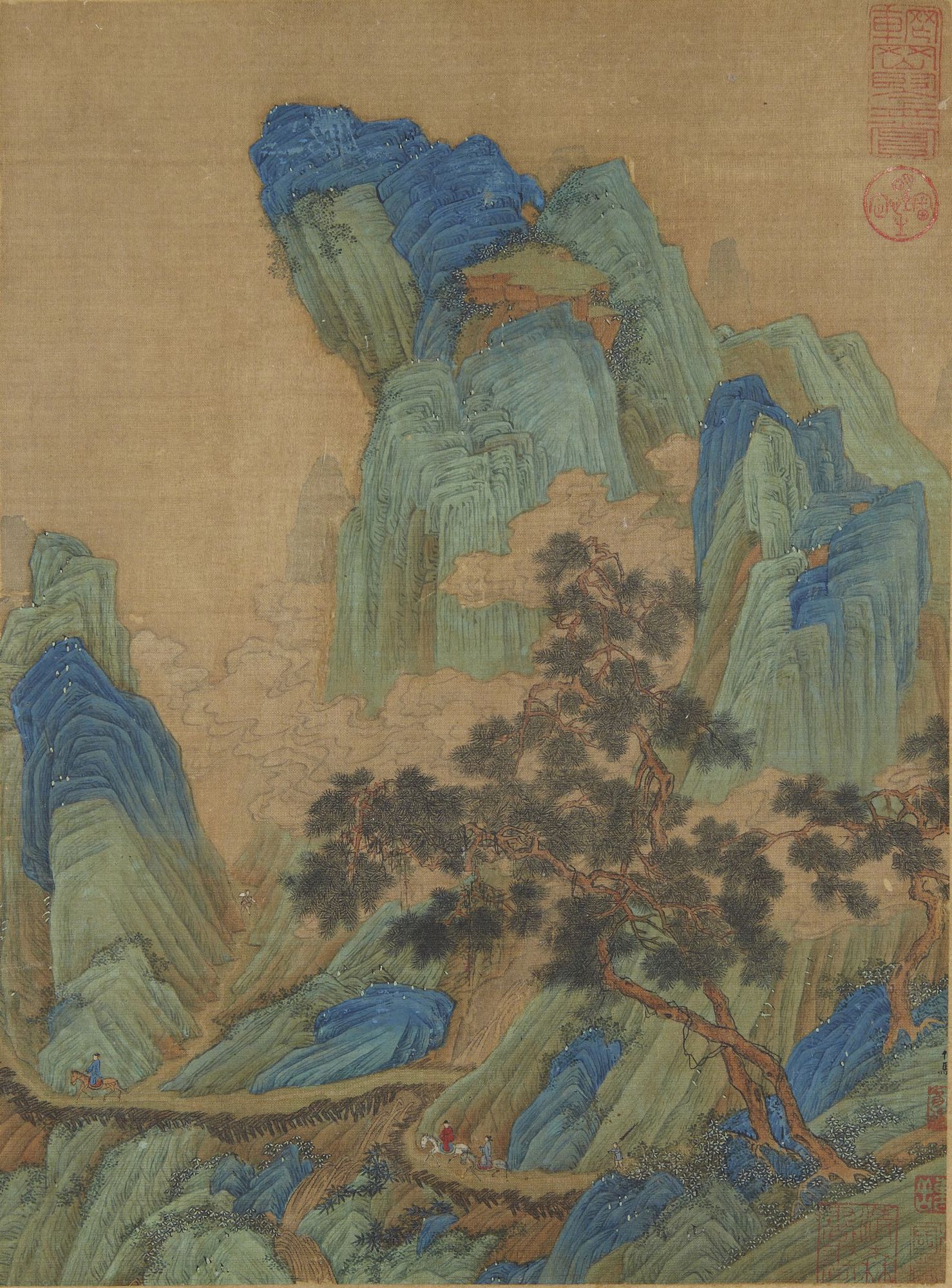
Unknown Artist
Ink and colour on silk, 27.2 x 20.2 cm | 10.7 x 8 in
Princeton University Art Museum
Malachite in the 19th Century
The 19th century witnessed an unprecedented expansion in the range of colours available to artists. Advances in chemistry led to the introduction of numerous new pigments, many of which offered brighter colour, improved consistency, and lower cost than traditional materials.
Nevertheless, Malachite had not vanished completely from artists’ palettes. Technical studies have identified its use in Pierre-Auguste Renoir’s Chrysanthemums, where it appears alongside modern pigments such as Cobalt Blue and Cadmium Yellow. The painting captures a moment of transition in the history of artists’ materials, when ancient pigments coexisted with the new products of industrial chemistry.

Pierre-Auguste Renoir
Oil on canvas, 54.8 × 65.8 cm | 21.6 x 25.9 in
Art Institute of Chicago
Nevertheless, Malachite belonged to an older tradition of colour-making. 19th-century artists could choose from a growing range of industrially-produced synthetic greens, including Viridian and Emerald Green. As these newer pigments became widespread, Malachite became an increasingly less familiar presence on European artists’ palettes.

Today, Malachite is far less common than it once was, yet it remains one of the most historically significant green pigments. Its story connects Egyptian mythology, medieval European workshops, Chinese landscape painting, and 19th-century Impressionism. Malachite is a material thread running through a variety of painting traditions.
Further Reading
Mineral Pigments in Chinese Blue-Green Landscape Painting
Introducing Jackson’s Pigment Stories Book
Exploring the Impact of the Victorian Colour Revolution
Shop Art Materials on jacksonsart.com





I just like the helpful information you provide in your articles