
Healthcare organizations need event registration software for programs that sit at the intersection of clinical education, compliance, and professional development. A regional hospital system planning its annual medical staff conference, a professional association managing continuing medical education (CME)-accredited workshops, or a pharmaceutical company running investigator meetings each faces registration requirements that go well beyond what a basic ticketing tool can handle.
This guide covers the specific registration challenges healthcare organizations face, what to look for in a platform, and the questions worth asking before you commit.
The Unique Registration Challenges Healthcare Organizations Face
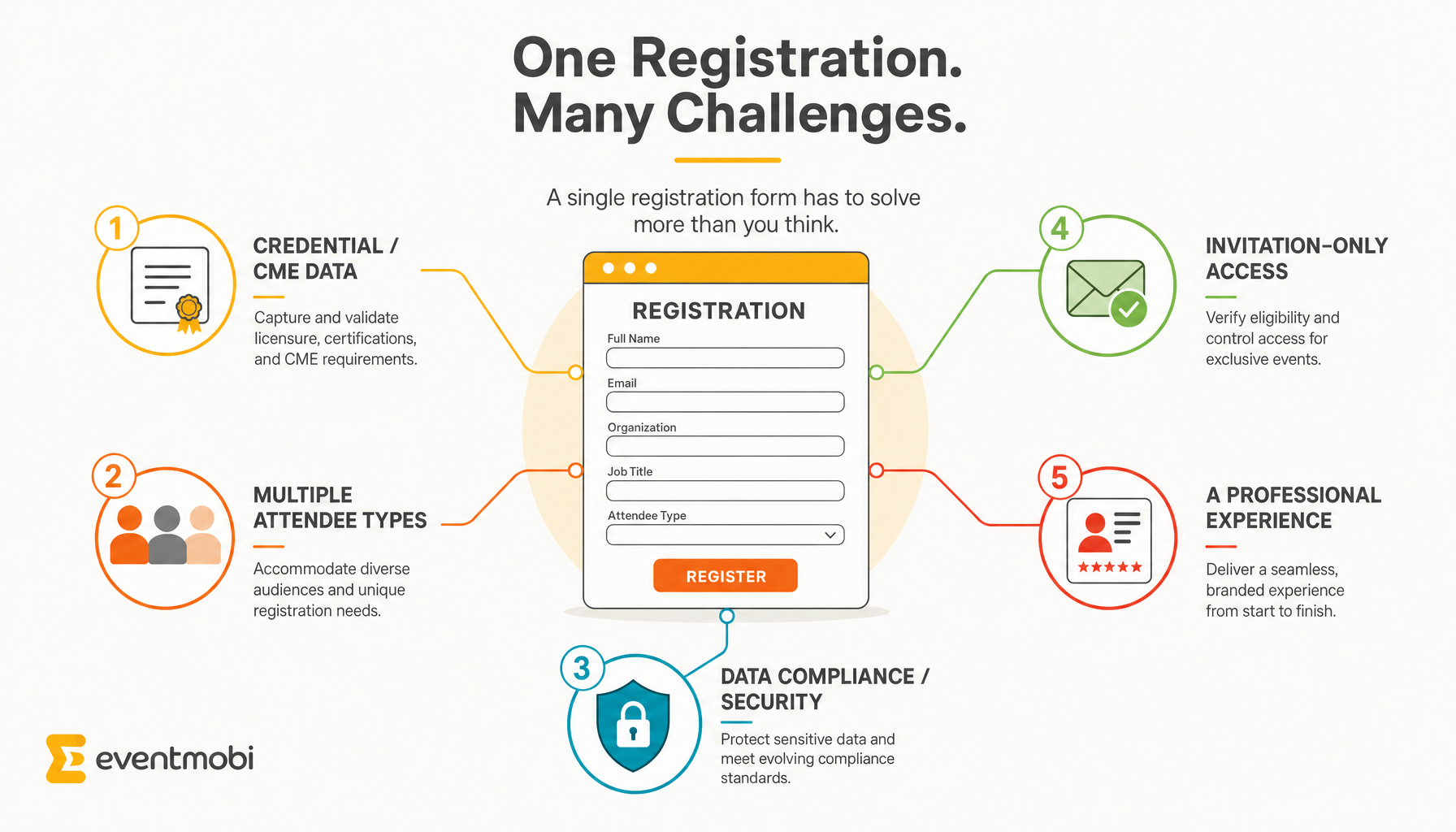
Healthcare event registration is more demanding than standard event ticketing because it sits at the intersection of clinical education, compliance, and professional development. Organizers have to capture credential data for accreditation, serve multiple attendee types, protect sensitive information, and gate invitation-only events. The five challenges below are what set healthcare registration apart.
Continuing Medical Education (CME) and CE Tracking
For many healthcare events, registration is not just about confirming attendance. It is the first step in a chain of data that ends with accreditation records. CME and continuing education credits require organizers to capture credential numbers, track session attendance, and export structured data that feeds into post-event certification records. Registration forms need to collect this data cleanly and accurately at the point of sign-up, not through a manual follow-up process after the event. Custom form fields for license numbers, credential types, and session selections are a baseline requirement for CME event registration and other healthcare events with continuing education components.
Multiple Attendee Types With Very Different Needs
A single medical conference might include physicians, nurses, allied health professionals, administrators, pharmaceutical representatives, and exhibitors, all registering through the same event but with different ticket types, access levels, and data requirements. A physician needs to provide credential information. An exhibitor needs booth assignment details. A sponsored attendee needs different payment handling than a self-paying registrant. Managing this cleanly in a single registration system requires flexible form logic. Without conditional logic that shows each attendee type only the fields relevant to them, you end up with either an overwhelming form or separate registration processes for each group.
Compliance and Data Sensitivity
Healthcare organizations are subject to well-established data governance regulations, including the Health Insurance Portability and Accountability Act (HIPAA) in the United States, that impose requirements beyond those in many other sectors. Attendee data collected at registration may include professional license numbers, employer information, and in some cases clinical affiliations that carry sensitivity beyond typical event data. The registration platform needs to handle this data securely and allow for appropriate access controls. For events involving pharmaceutical or medical device industry sponsors, there are additional compliance considerations around who is sponsoring attendance, disclosure requirements, and the separation of educational content from promotional activity (as governed by the Accreditation Council for Continuing Medical Education (ACCME) Standards for Integrity and Independence and related industry guidance). Registration data often needs to capture and track this information explicitly.
Private and Invitation-Only Events
Not all healthcare events are open to the general public. Investigator meetings, advisory board meetings, medical staff forums, and internal clinical education events require invitation-only registration with controlled access lists. The platform needs to support private registration gating, RSVP flows with acceptance tracking, and the ability to restrict access without requiring a workaround.
High Attendee Expectations for Professionalism
Healthcare professionals attend events with high expectations for the quality of the registration experience. A generic form on a third-party platform does not reflect well on a hospital system or professional association. A branded, multi-page event website with a professional registration flow, a clear confirmation email, and responsive attendee support creates the right first impression.
What to Look for in Healthcare Event Registration Software

The right healthcare event registration software collects credential and continuing education data, adapts to multiple attendee types, and controls access for invitation-only events. It should also connect registration data to the event website, email, payments, and onsite tools within one platform. The capabilities below are the ones that matter most when you evaluate options.
Custom Form Fields for Credential and CE Data. The registration form needs to support custom fields that capture credential-specific information: license number, license type, state or jurisdiction, National Provider Identifier (NPI) if applicable, and session selections for CE credit tracking. These fields should be configurable per event without requiring platform customization or developer involvement. When you evaluate medical conference registration software, confirm that this level of custom data collection is available out of the box.
Conditional Logic for Multiple Attendee Types. A form builder that shows or hides fields based on ticket type or prior selections is essential for healthcare events with multiple attendee categories. Physicians, nurses, administrators, and exhibitors all have different data requirements. EventMobi’s Form Conditions apply if/then logic that keeps the form manageable for each group while keeping all registrant data in a single system.
Private Registration and RSVP Flows. For invitation-only events, the platform needs to support private registration with controlled access lists, RSVP flows that track acceptance and decline before the form opens, and codes that reveal hidden ticket types for sponsored or complimentary attendance categories. EventMobi’s Public/Private gating controls access at the form level, RSVP sends private invitations to a curated list and tracks acceptance before registration opens, and Promo Codes reveal hidden ticket tiers to specific groups only.
Branded Event Website. A drag-and-drop website builder that supports multi-page sites, branded design, and a dedicated registration page is important for professional-facing healthcare events. The site needs to communicate agenda, accreditation information, faculty bios, and venue logistics clearly, without requiring a web designer or separate tool. EventMobi brings event registration software, badging, and check-in together in one platform, so the registration page is native to the site rather than embedded from elsewhere.
Integrated Email Communications. Pre-event email communications for healthcare events often include detailed logistics, CME instructions, disclosure reminders, and agenda updates. An email tool that reads directly from registration data allows segmentation by registration status, ticket type, and any custom field collected at sign-up, ensuring the right communications reach the right attendees without manual list management.
Payment Gateway Compatibility. Healthcare events often involve a mix of self-paying registrants, employer-sponsored attendees, and complimentary passes for faculty or sponsored participants. The platform needs to support multiple ticket types with different pricing and access conditions, and connect to the payment gateway the organization already uses. EventMobi supports seven gateways (Stripe, PayPal Payflow Pro, Braintree, Cybersource, Bambora, Moneris, and Authorize.net), so finance teams can keep the provider they are contracted with.
Connected Event App and Onsite Tools. For multi-day conferences, registration data needs to flow automatically into the event app, check-in and badge printing system. A platform that handles all of these from a single system eliminates the manual data import step that consumes staff time the morning of a large event and introduces the risk of data errors. With EventMobi, registration data flows directly into the event check-in app and badges printed onsite without a separate export.
AI-Powered Attendee Support. Healthcare professionals often have specific questions before registering: whether CME credits are available for specific sessions, what accreditation body has approved the program, whether disclosure forms are required, and what the cancellation policy is. EventMobi’s MobiAI Reg Concierge, an AI-powered assistant embedded on the event website, can answer these questions instantly, 24 hours a day, reducing the volume of pre-event emails that reach the organizing team.
Common Healthcare Event Registration Scenarios

Healthcare event registration needs vary by event type, from CME-accredited workshops to invitation-only investigator meetings and large association conferences. Each scenario combines its own mix of attendee types, credential tracking, access controls, and payment handling. The examples below show how these requirements come together in practice.
Annual Medical Staff Conference or Department Grand Rounds. Moderate to high complexity registration with multiple attendee categories, CME credit tracking, and a multi-page event website covering agenda, faculty bios, and accreditation information. Often involves a mix of self-paying and employer-sponsored registrants.
CME-Accredited Workshop or Seminar. Registration form must capture credential information for accreditation records, with session selections that map to specific credit hours. Post-event data export requirements are significant. Custom form fields and structured data collection are the critical requirements.
Investigator Meeting or Advisory Board. Invitation-only event with a curated list of physician investigators or medical advisors. RSVP flow with personal invitation tracking, small guest list, and high expectations for the professionalism of the registration experience. Disclosure and compliance data often collected via custom form fields.
Healthcare Association Annual Conference. The flagship event for a medical professional association, typically involving the full complexity of healthcare event registration: multiple attendee types, early bird pricing, CME tracking, sponsored attendance categories, exhibitor registration, and a content-rich multi-page event website.
Internal Clinical Education or Training Event. Employee-only registration with domain-restricted or invitation-only access. Simpler form, free registration, and logistics-focused communications. The requirement is keeping the event internal without requiring a separate registration process outside the main platform.
Questions to Ask When Evaluating Platforms
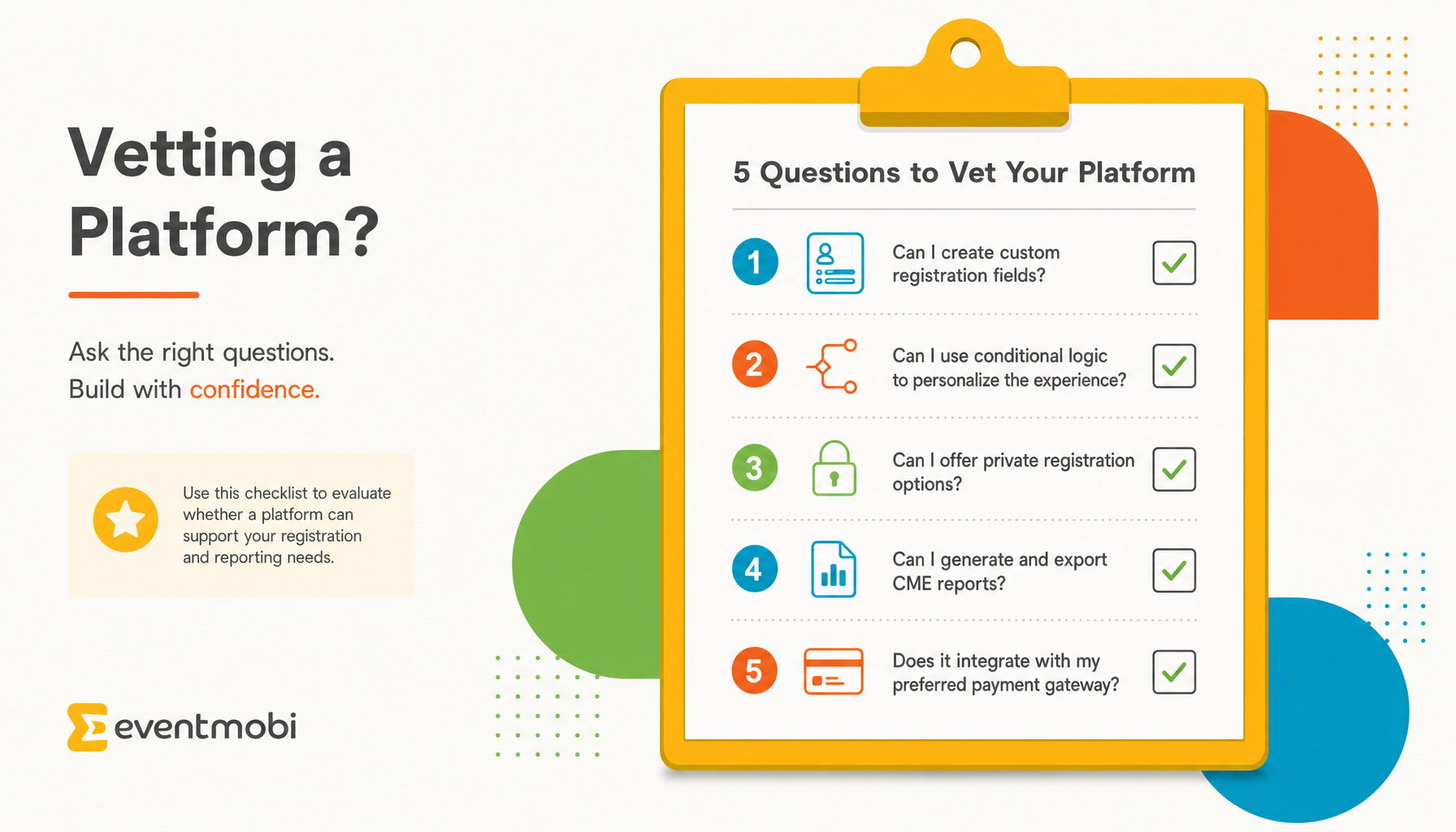
Does the platform support custom fields for credential and CME tracking data? Confirm that you can add custom fields for license numbers, credential types, and session selections without requiring developer involvement or platform customization.
Can the form show different fields to physicians, nurses, and exhibitors without building separate forms? Conditional form logic is the practical requirement here. Ask for a demonstration before committing.
Does the platform support private registration for invitation-only events? Confirm that RSVP flows, private access controls, and invitation list management are available within the same platform as your public events.
How does registration data connect to CME reporting and post-event certification records? Many registration platforms do not offer native CME reporting. Confirm what data export capabilities are available and whether the format is compatible with your accreditation management system.
Does the platform support the payment gateway your organization is contracted with? Healthcare organizations often have specific procurement and compliance requirements around payment processing. Confirm gateway compatibility before committing.
Frequently Asked Questions
The Bottom Line
Healthcare event registration is more complex than most sectors, but the complexity is manageable with the right platform. The requirements are specific: custom fields for credential data, conditional logic for multiple attendee types, private access controls for invitation-only events, and a connected system that flows registration data into the event app and onsite tools without manual intervention. For healthcare organizations evaluating platforms, the questions to prioritize are data collection flexibility, access control capabilities, and how registration data connects to the downstream tools used to run the event.
See how EventMobi makes CME-compliant, credential-verified registration easy for your next conference