
Nonprofits run some of the most logistically complex events in any sector. A single annual gala might involve donor tables, volunteer registrations, sponsor packages, complimentary tickets for board members, and a silent auction, all managed by a team of two or three people who are also running the organization’s day-to-day operations.
Add a multi-event calendar (fundraising dinners, awareness walks, educational workshops, advocacy days), and the administrative burden of managing registration across all of it becomes significant. The right event registration software for nonprofits can dramatically reduce this burden while keeping more of your fundraising revenue where it belongs: supporting your mission.
This guide covers what nonprofits need from nonprofit event registration software, where common tools fall short, and what to look for when evaluating platforms.
The Unique Registration Challenges Nonprofits Face
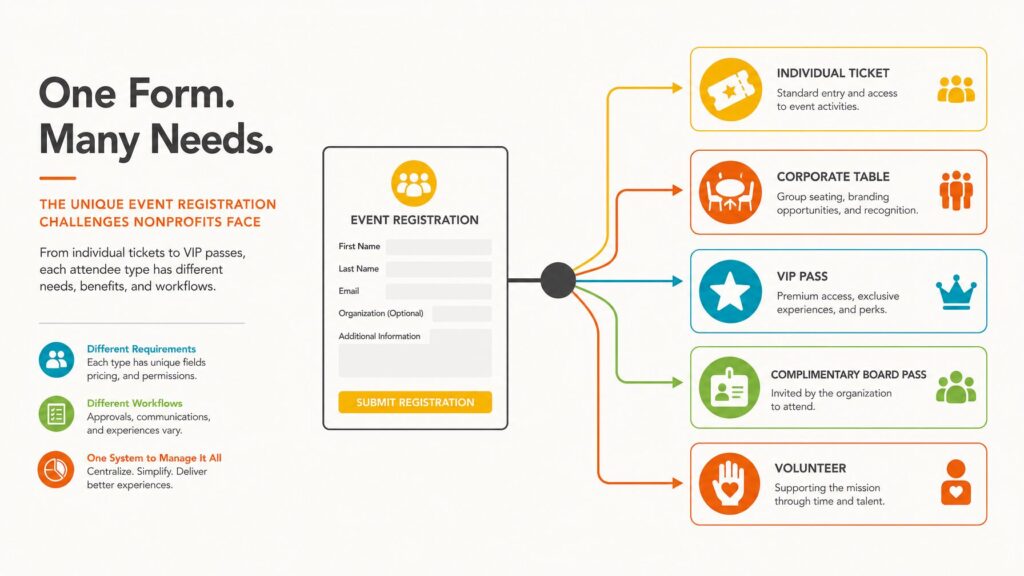
Nonprofits face distinct event registration challenges that standard ticketing platforms are not designed to handle. These include managing multiple attendee types with complex pricing, coordinating volunteer sign-ups alongside attendee registration, capturing donor recognition data, and doing it all with small teams and tight budgets.
Multiple Attendee Types With Different Access and Pricing
Nonprofit events rarely have a single ticket type. A fundraising gala might have individual tickets, corporate tables, VIP packages, complimentary board member passes, and volunteer registrations, each with different pricing, access conditions, and data requirements. Managing this in a single form, cleanly and without confusion, requires more flexibility than most basic ticketing tools offer.
The challenge is compounded by the fact that many of these ticket types should not be publicly visible. A corporate table package or a complimentary board pass does not belong on the general registration form. Promo codes that reveal hidden ticket types allow nonprofits to manage these audiences privately without building separate forms or processes for each.
Volunteer Registration Alongside Attendee Registration
Many nonprofit events require both attendees and volunteers to register, often for different roles, shifts, or responsibilities. Some platforms handle this within a single registration system using ticket types and custom fields. Others require a completely separate process for volunteers, which fragments the data and increases administrative overhead.
Donor and Sponsor Recognition
For fundraising events, registration data often needs to capture donor and sponsorship information (contribution amounts, recognition preferences, table assignments) that feeds into event program materials, seating plans, and post-event acknowledgment. Custom registration fields and the ability to export structured data are important for this workflow.
Small Teams, High Event Volume
Nonprofit event teams are typically small relative to the event calendar they manage. Every hour spent on manual data reconciliation, spreadsheet maintenance, or answering repetitive pre-event emails is an hour not spent on mission-driven work. The operational efficiency of the registration platform matters more for nonprofits than for organizations with larger teams.
Budget Constraints and Per-Ticket Fee Sensitivity
Nonprofits are cost-conscious by necessity. Per-ticket transaction fees that are acceptable for a corporate event can meaningfully erode the revenue from a nonprofit fundraising event where ticket margins are already tight. Understanding the full cost of a registration platform, including subscription fees, per-ticket fees, and payment processing costs, is essential for nonprofits evaluating options.
EventMobi offers nonprofit-friendly pricing with no per-ticket registration fees beyond standard payment-gateway processing, keeping more of your fundraising dollars directed toward your mission.
Q: Why do nonprofits need specialized event registration software?
A: Nonprofits require event registration tools that handle multiple attendee types (donors, volunteers, sponsors, board members) with different pricing and access levels, all while minimizing per-ticket fees that erode fundraising revenue.
Q: What is the biggest registration challenge for nonprofit events?
A: Managing complexity with limited resources. Nonprofits must juggle VIP passes, complimentary tickets, volunteer sign-ups, and donor data collection within a single event, often with teams of only two or three people.
What to Look for in Event Registration Software for Nonprofits
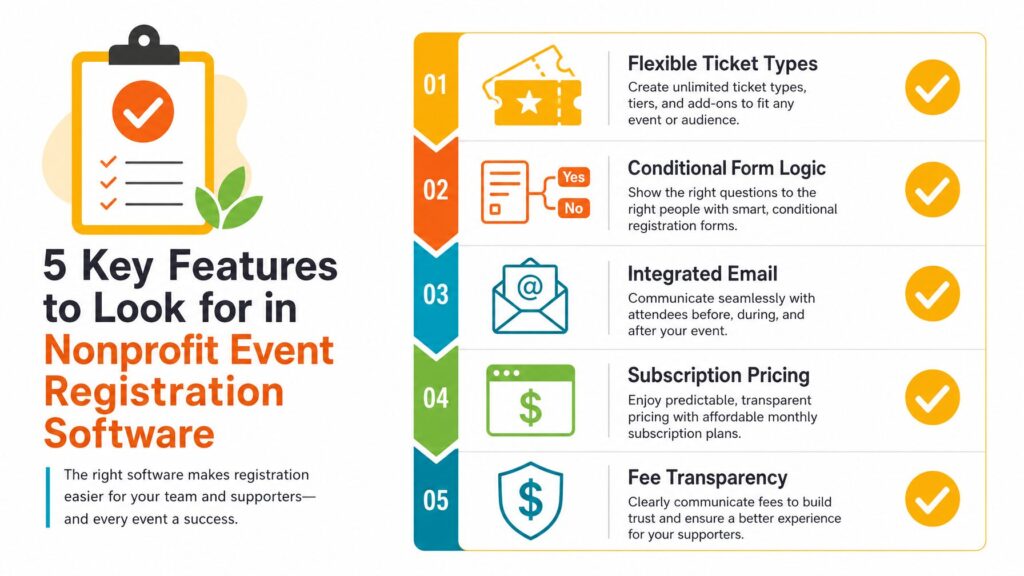
The most important features for nonprofit event registration software are flexible ticket types with hidden pricing tiers, conditional form logic, integrated email communications, multi-event subscription pricing, and transparent fee structures. These capabilities directly address the operational and budget constraints nonprofits face.
Flexible Ticket Types and Hidden Pricing Tiers
The platform should support multiple ticket types within a single event (individual, table, VIP, volunteer, complimentary) with different pricing, availability, and access conditions. Promo codes that reveal hidden ticket types are essential for managing board passes, sponsor packages, and volunteer registrations without exposing them to the general public.
Custom Registration Forms With Conditional Logic
Nonprofit events need to collect a wide range of attendee data at registration: dietary requirements, accessibility needs, table seating preferences, donor acknowledgment names, and volunteer shift selections. A customizable form builder with conditional logic that shows relevant fields based on ticket type or prior selections allows nonprofits to collect the right data from the right people without overwhelming general attendees with irrelevant questions.
RSVP and Invitation Management
For donor cultivation events, board dinners, and other invite-only gatherings, private registration gating and RSVP flows are a baseline requirement. The platform should allow organizers to send invitations to a specific list, track acceptances and declines, and prevent uninvited guests from accessing the registration form.
Integrated Email Communications
Segmented email communications that target non-registrants, incomplete registrants, and confirmed attendees with different messages require email tools that read directly from registration data. For nonprofits with limited staff time, setting up targeted campaigns within the same platform as the registration form reduces both time spent and the risk of sending the wrong message to the wrong person.
Multi-Event Subscription Pricing
Nonprofits running multiple events per year benefit significantly from subscription pricing that covers all events rather than per-event fees. This is particularly valuable for organizations that run a mix of high-attendance flagship events and smaller, lower-cost community events. Under a subscription model, the smaller events cost nothing additional to run on the same platform.
Payment Gateway Compatibility and Fee Transparency
Confirm which payment gateways the platform supports and what transaction fees apply. Some platforms charge a percentage of ticket revenue in addition to the subscription or per-event fee. For charity event registration where ticket revenue goes directly to the mission, understanding the full cost structure upfront is essential.
Ease of Use for Non-Technical Staff
Nonprofit event teams often include staff and volunteers with varying levels of technical proficiency. The platform should be configurable by someone without a technical background. A drag-and-drop form builder, a visual website builder, and an intuitive email tool are all important for teams that cannot rely on a dedicated IT resource.
AI-Powered Attendee Support
For lean nonprofit event teams, an AI registration concierge that answers visitor questions 24/7 on the event website can meaningfully reduce the volume of pre-event emails that reach the team’s inbox. This is particularly valuable for events with international donors or supporters across multiple time zones.
Q: What features should nonprofits prioritize in event registration software?
A: Prioritize flexible ticket types with hidden tiers, conditional form logic, integrated email tools, multi-event subscription pricing, and fee transparency. These features address the complexity and budget constraints unique to nonprofit events.
Q: Do nonprofits need conditional logic in registration forms?
A: Yes. Conditional logic allows a single form to collect different information from different attendee types (donors, volunteers, VIPs) based on their selections, eliminating the need to build and manage multiple separate forms.
Common Nonprofit Event Registration Scenarios
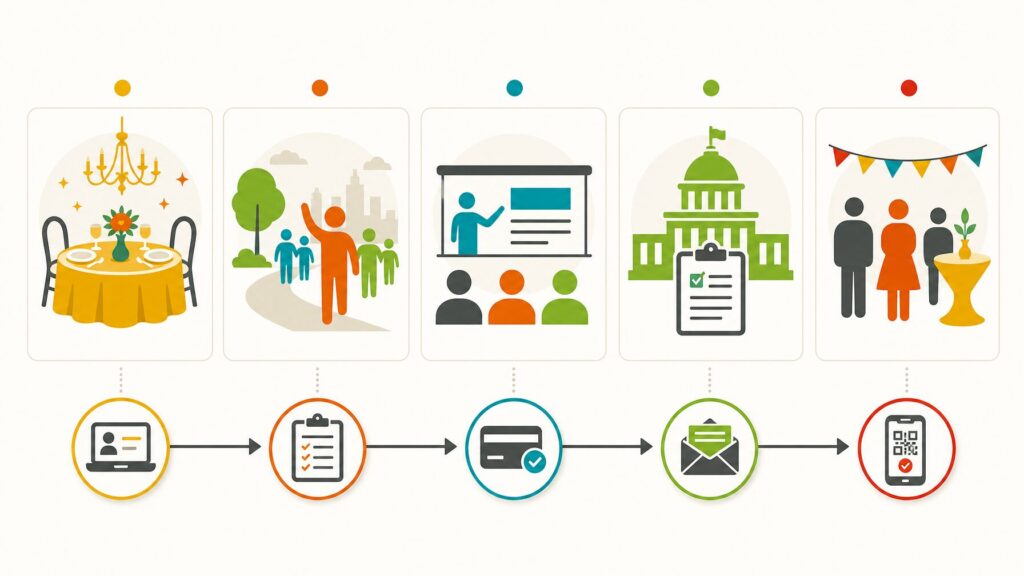
The five most common nonprofit event registration scenarios are for annual galas, awareness walks, educational workshops, advocacy days, and donor cultivation events. Each has distinct registration requirements, from complex multi-ticket fundraising dinners to high-volume community events with team sign-ups.
Annual Gala or Fundraising Dinner
The flagship fundraising event typically involves the most complex registration requirements: individual tickets, corporate tables, VIP packages, complimentary passes for board members and major donors, and volunteer registrations, all within a single event. Early bird pricing, donation options at checkout, and seating preference collection are common requirements. Fundraising event registration software should handle all of these without requiring separate systems.
Awareness Walk or Community Event
Higher-volume, lower-complexity registration with free or low-cost tickets, team registration for group participants, and volunteer sign-ups. The key requirement is handling volume without creating administrative overhead for the organizing team.
Educational Workshop or Training Event
Moderate complexity with session or track selections, continuing education tracking in some cases, and a mix of member and non-member pricing for organizations with membership programs. Custom form fields for credential tracking or prerequisite verification are common.
Advocacy Day or Government Relations Event
Invite-only or member-gated registration with private access controls and careful management of the invitation list. Often involves travel and accommodation coordination that benefits from custom form fields capturing logistics preferences.
Donor Cultivation and Stewardship Events
Small, invite-only events for major donors and prospects. RSVP flows with personal invitation tracking and registration data that captures donor recognition preferences and seating requirements for post-event acknowledgment.
Q: What is the most complex nonprofit event to manage registration for?
A: Annual galas and fundraising dinners are typically the most complex, requiring multiple ticket types (individual, table, VIP, complimentary), early bird pricing, donation add-ons, volunteer coordination, and seating preference collection within a single registration system.
Questions to Ask When Evaluating Platforms
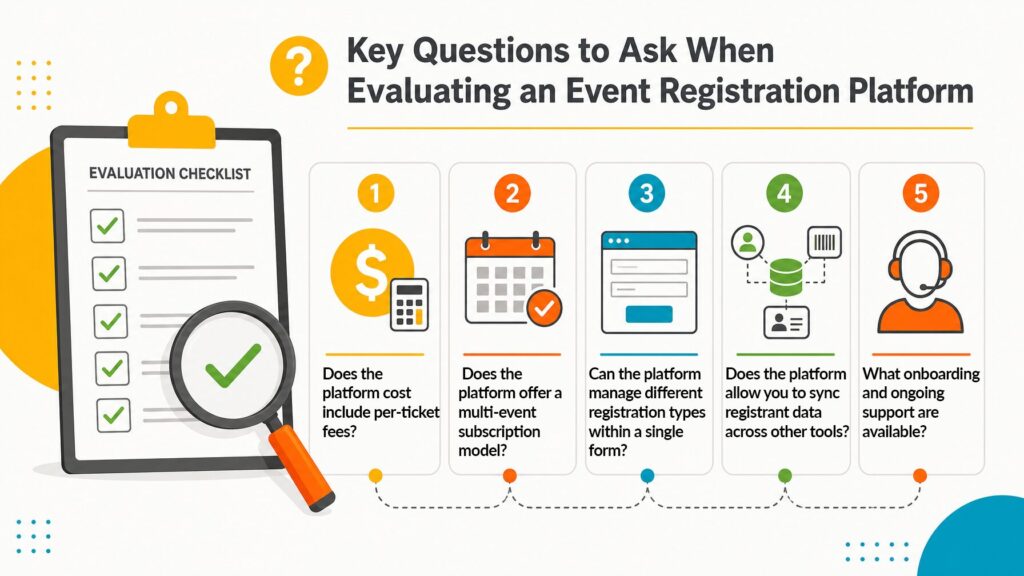
Before selecting nonprofit event registration software, ask these five questions to ensure the platform meets your organization’s operational and budget requirements.
What are the total costs, including transaction fees and payment processing? For fundraising events, per-ticket fees and payment processing costs come directly out of event revenue. Get a full cost breakdown before committing.
Does the platform support multiple events under one subscription? For nonprofits running more than two or three events per year, subscription pricing almost always offers better value than per-event fees.
Can we manage member, donor, volunteer, and general attendee registrations within a single form? The alternative is separate forms and separate data sets, which creates reconciliation work and makes it harder to get a unified view of who is attending.
How does registration data connect to event app, badge printing, and check-in tools? If your flagship event uses an event app or onsite check-in, confirm how registration data flows to those tools and what manual steps are required. EventMobi’s onsite check-in and badge printing integrates directly with registration data for a seamless experience.
What does the onboarding and support experience look like? For nonprofits with limited technical resources, access to group training, a knowledge base, and responsive customer support is more important than for organizations with dedicated IT staff.
Frequently Asked Questions
The Bottom Line
Nonprofit event teams do more with less than almost any other type of organization. The right nonprofit event management software reduces the administrative burden of managing complex, multi-audience events, freeing up the team’s time for the work that matters most.
For nonprofits evaluating platforms, prioritize total cost transparency, multi-event subscription value, and operational efficiency over feature lists. The platform that saves your team the most time, at a cost that makes sense for your event program, is the right one.