
Edgar Allan Poe: The writer who made the Gothic personal

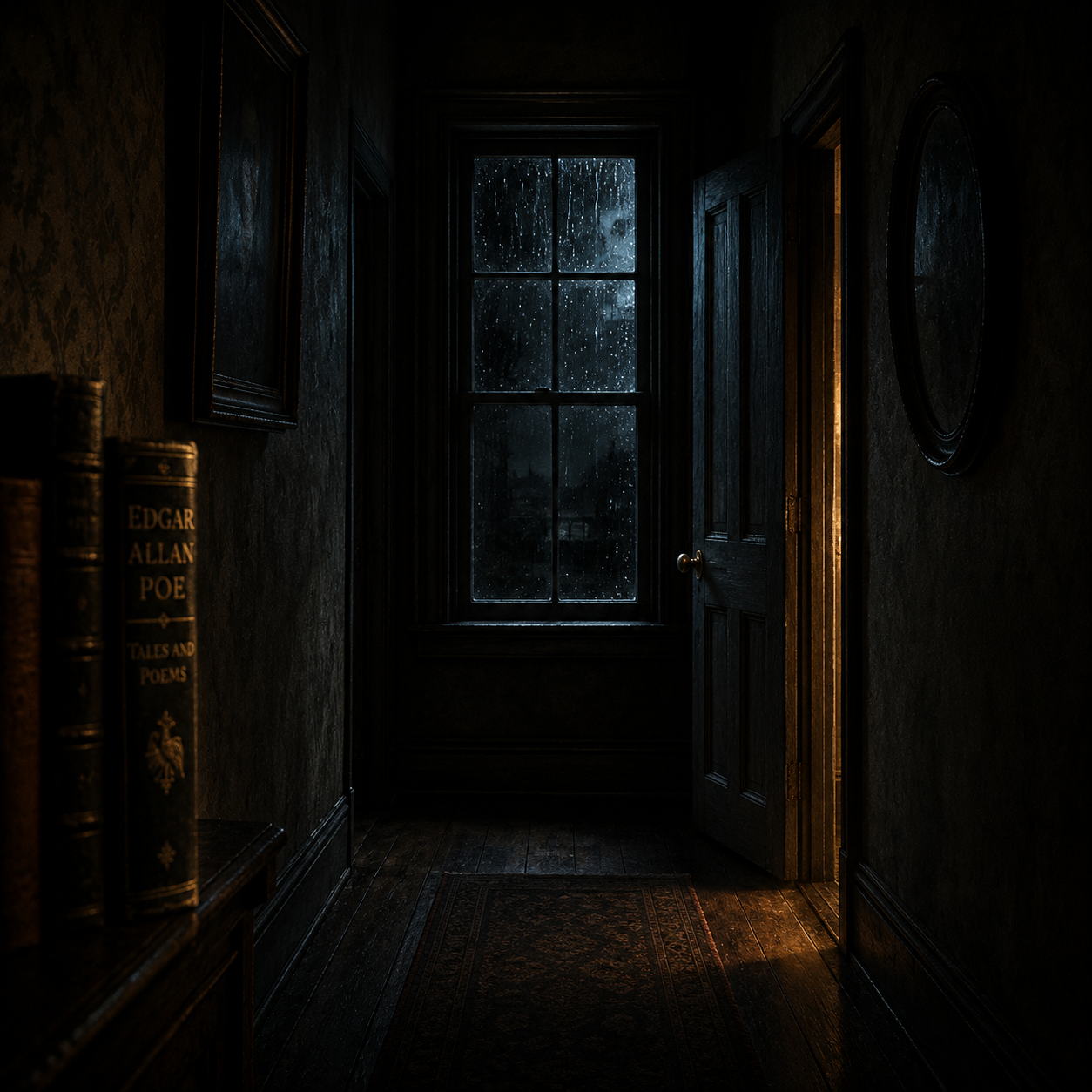
Some links on this page are affiliate links. If you choose to buy, it supports the site at no extra cost to you.
Why Edgar Allan Poe redefined Gothic fiction
I keep coming back to Edgar Allan Poe because he moved the Gothic. Before him, the genre’s horror mostly lived in places: castles, ruined abbeys, curses handed down with the estate. Poe moved it into the mind of the person telling the story, and the genre has been working from that address ever since.
Most readers meet Poe as a horror writer, and he is one. He also belongs squarely in the Gothic tradition. Haunted houses, family decline, premature burial, doubles, and unstable minds run through everything he wrote, and each of those is a Gothic concern. What he changed was where the horror sits. He put it inside the narrator.
When I reread Poe, the plots barely matter. Most readers already know how they end. What gets me is how he traps me inside a single consciousness and won’t let me out. The stories feel claustrophobic even when very little happens, and that’s a big part of why they still work almost two centuries later.
The elements of Edgar Allan Poe’s psychological horror
His narrators can’t be trusted, his settings are sealed, and his endings feel decided before the first line. The plots are simple: a confession, a burial, a revenge. The force comes from how close Poe keeps me to the narrator’s mind, and how long he keeps me there after it stops feeling comfortable. In Poe, the narrator is the haunted house.
The themes Poe returns to
Obsession drives most of Poe’s fiction. A narrator fixates on a sound, a person, an idea, or an injury until it consumes everything else. Guilt usually follows close behind. His narrators spend enormous energy justifying themselves, and their explanations give away more than they hide. Death rarely stays settled either. The line between the living and the dead keeps slipping, and what gets buried tends to come back. Under all of it runs a question Poe never answers: how much of what the narrator says can be trusted?
Where to start reading Edgar Allan Poe: The best short stories
For a first-time reader, I’d start with the short works, where his structure is easiest to see. Nearly everything below is in one collected volume, so there’s no need to buy the stories separately.
The Complete Tales and Poems of Edgar Allan Poe (Barnes & Noble Leatherbound Classics)

The edition I’d want on my shelf: bonded leather, gilt edges, a ribbon marker, and every story on this list.
Find a copy: Barnes & Noble
Complete Tales and Poems by Edgar Allan Poe

The plain reading copy. Same stories, much lower price, and easier to carry around.
Find a copy: Bookshop.org | Amazon
The Tell-Tale Heart (1843)
A narrator insists on their own sanity while describing something that proves the opposite. On rereads I find the rhythm almost unbearable. Poe controls the pace so tightly that the ending lands as both inevitable and shocking every time.
The Fall of the House of Usher (1839)
The house and the family mirror each other until they’re hard to tell apart. Poe uses physical decay to build psychological pressure, and the setting collapses along with the story.
The Black Cat (1843)
Violence, guilt, and denial share a single voice. The narrator tells exactly what happened and never understands any of it.
The Cask of Amontillado (1846)
A revenge story told calmly and on schedule. Montresor never raises his voice. He does exactly what he planned, and his calm is what stays with me.
Ligeia (1838)
One of Poe’s most dreamlike stories. Memory, identity, grief, and obsession blur together until I can’t tell where reality ends and desire begins.
The Raven (1845)
The only poem on the list, and the clearest case of Poe building atmosphere out of sound. The repetition does the work. The plot is a man, a bird, and one word.
Poe’s place in Gothic history
Poe’s interest in perception, obsession, and confinement fed straight into what came after him: the doubles and decaying families of the Victorian Gothic, the body horror of later writers, and the cosmic Gothic, where the open question is whether perception can be trusted at all. In American fiction he sits at the center, between Charles Brockden Brown’s Wieland and Shirley Jackson.
How to read Poe
Poe works best for me when I slow down and listen to the voice. The stories are short enough to finish in one sitting, but they’re built from rhythm, repetition, and pressure, and reading fast skips most of what makes them work. The structure is tight and the meaning isn’t fixed, because the narrator doing all the work can’t be trusted. I’ve stopped trying to pin the stories down, and they’ve gotten better for it.
Frequently asked questions
Both. His work sits where the two overlap, and his focus on atmosphere and psychology keeps him inside the Gothic tradition.
The Tell-Tale Heart. It’s short, and it shows how much tension Poe can build in a few pages.
One collected volume covers everything you’re likely to want. The Complete Tales and Poems is the practical choice. The Barnes & Noble Leatherbound edition is the one to give as a gift.
No. The stories stand on their own, so you can move between them freely.
→ American Gothic literature
→ Victorian Gothic literature
→ Gothic literature reading order
→ Gothic literature starter pack
→ Body Gothic
→ Cosmic Gothic
→ Back to Gothic Literature


