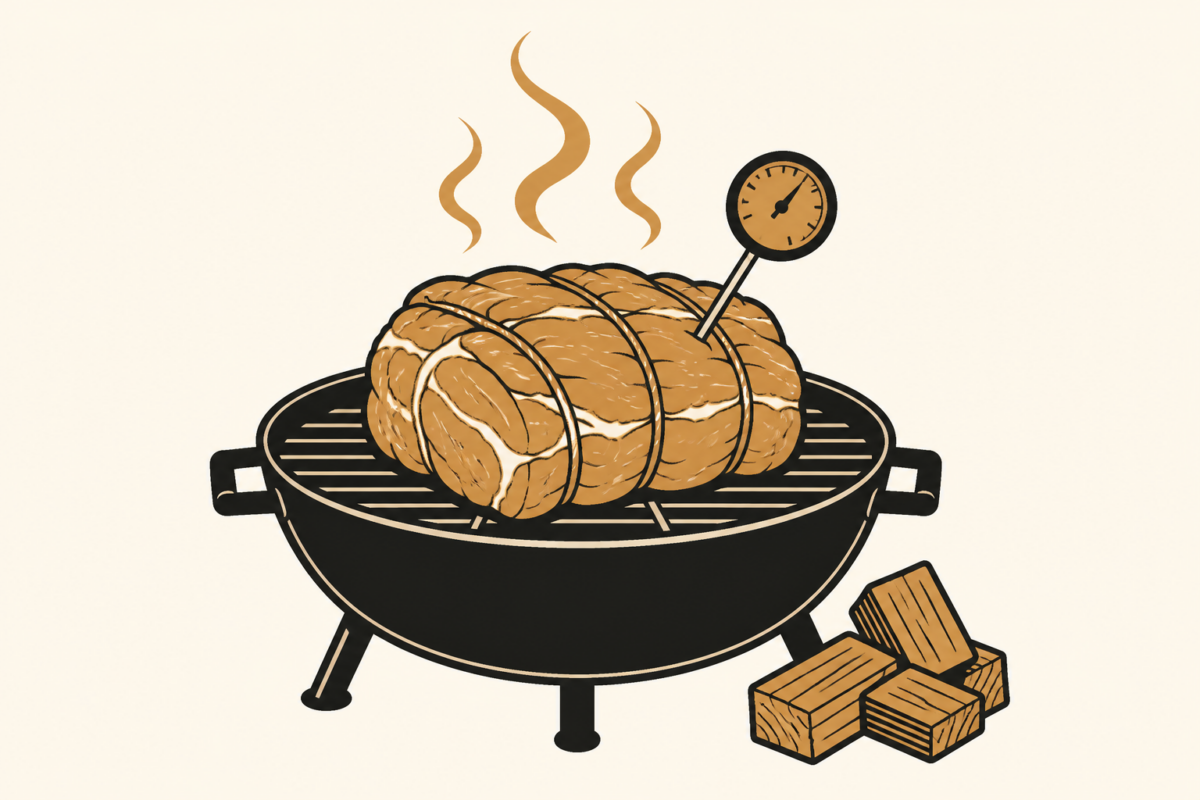
A 3 lb Boston butt takes roughly 4.5 to 5.5 hours at 225°F, or about 3.5 to 4.5 hours at 250°F.
Smaller than a typical backyard butt, it cooks faster but still needs to hit 195°F to 205°F internal before it pulls properly. Plan around internal temperature, not just the clock.
Key Takeaways
- At 225°F, a 3 lb Boston butt takes approximately 4.5 to 5.5 hours.
- At 250°F, budget 3.5 to 4.5 hours. At 275°F, plan for 3 to 3.5 hours.
- Pull the meat at 195°F to 205°F internal for pulled pork, not 160°F.
- The stall can hit even a 3-pounder. Wrap in butcher paper or foil to push through it faster.
- Rest the butt for at least 30 minutes before pulling. An hour is better.
- Fruitwoods like apple and cherry are the best match for pork at any weight.
Why a 3 lb Boston Butt Cooks Differently Than a Larger Cut
Most Boston butt guides are written around 8 to 10 lb roasts. A 3-pounder is a different animal. The smaller mass means heat reaches the center faster, which tightens your margin between perfectly done and overdone.
The upside is obvious: a 3 lb butt fits a weeknight cook. You can start it mid-morning and have pulled pork on the table for dinner without staying up late or pulling an overnight session.
The downside is that the stall, while shorter, still happens, and on a smaller cut it can feel disproportionate.
You might sail to 165°F and then watch the probe sit there for an hour. Wrapping solves this, and I cover it below.
Smoke Times for a 3 lb Boston Butt by Temperature
These ranges account for real-world variables: whether the butt is bone-in or boneless, how cold it was when it went on, and how consistently your smoker holds temperature.
Use a reliable meat thermometer throughout. Time estimates are planning tools, not finish lines.
| Smoker Temp | Estimated Cook Time (3 lb butt) | Start Checking At |
|---|---|---|
| 225°F | 4.5 to 5.5 hours | 4 hours |
| 250°F | 3.5 to 4.5 hours | 3 hours |
| 275°F | 3 to 3.5 hours | 2.5 hours |
For a deeper look at how cook temperature changes your results across those three settings, check out the guides on smoking Boston butt at 225°F, smoking at 250°F, and smoking at 275°F.
Hot Tip
Bone-in butts hold moisture slightly better and give you a more even cook. If your 3-pounder is boneless, watch the internal temp more closely in the final hour. Boneless cuts can climb fast once they break through the stall.
What Internal Temperature to Pull a 3 lb Boston Butt
Pull at 195°F to 205°F. That range is not arbitrary. Below 195°F, the collagen has not fully broken down into gelatin, and the meat resists pulling rather than shredding cleanly.
At 195°F you get pork with a little structure that slices or shreds.
At 203°F to 205°F the collagen conversion is complete and the meat falls apart with almost no effort. For classic pulled pork, aim for the higher end of that window.
Do not pull at 160°F, which is the safe internal temperature for whole muscle pork but leaves Boston butt tough and chewy. Food safety and ideal texture are two different targets for this cut, and 160°F only satisfies the first one.
The hard ceiling is 210°F. Past that point the rendered fat and converted collagen begin to dry out, and no amount of sauce recovers the texture.
How to Handle the Stall on a Smaller Butt
The stall is the period where the internal temperature plateaus, usually between 150°F and 170°F, as moisture evaporates from the surface and cools the meat.
On a 3-pounder it tends to be shorter than on a 10-pounder, but it can still add 45 minutes to an hour if you do nothing.
For a full explanation of the science behind it, the guide on the stall temperature for pork shoulder covers it in detail. The practical fix is wrapping.
Wrap the butt in butcher paper or aluminum foil when the internal temperature stalls.
Butcher paper breathes slightly and preserves more bark. Foil traps steam completely and gives a softer exterior but a faster finish. Both work. Choose based on whether bark texture matters more to you than cook time.
Rub, Wood, and Prep for a 3 lb Boston Butt
Seasoning
A simple rub of coarse salt, black pepper, garlic powder, and paprika works well. A dedicated pork rub adds more complexity without much effort.
Apply it the night before for better bark, or at least 30 minutes before the meat goes on.
With a 3 lb butt, the rub-to-meat ratio is higher than on a large roast, so season generously but taste the rub before committing to a thick crust.
A salty rub applied heavily to a small cut can overwhelm the pork flavor.
Wood choice
Apple and cherry wood are the best starting point for pork. Both add a mild, slightly sweet smoke that complements the fat in the shoulder without overpowering it.
Applewood chunks and cherry wood chunks are both solid choices.
If you want more smoke punch, mix in a single chunk of hickory.
Go easy on hickory with a smaller cut. Too much on a 3-pounder and the smoke flavor turns bitter before the cook is done.
Fat cap orientation
Orient the fat cap toward your heat source. On a vertical smoker or pellet grill where heat rises from below, fat side goes down.
On an offset smoker where heat flows from the side, orient the fat cap toward the firebox side. The fat acts as a buffer and slows heat penetration to the muscle.
Resting and Pulling a 3 lb Boston Butt
Rest the butt for at least 30 minutes after pulling it from the smoker. An hour is better. Resting lets the internal juices redistribute and the residual heat finish any remaining collagen work.
The internal temperature will continue to rise 5°F to 10°F after you pull it off, so factor that into your target.
Wrap the butt tightly in foil after the smoke session and rest it in a cooler (no ice) with a towel over it. This keeps it hot and ready to serve for up to two hours, which is useful if your cook finishes early.
When you are ready to pull, use bear claw meat shredders or two forks. The bone on a bone-in butt will slide clean out after a proper cook, which is a reliable sign that collagen breakdown is complete. If it resists, the meat needed more time.
For a complete breakdown on how to pull and serve, you can also look into finishing pulled pork in the oven if your smoker session gets cut short.
How Much Pulled Pork Does a 3 lb Boston Butt Make?
After the cook, a 3 lb Boston butt yields roughly 1.5 to 2 lbs of finished pulled pork. Bone weight accounts for part of the loss on bone-in cuts.
Fat renders out and moisture evaporates during the long cook. A roughly 40 to 50 percent yield is standard for Boston butt.
At about 4 to 5 oz of pulled pork per sandwich, a 3-pounder feeds 4 to 6 people depending on sides. It is the right size for a small family dinner, not a party.
If you need to feed more than 6, smoke two 3-pounders side by side rather than stepping up to a single 6 or 7 pounder. Two smaller butts finish faster and give you more bark surface per pound of meat.
Frequently Asked Questions
Can I smoke a 3 lb Boston butt at 225°F overnight?
You can, but there is no reason to on a 3-pounder. At 225°F it finishes in 4.5 to 5.5 hours, which fits comfortably in a daytime window.
An overnight cook makes more sense for 8 to 10 lb butts. If you start a 3-pounder at midnight, you are pulling it off at 5 or 6 a.m. with nothing to do but rest it for hours.
Do I need to inject a 3 lb Boston butt?
No. Boston butt has enough intramuscular fat to stay moist through a long cook without injection.
Injection is most useful on leaner cuts, or on large butts where you want to add flavor deep into the center. A 3 lb butt is small enough that a good rub and proper internal temperature get the job done.
Should I spritz a 3 lb Boston butt while it smokes?
Spritzing with apple juice or cider vinegar every hour or so helps maintain surface moisture and can add a subtle flavor layer.
On a smaller cut, it is more important not to open the smoker too frequently, since temperature recovery takes a proportionally bigger toll. If you are going to spritz, use a quick spray and close the lid fast.
What is the stall and how long does it last on a 3 lb butt?
The stall is a plateau in internal temperature caused by evaporative cooling from the meat’s surface. On a 3 lb butt it typically lasts 30 to 60 minutes, shorter than on larger cuts.
Wrapping in butcher paper or foil when the temperature stalls (around 150°F to 165°F) cuts the stall significantly.
The full breakdown is in the guide on pork shoulder stall temperature.
Can I smoke a 3 lb Boston butt on a charcoal grill?
Yes, using a two-zone setup. Bank the coals to one side and place the butt on the opposite side with a drip pan underneath. Add wood chunks directly to the coals for smoke.
A kettle grill holds temperature well enough for a shorter 3-pound cook. You will need to add charcoal every 45 to 60 minutes to maintain your target temperature.
Is a 3 lb Boston butt bone-in or boneless?
It can be either. At 3 lbs, many butts at the grocery store are boneless or have a partial bone. A true bone-in Boston butt at 3 lbs is on the smaller end but exists.
Boneless cooks slightly faster since there is no bone to conduct heat inward. If yours is boneless, start checking internal temperature a bit earlier than the low end of the time range.
What temperature does a 3 lb Boston butt need to reach for food safety?
The USDA requires whole muscle pork to reach 145°F internal followed by a 3-minute rest for food safety. However, 145°F leaves Boston butt far too tough to pull.
You need 195°F to 205°F for the connective tissue to break down properly. Cooking to that range far exceeds the food safety minimum, so you are covered on both fronts.
How do I know when the 3 lb Boston butt is done without a thermometer?
The bone-pull test works on bone-in cuts: grab the exposed bone and twist. If it rotates freely and slides out clean, the meat is done.
The probe test is another option: push a skewer or butter knife into the thickest part.
If it slides in with no resistance, the collagen has broken down. That said, a meat thermometer gives you certainty that neither method can match, and for a cut this size the margin for error is real.


I have been smoking and grilling meat from an early age and enjoy sharing my knowledge and expertise through the hundreds of articles I have written about BBQ. I hope to make everyone’s BBQ journey that little bit easier.