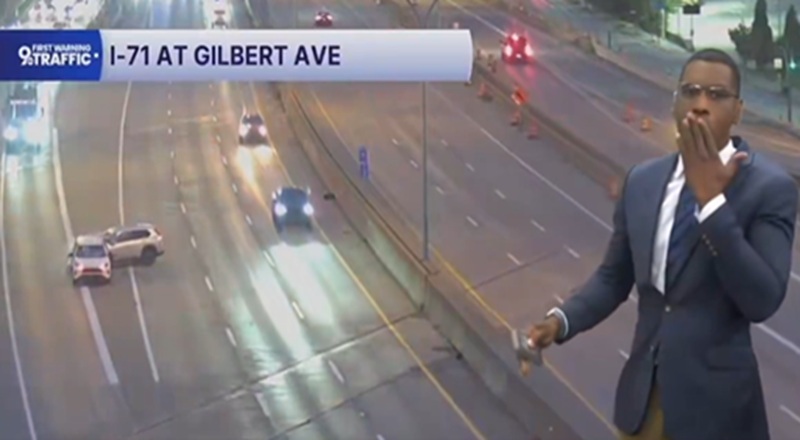
KJ Jacobs Covers Mouth, Apologizes After Rear-End Collision During Cincinnati Traffic Segment
A Cincinnati traffic reporter nearly dropped an F-bomb on live television after watching a car crash unfold on his monitor. KJ Jacobs, a meteorologist and traffic anchor at WCPO 9, was delivering a routine update on Interstate 71 at Gilbert Avenue when a vehicle rear-ended a stopped car on the live camera feed. His reaction—a near-swear cut short, followed by an immediate apology and a hand over his mouth—has since gone viral.
The 16-second clip, posted August 6 by Jacobs himself with the caption “LIVE TV‼️ OSh… First time seeing a crash during a traffic segment #blooper,” has reached over 11 million views. The moment has been widely praised as a relatable, human reaction to an unexpected event during live broadcasting.
A Routine Update Interrupted by a Rear-End Collision
Jacobs stands in the foreground of the WCPO 9 studio, wearing a suit jacket and tie. He was presenting with one hand while holding a device in the other. A live traffic camera feed of Interstate 71 at Gilbert Avenue is displayed behind him, showing vehicles moving along the multi-lane highway at night with headlights and taillights visible.
He begins in a standard professional reporting tone, delivering the traffic information as he would during any other broadcast. He identifies the location and describes the situation: a specific car is stopped in or near the gore area with hazard lights activated, and traffic is slowing around it.
Mid-sentence, as he notes the slowdown around the stopped vehicle, a second vehicle enters the frame from the on-ramp area, crosses or fails to properly merge, and collides with the rear of the stopped vehicle. The impact is visible on the live feed.
When the ‘Oh Sh—’ Moment Happened
KJ Jacobs’s tone shifts abruptly from professional narration to genuine shock. He exclaims “Oh sh—”, cutting the word short. After that, he immediately raises his hand to cover his mouth in a clear physical reaction of surprise and self-censorship.
From there, he then recovered with an immediate apology and explanation: “Oh, I’m so sorry. Literally just watched a crash happen in real time.” He continues: “And I almost said something inappropriate, um, but you can see this car just smash right into this car.”
He points toward the feed while describing the collision, noting the impact and the prior position of the stopped car with its hazards on. The narrative flow moves from routine traffic update, to sudden real-time event, to shocked interjection, to quick professional recovery and continued factual description.
The Professional Save That Made the Moment
Jacobs’s hand-over-mouth gesture coincided exactly with the near-swear. His pointing toward the feed as he described the smash reinforced that the reaction was tied directly to the live visual of the collision rather than any scripted or separate event.
The recovery was immediate. He apologized, explained the near-slip, and continued describing the new crash factually. The tone shifted from neutral professional to startled human reaction and back to composed reporting. The professional recovery demonstrated standard training for live broadcasters to maintain composure and serve the informational purpose of the segment even after interruption.
Jacobs himself posted the clip to his X account with the caption confirming it was the first time he had witnessed a crash unfold during one of his live traffic segments. He also shared versions on other platforms including Instagram and Facebook, framing it as a natural reaction and noting he was glad he “hit the brakes just in time.”
What Happened on I-71
The incident occurred during a live traffic report on WCPO 9 in Cincinnati, Ohio, on Thursday, August 6. A vehicle had stopped in the gore area between the highway lanes and an on-ramp with its hazard lights on. A second vehicle then left or crossed from the on-ramp and rear-ended the stopped vehicle, producing a visible collision on the live traffic camera feed.
No detailed public information has emerged regarding injuries, citations, or the identities of the drivers involved. Separate Cincinnati-area police or scanner reports referenced an accident on southbound I-71 near Gilbert Avenue with no injuries reported, though exact matching to the precise moment has not been independently confirmed.
The broader setting is standard local television news traffic reporting, where anchors routinely use live camera feeds of highways. Live television inherently carries the risk of unscripted events appearing on air. Jacobs’s self-posting of the clip as a “blooper” aligns with a pattern in which broadcasters sometimes share light-hearted or unexpected on-air moments.
Viewers on X React to the Near-Slip
KJ Jacobs’ post on X delivered over 11 million views, more than 83,000 likes, and thousands of reposts. The @DailyLoud share provided nearly 1 million additional views and over 16,000 likes. Reactions were predominantly positive, humorous, and empathetic.
“Perfectly valid reaction,” one user wrote. “You’re good, everyone watching said the same thing.” Another observed: “The way he cut himself off mid-swear is the most professional unprofessional thing I’ve ever seen.” Comments on the recovery appeared frequently: “Great catch and professional save.”
Humorous takes noted the irony of a traffic report becoming a live crash. “Traffic guy was giving the forecast and the universe said ‘hold my beer,’” one user wrote. “Live TV never disappoints.” Remarks on the drivers also appeared: “Hit a car parked with the flashers on, who in the world was driving.”
Relatable affirmations were common: “His reaction is all our reactions,” “Everybody at their house said that shit too,” and “I would have done the same thing.” Light mockery and memes around the near-expletive appeared, along with appreciation for Jacobs posting it himself.
The Unpredictability of Live TV
The situation shows the inherent unpredictability of live television broadcasting. Traffic reporting exists to inform the public of current conditions, delays, and hazards. The simultaneous occurrence of a new collision during the report itself turns the segment into an unplanned documentation of an incident.
The near-expletive and rapid recovery highlight the tension between professional broadcast standards and spontaneous human responses to sudden visual stimuli. The professional recovery—apologizing, explaining the near-slip, and continuing to describe the new crash factually—demonstrates standard training for live broadcasters.
For Jacobs, the self-shared clip generated substantial positive attention rather than apparent professional repercussions. Coverage from local and national outlets treated it primarily as a light “blooper” rather than a serious breach. For the viewing public, the moment reinforces the value of live feeds while also showing how quickly local content can circulate nationally and internationally.
Final Thoughts
Jacobs’s reaction stands out for the speed of the self-censorship and the immediate return to professionalism.
The event also touches on road safety themes. A stopped vehicle with hazards in a gore area is itself a hazard, and improper merging or failure to notice a stopped vehicle can produce collisions. The live camera feed provided a real-time illustration of the risks drivers face on highways.
The rapid online spread of the clip demonstrates how social media amplifies short, emotionally resonant moments from local news, converting a routine traffic update into widely viewed content within hours. No evidence indicates lasting policy changes at the station or regulatory involvement. The primary significance remains as a documented instance of real-time reporting intersecting with an actual roadway event.