Undisputed! Andrew Boutros Makes a False Claim

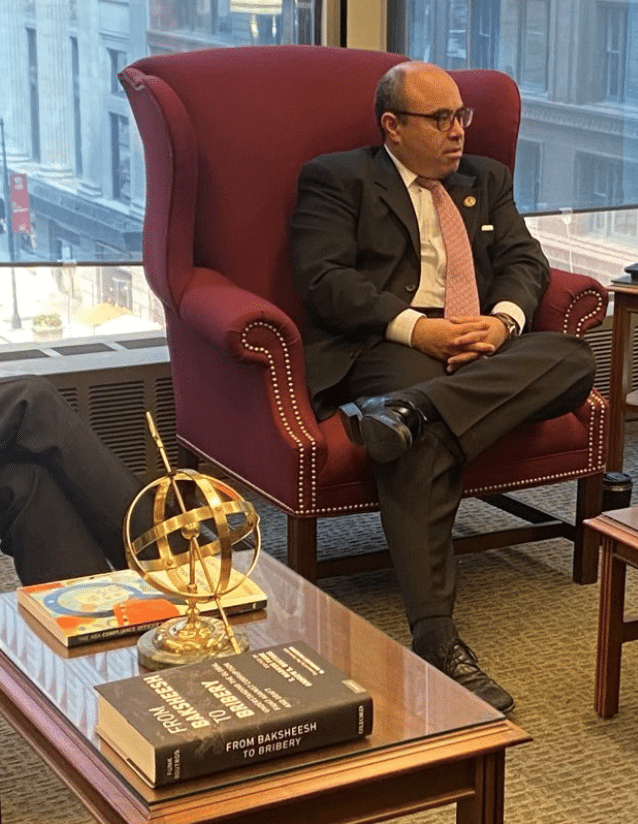
In a motion arguing he and his AUSAs should not be sanctioned, US Attorney for Chicago Andrew Boutros made a substantive false claim. I can’t prove he knowingly lied; that would require the kind of investigation Boutros insists is not warranted. But I can show his false claim happens to be among the core disputes in the Broadview 6 case.
The legal argument in this filing (inapt invocation of Trump v. US notwithstanding) might be sound. But it’ll only work if Judge April Perry buys his explanation for why his AUSAs handed her grand jury transcripts that kept the misconduct Sheri Mecklenburg engaged in hidden behind redactions. The excuse is that William Hogan, a guy with past ethical accusations that Boutros chose not to mention in his filing, was just following orders — April Perry’s orders — to provide the grand jury transcripts pertaining to how they charged a conspiracy.
Boutros claims Judge Perry can only hold prosecutors in contempt if they disobeyed her order to turn over instructions on conspiracy
Boutros explains it this way:
The only potentially applicable order in this case [for which prosecutors could be held in contempt] is this Court’s order regarding the grand jury transcripts. Yet former Defendants made a very “narrow” request for only those portions of the grand jury transcripts “pertaining to how the 18 U.S.C. § 372 conspiracy charge was explained to the Grand Jury” and any “related exchanges.” R. 118 at 1. This Court ordered the Government to provide in camera “the relevant portions of the transcripts as outlined in the motion.” R. 119. The Government undisputedly provided all those portions in the redacted transcripts. Whether the Government should have provided additional portions not requested, former Defendants have never argued the Government failed to comply with this Court’s order. United States v. Streett, 437 F. Supp. 3d 940, 952 (D.N.M. 2020) (defendant’s attempts to convince someone else to get picture of his child abuse victims and cover it up was not contemptuous because it did not violate Court’s order prohibiting him from contacting or attempting to contact victims); see also, e.g., Denver-Greeley Valley Water Users Assoc. v. McNeil, 131 F.2d 67, 70 (10th Cir. 1942) (“literal compliance” is not contempt).
Nor did the Government violate the Court’s order to turn over “any related exchanges” to the § 372 legal explanation. R. 118 at 1. “Related exchanges” do not “clearly” (Joyce, 498 F.2d at 596) include: Experienced AUSA 1’s preamble containing “vouching” (Oct. 9), statements suggesting jurors who could not deliberate without bias should leave (Oct. 16), or references to ex parte communications unrelated to the law (Oct. 23). At a minimum, the order is “ambiguous” as to those discussions, and any failure to turn those portions over was not contemptuous. In re Betts, 927 F.2d at 987.
Boutros argues that Judge Perry has no authority to punish the prosecutors, because she did not issue any order that prosecutors defied. He says the only possible contempt was the order she gave to provide the portions of grand jury transcripts outlined in defendants’ motion to compel them.*
He claims to be sure, however, that prosecutors had “undisputedly” provided all those portions; he cites nothing defendants or Perry have said where they agree.
In any case, his claim is false. Prosecutors did not fully comply with Judge Perry’s order to turn over all the legal instructions on conspiracy.
Prosecutors withheld critical instruction on leaving a conspiracy
Most importantly, prosecutors omitted a fairly critical exchange from the October 23 transcript, the session where the grand jury ultimately indicted the Broadview 6, from what they initially shared with Judge Perry; I first noted this omission this post.
As a grand juror tried to track each of the (at that point) six defendants on the two videos prosecutors were showing, they mentioned that some of the defendants seemed to walk away from the Expedition that had driven into their protest. Mecklenberg responded to that observation by claiming that walking away from a spontaneous conspiracy would not affect whether they had joined the conspiracy or not.
GRAND JUROR: — Michael Rabbitt no longer appears in the frame. And neither Kat or either Kat appears to be anywhere near the front of the truck again. I’m just wondering about that. So I don’t — I’m struggling to locate them.
MS. MECKLENBURG: You — they don’t have — they can step away. You can do it that — you can impede for some time, and then you can decide that you’re going to stop. That doesn’t change the fact that you have impeded for some time. And they could be going — and we don’t know where they are here. They could be going and doing something else to the car or something else. We just don’t know.
GRAND JUROR: Okay.
MS. MECKLENBURG: So I — what’s — the probable cause comes from when you do see them on the video, not from when you don’t.
Shortly thereafter, in response to the foreperson also attempting to track each of the defendants, Mecklenburg claimed it was part of the conspiracy that people moved in and out (of the frame? the crowd? I have no idea).
MS. MECKLENBURG: So it’s happening at the same time. But keep in mind, people are moving in and out —
MADAM FOREPERSON: Yeah.
MS. MECKLENBURG: — which is part of the conspiracy.
You can argue whether Mecklenburg’s claim about conspiracy law was correct or not; I think it is (as a grand juror said of the case as a whole) a crock of shit.
But she was undisputedly responding to questions about how conspiracy law applied in this case.
These exchanges should have been included in what got shared with Perry.
Prosecutors included similar instructions
Such exchanges are precisely the kind of thing that Boutros pointed to as proof of the robust back and forth in the October 9 and 23 grand jury discussions.
The grand jurors asked the AUSAs about, among other things, whether conspiracy required forethought (id. at 22), if actions alone could show a conspiratorial agreement (id. at 23), “how far does” the scope of the conspiracy “go” (id.), and whether it was against the law to touch a law enforcement car (id. at 24-25, 30-31).
[snip]
The grand jurors also asked questions about the law, including: the necessity of them weighing in on a misdemeanor (id. at 51-52, 25-31), and if “basically . . . anybody who walked in front of that car could be charged with a conspiracy even if they weren’t actually touching the car and somehow impeding it.” Id. at 55; see also id. at 9, 16, 52-54 (other questions). [links added]
All of these, which include multiple questions about whether it was illegal to touch a cop’s car (and — in one case — challenging whether defendant Cat Sharp had done so), were included, unredacted, among the materials that Hogan deemed responsive Judge Perry’s order.
Questions about whether touching the car were included unredacted.
Questions about whether people who stepped away could be charged were not.
Given the standard for inclusion Boutros is describing in his filing — and given what was actually included in the transcripts originally shared with Perry — the exchanges about leaving a conspiracy should have been included. They were not.
It could be a mistake! Indeed, but for all the other damning evidence, that should be the default assumption here.
But there’s a lot of reason to believe it was intentional.
Boutros gets touchy about the standard for entering this conspiracy
Remember what happened here: People were protesting on a public street, and the ICE goon drove his black Expedition into them. There were definitely people who responded by surrounding and pounding on the car; there was damage (including the word “pig” scratched into the car) that prosecutors not only never tied to the defendants, but never isolated as having been done by anyone in the crowd.
Prosecutors argued that the act of impeding a car that drove into protestors was a spontaneous conspiracy to obstruct the ICE goon’s work, or at least his attempt to get to work. Spontaneous conspiracies are already pushing the edge of conspiracy law (though the argument worked in the Spokane protestors’ case on the same conspiracy charge), but in this case, the “conspiracy” involved a “victim” who initiated contact with lawful protestors in public space, protestors he called “trash in the street” in a text he sent.
What constituted entering into and remaining in this spontaneous conspiracy would always have been a heated contest. In his filing, Boutros uses merely touching the ICE goon’s car — the car that drove into protestors — as the baseline for entering into the conspiracy.
There was a crowd protesting at the facility, some of whom ended up in front of and touching and/or banging on his car. Id. at 78-80. The parties disagreed about the legal significance and constitutional implications of their actions, but former Defendants have never contested that each of them at least touched the Agent’s car, and the Court has confirmed as much. R. 142 at 7-9
[snip]
Former Defendants have never disputed their presence on the scene—which was captured on publicly available video—and even agreed they touched Agent A’s car (also captured on video).
And he seems to assert, without pointing to proof, that defendants did not contest whether they did touch the car that drove into them (as noted above, in the grand jury, there was heated debate about whether Cat Sharp ever did touch the car).
In other words, Boutros tries to dodge the problematic structure of this imagined conspiracy by criminalizing touching a car that drove into you.
This kind of instruction is precisely what defendants asked for
And that’s precisely why defendants took a series of steps that led up to the sharing of transcripts with Judge Perry; it’s precisely the kind of question defendants were raising in the filing Perry invoked when issuing her order.
Boutros’ discussion of the background to defendants’ request for transcripts notes that the request came in the wake of a prior request for specifics about how DOJ was applying the conspiracy. He quotes the defendants saying their request was “narrow,” and implies that Hogan complied by saying the misconduct Perry identified when she first revealed these transcripts would not have been included in her order. But he never bothers to show that Hogan provided everything she asked for.
On January 23, 2026, former Defendants moved for clarification about which of the three means in § 372 they were alleged to have violated. R. 61. Around that time, Experienced AUSA 1 left the Office for a temporary detail in another branch of Government. R. 83, 86. On February 2, 2026, Experienced AUSA 2—who has been with the Office for roughly 40 years—entered his appearance. R. 73. A third prosecutor, AUSA 3, filed his appearance on February 13, 2026. R. 85. The Government filed a motion saying it would only proceed on the “force and intimidation” prong of § 372 and thereby narrowed Count 1 (the felony charge). R. 96. Around that time, the Government moved to dismiss two of the former Defendants with prejudice. R. 91.
The remaining former Defendants sought discovery relating to vindictive or selective prosecution. R. 94. This Court denied the motion. R. 117. [long discussion that doesn’t address the evidence of vindictiveness since released]
The next day, on April 8, 2026, former Defendants made a “narrow” request to see “Grand Jury transcripts pertaining to how the 18 U.S.C. § 372 conspiracy charge was explained to the Grand Jury” and “any related exchanges.” R. 118 at 1. Former Defendants wanted to ensure the grand jury had been instructed on all the relevant § 372 means now that the Government was proceeding on only one. Id. at 1-2, 4. Alternatively, they asked this Court to conduct an in camera review “and order disclosure of those portions of the transcripts the Court determines are necessary to allow Defendants an opportunity to develop this issue further.” Id. at 1, 12.
But Boutros leaves key context out of the request. I provided that background myself in this post. The important bits are:
- Defendants, January 23: Hey, it’s not at all clear how defendants violated 18 USC 372 or what theory of force you’re using. Can we have a Bill of Particulars? [Doc 61]
- DOJ, February 11: No. [Doc 81]
- Defendants, February 23: But bodyworn camera video you only provided on February 12 confirms what we argued in our motion: “Abughazaleh, Defendants Joselyn Walsh, Andre Martin, Michael Rabbitt, and Catherine Sharp all independently moved away from the SUV within seconds after they found themselves in its path.” [Doc 87]
- Judge Perry, February 26: You gotta tell them which theory of conspiracy you’re using. [Doc 89]
- DOJ, March 12: Uh, we’ve decided we don’t have a case against Cat Sharp and Joselyn Walsh. [Doc 91]
- DOJ, March 13: Uh, we’ve decided we only have evidence that defendants intimidated the ICE goon who drove into them. [Doc 96]
- Several requests, including a motion for discovery on selective and vindictive prosecution, a motion to dismiss on 1A grounds, and a motion for details of what evidence from other conspirators will be used.
- Defendants, April 8: Since the government changed its theory of the case and keeps needing to think about it, we want grand jury transcripts “pertaining to how the 18 U.S.C. § 372 conspiracy charge was explained to the Grand Jury.” [Doc 118]
- Judge Perry, April 9: The government can either respond to defendants’ request, or “the relevant portions of the transcripts as outlined in the motion may be provided to the Court by 4/20/2026 in lieu of a written response.” [Doc 119]
That’s the genesis of the order that, Andrew Boutros insists, Hogan “undisputedly” responded to in full. The claim that most of the defendants responded to an Expedition driving into their protest by walking away was at the core of their request for explanation about the conspiracy charge; it was likely at the core of the reason the government dropped their case against Sharp and Walsh. And it would be at the core of any claim that defendants entered into a spontaneous conspiracy to obstruct the guy who just drove his giant SUV into their protest.
What did they do when the Expedition drove into them?
They walked away.
And yet, when grand jurors, based on their observation that some of the defendants did just that, asked Sheri Mecklenburg on the day they indicted the Broadview 6, what about people who walked away, Mecklenburg said that was all part of the conspiracy.
Again, it doesn’t matter whether Mecklenburg’s instruction to jurors was right or not: that you could be charged for conspiring to obstruct an ICE goon after he drove his SUV into your protest if your response was to walk away. If the instruction was pertinent to grand jurors’ decision to indict people who did walk away, then DOJ had to turn it over to Judge Perry.
They did not.
They didn’t do so, even though a significant part of defendants’ argument that led Judge Perry to make DOJ explain their theory of conspiracy in the first place substantially focused on how you could enter into a spontaneous conspiracy if you walked away from it.
The hybrid section of Hylton’s testimony
There’s one more piece of arguable legal instruction that Hogan withheld, revealed by the funkiness in the treatment of FBI Agent Evan Hylton’s transcript (I wrote abt the far bigger funkiness with the ICE witness’ testimony here).
As I laid out here, the court reporters treated testimony from the ICE witness as a separate transcript for both his October 16 (the sketchy one) and his October 23 testimony. That has a number of effects, two of which are important to the question of whether Hogan complied with Judge Perry’s order or whether DOJ deliberately tried to hide stuff from her.
- Funkiness aside, the ICE witness’ testimony makes up a negligible portion of the transcript that includes legal instruction; in the October 23 transcript, for example, the ICE agent’s testimony is marked by a 4-line placeholder
- The ICE witness’ testimony has its own table of contents (October 16; October 23)
These tables of contents were made after the fact and should not be considered reliable, but they do provide an extra road map for what happened with the transcript.
In the case of Hylton, however, the court reporter treated it as all one transcript. And he inaccurately described that the entire thing, pages 3 through 76, consisted of direct examination — of Hylton, is the implication — by Sheri Mecklenburg.

When Hogan redacted the October 16 and 23 transcripts, he could just ignore the separate transcripts pertaining to the ICE testimony (ignoring, of course, the 7-minute anomaly in the October 16 one). But for the October 9 transcript, he had to isolate Hylton’s testimony himself.
To make things worse, Mecklenburg prepared to discuss the law — “I would like to present the law to you” — right before she invited questions, making that work harder. Most of what ensued involved questions for Hylton. But then the foreperson premised a question, “I don’t know if this is a legal question or a question for the agent. I’m pretty sure it’s legal.” Mecklenburg immediately stopped the question and dismissed Hylton.
So there was this hybrid period. Hylton was still there but grand jurors were asking whatever they wanted to know. During it, both the agent and Mecklenburg addressed some questions about the investigation: why they weren’t presenting any of the more obviously obstructive protestors, whether there were fingerprints, what a trucker who would have witnessed the event said. The investigation is ongoing, one or another of them responded.
When Hogan redacted the transcript, he redacted everything up to the moment that Mecklenburg formally dismissed Hylton, on page 62, which would have looked perfectly reasonable to Judge Perry, since the table of contents identified everything up through page 73 as testimony. When DOJ publicly released the transcripts however, they withheld only from the moment from when Hylton was sworn — recorded on page 10, to the moment Mecklenburg described she wanted to discuss the law on page 53 for further redaction. That was released on June 9, and then the pages of Hylton’s testimony that had been redacted in the purportedly unredacted testimony, pages 10 through 53, were released on June 18. (Note, this only pertains to the public releases. I think defendants got everything on May 21.)
And the release of that hybrid section revealed an exchange that was not obviously evidentiary, and Mecklenburg answered that herself: by bullying the grand juror who asked it.
GRAND JURY: Couldn’t he have stopped?
MS. MECKLENBURG: Couldn’t he have stopped?
GRAND JURY: If he is afraid of running over people, isn’t the right thing to do to stop?
MS. MECKLENBURG: Well, didn’t you hear the testimony that he said he was afraid to stop because he was afraid they were going to break the windows and pull him out and he would be injured?
So he said — the testimony was that he said he was concerned about stopping for his own safety and he was concerned about the safety in the front. So he had to balance it. And this is not testimony now, but I would argue he did a pretty good job of balancing it because nobody got hurt.
GRAND JURY: I know.
MS. MECKLENBURG: So you want to talk about the right thing. What if he had stopped?
GRAND JURY: But it’s the flip of the thing is can’t you say he was trying to run over the people?
MS. MECKLENBURG: Did you really think when you saw that video
GRAND JURY: No. It’s a bad question —
This is a less clear-cut case than the two exchanges that included the word “conspiracy” as part of the answer. But it’s still important.
The question is important background to a question Boutros himself pointed to (I’ve marked it in red in his discussion above), does the ICE goon have the right to drive into protestors, which was shared with Perry, as well as Boutros’ insistence that anyone who was touched by the car is fair game for indictment. It’s important background to DOJ’s insistence that grand jurors who thought this whole thing was a crock of shit were biased, as opposed to offended by the notion that the ICE goon who decided to drive into a protest was a victim.
And the answer to that question was integrated into Matthew Skiba’s legal instruction and presentation for both the subsequent weeks (October 16; October 23).

Skiba certainly treated it as legal instruction.
Yet it, and the bullying Mecklenburg did, was withheld from Perry, treated as Hylton’s testimony.
The disappearing bodyworn cameras
Now’s a good time to talk about the bodyworn cameras — the ones that defendants claim showed most of them walking away from the scene of the imagined conspiracy.
There was a big to-do early in this prosecution about such things. In January, after learning that Mecklenburg cherry-picked what video from Broadview police department was relevant, defendants asked for a preservation order. The government did not object, but did claim that Mecklenburg, Skiba, and the FBI agent pulled all bodyworn video that showed the defendants. Perry signed the preservation order on January 30. But — as disclosed during pretrial motions in limine practice in May — in fact, bodyworn camera video that would be important to determine whether defendants did walk away was destroyed.
Counsel for the government repeatedly assured defense counsel that Broadview was informed of this request, and, in a letter dated December 18, 2025, further advised that the AUSAs personally went to Broadview, reviewed all the videos, and “tagged the video showing the incident and any video that morning showing any of the defendants” so that it would be saved to be included in a future discovery production. Despite assurances that the video was being preserved, defense counsel was later notified that certain Broadview police department body camera footage had been “lost/deleted.” Defense counsel were advised that this lost or deleted footage included videos that were previously tagged by the AUSAs as being relevant and material. Specifically, the AUSA assigned to the case at the time wrote to defense counsel as part of a discovery production on February 12, 2026:
Also, you will see an FBI 302 explaining that the Broadview Police Department was unable to transmit some of the videos that we tagged during our visit to the Broadview Police Department in December 2025, that the Broadview Police no longer can access those videos, and their efforts to recover those videos thus far have been unsuccessful. It is our understanding, memorialized in a 302, that Broadview Police had a new system for body-worn camera footage and they appeared to have difficulty with it at the time. However, based on our review, the videos were all repetitive of the same scenes from different officers’ body cameras, standing near each other. In reviewing the videos we were able to obtain and produce to you, it appears that these videos show the same scenes we saw on the videos that Broadview was unable to access.
[snip]
As the Court will see at trial, there will be material disagreements about exactly what happened in the moments before and during the time Agent A decided to turn his SUV into the crosswalk and into the protestors. What the government describes as “repetitive” likely shows different angles that are most likely material to Defendants’ version of events, especially because Defendants were located at different positions in the crosswalk when the SUV turned into them.
That makes Mecklenburg’s squirminess, in two instances in the transcripts, about the Broadview cops suspect. When a grand juror asked her, on October 9, whether they’d be hearing testimony from the cops who let the ICE goon through their checkpoint, Mecklenburg almost immediately turned it into a discussion about politics and jurisdiction as a way of explaining why she wasn’t calling the cops.
Perhaps most damning, the following week, Mecklenburg responded to a grand juror asking whether there was any law enforcement video by claiming that there were no cops there and so no video.
GRAND JUROR: Who took the videos? What’s the source of these videos?
MS. MECKLENBURG: This video is from Ms. Abagazala’s social media.
MR. SKIBA: Yeah. So some were like a Twitter, an Instagram. Some were, I believe, YouTube. This was all civilians taking photos.
MS. MECKLENBURG: Yeah. No law enforcement was out there, so they didn’t take any video.
As with Boutros, I have no idea whether this was an intentional lie. And it is not legal instruction, so this material wouldn’t have been turned over operating on Hogan’s claim that he was just trying to follow Perry’s order. But I find it suspect that, in October, Mecklenburg affirmatively claimed that video that would prove exculpatory did not exist, and then in February, she said it had been destroyed. It makes the choice to withhold related instruction more suspicious.
Some of Boutros’ unredacted page numbers are undisputedly redacted
Finally, Boutros made another misstatement (albeit not as central to his argument).
Partly to explain how Judge Perry had notice there were more than just a few lines of the grand jury missing, Boutros provides a very contorted inventory of the pages that were redacted and omitted. (This passage is one of the reasons I went down this rabbit hole, so thanks, Andrew!) In it, he claims the page numbers clearly show what was omitted.
On April 23, the Government submitted to the Court for in camera review those portions of the transcripts “detailing the presentment of the law on the 18 U.S.C. § 372 conspiracy charge and any related exchanges.” R. 128; R. 129 (Exs. A, B, and C). The transcripts the Government tendered to the Court also contained black redactions clearly marking what was not produced and page numbers showing that the first transcript omitted all pages between 4 and 61; the second transcript omitted pages 3, 9-10, and 30-36; and the third transcript omitted pages 4, 29-40, and a few pages at the end. R. 129 (Exs. A, B, and C). These omitted pages totaled more than 80.8 As he later stated in court, Experienced AUSA 2 took responsibility for the redactions. R. 187 at 30.
8 In addition to the 80 omitted pages, the transcripts contained additional pages that were not provided to the Court because they included witness testimony and portions other than the §372 law and related colloquies. See R. 219 (Oct. 9, 2025, transcript consisted of 76 total pages); R. 220 (Oct. 16, 2025, transcript consisted of 53 total pages); R. 221 (Oct. 23, 2025, transcript consisted of 98 total pages). All three transcripts consisted of a combined 227 pages. [my emphasis]
Having spent most of yesterday trying to track what actually happened with the transcripts, the notion this was feasible without the full transcripts is bullshit, particularly given that there’s no discernible reason why some stuff was omitted and other stuff just redacted.
And in several places — contrary to Boutros’ claim — a page number was redacted, which had the effect of making it harder to understand how many pages — 15, in this case — had been removed.

This includes the passage with the question about walking away from a conspiracy.
Hogan did not follow Judge Perry’s order
Boutros is wrong. It is bluster for the US Attorney to suggest that Hogan undisputedly complied with Judge Perry’s order. There are two instances where information that prosecutors otherwise treated as instruction was omitted from what got shared with Perry, and one of those goes to the heart of the case.
To some degree it doesn’t matter whether Boutros knowingly lied when he made the claim (though a knowing lie would be further contempt). Once the question is under dispute, then Judge Perry has reason to inquire further. Especially given the stack of evidence showing that prosecutors knew the import of that passage, and otherwise withheld related information.
So while I can’t prove Boutros wittingly lied when he claimed Hogan had complied, it should be undisputed there’s reason for Judge Perry to dig further into this.
*Throughout this post, I use the word “defendants” to refer to those now exonerated. I do so because my discussion addresses prosecutors’ treatment of them from the time they were targets, then defendants, and now exonerees; I found using the term “exonerees” when discussing the grand jury discussions confusing.