Jagaddhatri Puja in West Bengal: History, Heritage and Chandannagar’s Great Immersion Procession

It brings together Bengal’s clay-sculpture tradition, religious history, neighbourhood culture, colonial heritage, public art and the Hooghly River.
For a traveller, Chandannagar is particularly fascinating because the festival unfolds inside a historic French colonial town. Its churches, mansions, administrative buildings, riverfront and old streets form the backdrop to a distinctly Bengali celebration.
The result is a cultural experience that cannot easily be separated from the history of the town itself.
Who Is Jagaddhatri?
Jagaddhatri is a form of the Divine Mother whose name is commonly interpreted as “She who sustains the world.”
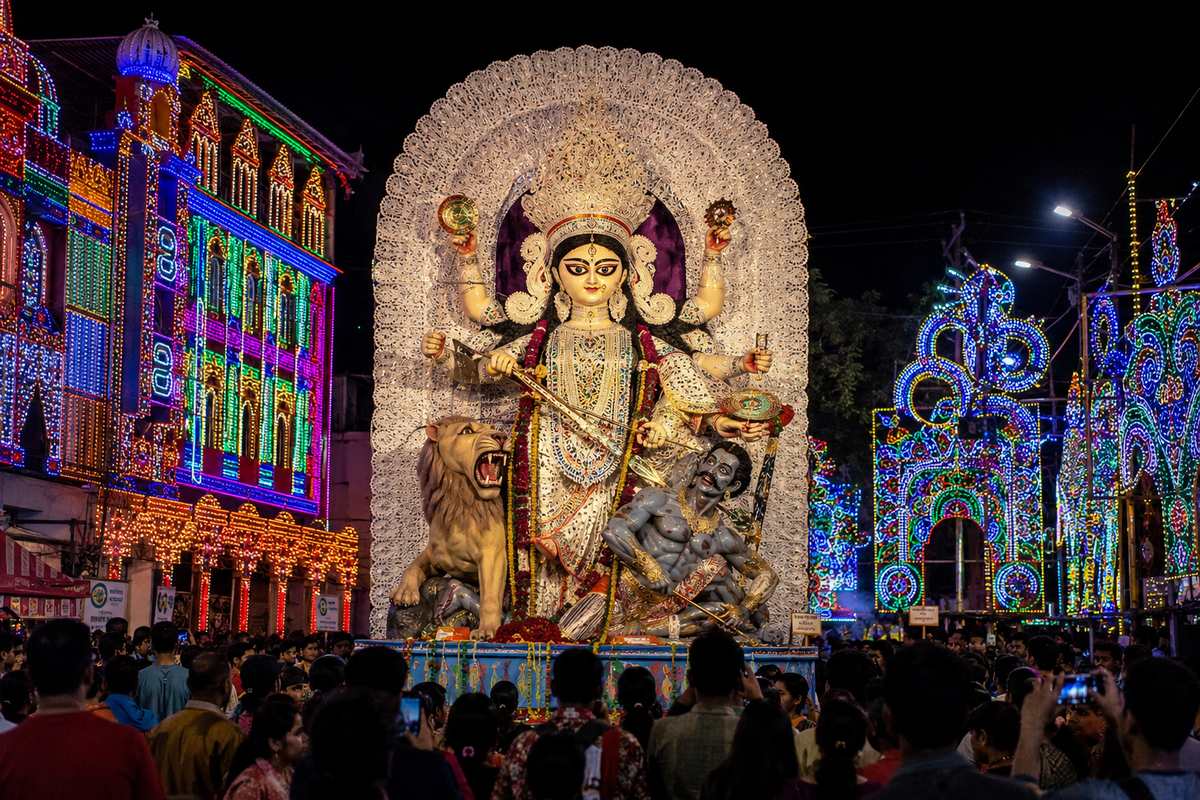
She is generally represented as a four-armed goddess seated on a lion, with the elephant-demon Karindrasura beneath her. Her weapons include the conch, discus, bow and arrow.
Her worship takes place on Shukla Navami of Kartik, generally in October or November.
Although Jagaddhatri is associated with the broader Shakta tradition of Bengal, her visual identity and festival traditions developed their own regional character.
Traditional shola work, daker saaj and elaborate idol decoration remain important elements of the festival, while Chandannagar has developed an especially famous tradition of illumination and large-scale processions.
The History of Jagaddhatri Puja
The history of Jagaddhatri Puja is often presented through a famous story about Raja Krishnachandra of Krishnanagar.
According to popular tradition, Krishnachandra was unable to celebrate Durga Puja after being imprisoned by the Nawab. On his return, he is said to have received a divine instruction in a dream to worship the goddess in the form of Jagaddhatri.
The story remains deeply embedded in the cultural memory of Krishnanagar.
Historical research, however, suggests that the story should not automatically be treated as documentary fact.
Research by Susan S. Bean on sacred arts in South Asia notes that the popular origin story has a weak historical basis and that documentary evidence points more strongly towards the reign of Girishchandra Ray, Krishnachandra’s grandson, who ruled from 1802 to 1841, for the establishment of the modern form of the Puja.
This does not make the Krishnachandra story unimportant. Quite the opposite: it demonstrates how Bengali festivals combine documented history, oral tradition and collective memory.
Jagaddhatri worship itself has a wider history, and the development of the public festival cannot be reduced to the actions of a single ruler.
Krishnanagar and the Tradition of Clay Sculpture
Krishnanagar is important not only because of its association with the royal origin story but also because of its long relationship with clay sculpture.
Royal patronage helped create an environment in which sculptors could develop sophisticated forms of terracotta and clay work.
This relationship between patronage and craftsmanship is important to understanding Bengal’s festival idols.
A temporary clay image is created, painted, decorated, worshipped and eventually immersed. The following year, another image is made.
Because the image does not have to survive permanently, artists can preserve its traditional identity while experimenting with its proportions, decoration and details.
The result is a remarkable artistic cycle:
Tradition is preserved by remaking it.
This is one reason Bengal’s temporary festival sculpture has developed such extraordinary variety.
Chandannagar: Where Jagaddhatri Became a City Tradition
Chandannagar developed a different relationship with Jagaddhatri Puja.
The town had already developed as a French trading settlement on the Hooghly. French influence began in the seventeenth century, and Chandannagar remained under French rule until the twentieth century.
Over generations, Jagaddhatri Puja became deeply connected with the identity of this historic town.
What had once been associated with particular families and communities developed into a large public celebration involving neighbourhood committees, artisans, lighting specialists, musicians, transport workers and thousands of visitors.
This is why Chandannagar’s Jagaddhatri Puja should be understood as both a religious festival and an expression of urban identity.
Chandannagar’s French Colonial Heritage
A visit during Jagaddhatri Puja becomes much more interesting when the festival is experienced alongside Chandannagar’s architectural heritage.
The town is not simply a modern Bengali city decorated for a festival. It retains the physical traces of a French colonial settlement.
Chandannagar Strand
The Chandannagar Strand is the natural starting point.
Running beside the Hooghly, this historic riverfront combines the landscape of the river with colonial-era buildings and later urban development.
During Jagaddhatri Puja, the Strand takes on an additional significance because the festival ultimately returns to the Hooghly.
The same river that once connected Chandannagar to international trade becomes the final destination of the goddess’s procession.
Institut de Chandernagor
The Institut de Chandernagor, associated with the residence of French governor Joseph François Dupleix, is one of the town’s most important colonial structures.
Today it houses the Chandannagore Museum, whose collections preserve material connected with the French period.
The building provides an opportunity to understand Chandannagar before experiencing its contemporary festival culture: maps, objects and architectural surroundings reveal the colonial trading town that existed alongside the Bengali communities that later made Jagaddhatri Puja a defining local tradition.
Sacred Heart Church
The Sacred Heart Church is another prominent landmark.
Its nineteenth-century architecture adds a distinctly European presence to the streetscape, making Chandannagar’s heritage different from neighbouring former colonial settlements.
The church stands close to the historic core of the town and remains an important architectural landmark.
Liberty Gate
The Liberty Gate offers an unusual connection between Chandannagar’s French past and modern Indian history.
The surviving gate commemorates the ideals associated with the French Revolution and carries the famous words:
Liberty, Equality, Fraternity.
Its presence is a reminder that Chandannagar’s French legacy was not simply architectural. Political ideas and the town’s relationship with France also formed part of its history.
Patal Bari
One of Chandannagar’s most unusual historic structures is Patal Bari, a riverside house with portions extending below ground level.
Its unusual design and position beside the Hooghly attracted literary figures including Rabindranath Tagore, while Ishwar Chandra Vidyasagar is also associated with the building.
It provides another reminder that Chandannagar’s heritage extends beyond formal colonial buildings into the literary and intellectual history of Bengal.
Rakhit Bhawan
The nineteenth-century Durgacharan Rakhit Bhawan represents another side of Chandannagar’s history: the interaction between Bengali society and the French administration.
Its architecture combines local and European influences, while the history of Durgacharan Rakhit reflects the complex relationships that developed between Bengali elites, philanthropy and French colonial institutions.
A Larger Heritage Landscape
The architectural heritage is not limited to these better-known landmarks.
Chandannagar’s historic landscape also includes former administrative buildings, courts, police offices, educational institutions, churches, convents, municipal buildings, post offices, hospitals, historic residences and other surviving structures associated with the French period.
This is important for visitors.
Chandannagar’s heritage is a townscape, not a single monument.
Walking between its surviving buildings is part of understanding the place.
The Art and Craft of the Jagaddhatri Idol
Chandannagar’s enormous Jagaddhatri idols are among the most recognisable festival images in Bengal.
But size alone does not explain their visual impact.
Traditional idol-making combines:
- bamboo and wooden frameworks
- straw
- layers of clay
- painting
- chalchitra
- daker saaj
- shola work
- jewellery
- textiles
At larger scales, idol-making also becomes an exercise in structural engineering. Separate components may be constructed and assembled so that the finished image can achieve monumental proportions without losing its visual unity.
The result is an artwork that combines craftsmanship and temporary architecture.
Chandannagar’s Illumination Tradition
The lights are perhaps the first thing many visitors associate with Jagaddhatri Puja in Chandannagar.
But the illumination should be viewed as a form of public art rather than merely decoration.
Specialist artisans and technicians create illuminated panels, moving figures and large installations that can depict mythology, history, animals, popular culture and contemporary social themes.
The technology changes from generation to generation, but the underlying idea remains the same:
The street itself becomes part of the festival.
The Great Jagaddhatri Immersion Procession
The climax comes with bisarjan.
This is where Chandannagar’s Jagaddhatri Puja becomes unlike an ordinary neighbourhood festival.
The idols are placed on decorated vehicles and taken through the streets in a grand procession.
But the vehicles are not merely carrying the goddess.
They often carry elaborate tableaux — moving or illuminated scenes created specifically for the procession.
Historical, mythological and contemporary subjects can become part of these temporary moving displays.
The procession therefore becomes a moving exhibition of local craftsmanship.
From the Festival Streets to the Hooghly
The route gives the immersion its particular character.
For several hours, streets that normally belong to everyday urban life become a ceremonial passage.
The goddess moves through neighbourhoods where she was worshipped. People gather along the roads. Drums and music accompany the vehicles. Illuminated structures pass through the darkness.
Eventually, the procession reaches the Hooghly.
This relationship between street, town and river is one of the defining features of Chandannagar’s festival.
The immersion is not merely the disposal of an idol. It is the final movement of the festival through the historic city.
The Changing Practice of Immersion
The river has always been central to Bengali immersion traditions, but modern Chandannagar has had to reconcile the ritual with the environmental and logistical demands of a large urban festival.
Research involving Jadavpur University and the University of Liverpool has examined Chandannagar’s Jagaddhatri Puja in relation to heritage, environment, social life and the festival economy. Research has also considered Chandannagar’s immersion practices and their relevance to understanding the environmental impact of river immersion.
Modern arrangements can include controlled immersion areas, nets and rapid retrieval of idols and materials.
The practice illustrates how an old ritual continues to adapt to contemporary environmental concerns.
Unique Rituals and Community Traditions
Some of the most interesting traditions are found away from the largest illuminated installations.
At the historic Tentultala Jagaddhatri Puja in Bhadreswar, men have traditionally participated in the farewell ritual wearing sarees and sindoor.
Such practices demonstrate how individual communities develop their own ritual language.
The wider Chandannagar region also contains traditions of participation that reflect the history of long-established neighbourhoods and relationships between different communities.
These smaller customs reveal a side of Jagaddhatri Puja that a visitor standing beneath a giant lighting installation may otherwise miss.
Krishnanagar, Chandannagar and Shantipur
The three major destinations offer very different experiences.
Chandannagar
Choose Chandannagar for:
- spectacular illumination
- enormous idols
- French colonial architecture
- the Hooghly riverfront
- historic neighbourhoods
- the great immersion procession
Krishnanagar
Choose Krishnanagar for:
- royal history
- traditional Jagaddhatri worship
- clay-sculpture heritage
- Nadia’s cultural traditions
- a closer connection to the famous Krishnachandra narrative
Shantipur
Choose Shantipur for:
- older neighbourhood traditions
- distinctive local pujas
- Nadia’s religious heritage
- traditional food and ritual practices
- a quieter cultural experience away from the largest crowds
Together, the three destinations demonstrate that there is no single Jagaddhatri Puja tradition.
The goddess remains recognisable, but each town gives the celebration its own character.
When Is Jagaddhatri Puja Celebrated?
Jagaddhatri Puja is observed on Kartik Shukla Navami, according to the Bengali lunar calendar.
The Gregorian date changes each year.
For travellers planning specifically around Chandannagar’s festival, it is important to distinguish between the Puja dates and the immersion procession date, because the procession is the final major public spectacle and can have separate traffic, crowd-control and route arrangements.
How to Experience Jagaddhatri Puja in Chandannagar
A good visit should combine the festival with the town’s heritage.
Start with the historic Chandannagar core.
Walk along the Strand and see the Hooghly before the evening crowds become intense.
Visit surviving colonial-era landmarks such as the Institut de Chandernagor and Sacred Heart Church.
Then explore the neighbourhood pujas.
Look carefully at the idol rather than photographing only the largest installation. Notice the face, crown, chalchitra, shola decoration, lion and elephant.
As evening arrives, follow the illumination routes.
Finally, if your schedule permits, experience the immersion procession.
This is when the different elements of Chandannagar come together: the goddess, the artisans, the neighbourhoods, the lights, the music, the historic streets and the river.
A Festival Inside a Historic Town
Chandannagar’s greatest attraction during Jagaddhatri Puja is not one particular idol.
It is the relationship between festival and place.
A French colonial town becomes the setting for one of Bengal’s most distinctive Hindu festivals.
Historic buildings stand beside temporary pandals.
The old Strand looks towards the Hooghly while illuminated procession vehicles move through the streets.
A former French administrative centre becomes a Bengali festival city.
The colonial past has not disappeared, nor has it remained frozen. It exists alongside the living culture of the town.
That is what makes Chandannagar different from simply visiting a festival ground.
Why Jagaddhatri Puja Deserves a Place on a West Bengal Itinerary
Jagaddhatri Puja offers a different way of experiencing Bengal.
Durga Puja is larger and internationally better known. Kali Puja is deeply associated with Bengal’s autumn calendar. But Jagaddhatri Puja provides an opportunity to see how religion, craftsmanship, colonial history, neighbourhood identity and river culture intersect in one place.
In Chandannagar, the experience can begin with a walk past French-era architecture, continue through streets filled with clay idols and electric art, and culminate with the goddess’s journey towards the Hooghly.
The festival lasts only a few days.
The heritage around it has survived for centuries.
That contrast is perhaps the most compelling reason to visit.
Experience Jagaddhatri Puja with SetMyTrip
For travellers interested in Bengal beyond the usual Kolkata itinerary, Jagaddhatri Puja can be combined with a heritage journey through Chandannagar, Krishnanagar and Shantipur.
In Chandannagar especially, do not visit only for the lights.
Walk the old Strand. Explore the French-era heritage. Visit the historic museum and church. Discover the neighbourhood pujas. And, if possible, stay for the great immersion procession.
Because the real story of Jagaddhatri Puja is not simply the story of a goddess.
It is the story of a historic town repeatedly recreating itself around her.
References and Further Reading
- Susan S. Bean, Making, Using, Disposing, Remaking: Sacred Arts of Re-Creation in Southern Asia, 2022.
ResearchGate - Rachel Fell McDermott, Revelry, Rivalry, and Longing for the Goddesses of Bengal: The Fortunes of Hindu Festivals, Columbia University Press.
Columbia University Press - Bholanath Roy Kavyashastri, Jagaddhatri, 1930, digitised Bengali historical/religious text.
Wikimedia Commons PDF - Tapati Guha-Thakurta, research on religion, urban space and festival culture in India.
Research material - Research on Hindu festivals, patronage, competition and public festival culture.
Taylor & Francis PDF - Census of India, District Census Handbook: Hugli, Government of India.
Government PDF - Chandannagar’s French colonial heritage and historic structures.
West Bengal Tourism - INTACH documentation and heritage survey material concerning Chandernagore’s historic buildings.
INTACH - Research on Chandannagar Jagaddhatri Puja by Jadavpur University and the University of Liverpool.
Anandabazar Patrika - Historical information on Chandannagar’s Jagaddhatri Puja traditions and immersion procession.
Hooghly Heritage