Mexico City artist Sofía Moreno speaks with Alexia Marmara about lineage, trans identity, and the women she carries into her work. Referencing figures such as Marjorie Cameron, Greer Lankton and Nahui Olin, Moreno describes her drawings and performances as acts of regeneration. Her monsters are intentional. So is the archive she is building.
“All these muses of mine, they’re mostly women that have been put aside. That’s my legacy. When I represent who I channel at the time, it’s because I want to regenerate them.”
It would feel almost sacrilegious to attempt to describe the artist Sofía Moreno as existing with the substance of one individual only. A conversation with Moreno shows this immediately: amidst the backdrop of a sunny day in Mexico City, her eyes dart in every direction. Opposite me is an extraspecial, perceptive being who appears to see it all. Through an expanding collection of drawings, photographs and collected ephemera the artist shows the glamorous perils in things invisible to those who have decided not to see good spells in darkness.

Courtesy of the artist.
Her regenerative catalog is a melding of the different voices belonging to those she reveres: “I really do feel like my experiences come from ancient times.” Sofía gifts these visions and understandings, aware of her own vulnerability when representing her exhumation of a future of her pasts unburied. As I attempt to interview Sofía I find myself frozen, sheepishly hiding my incapability in wanting to direct and clothe her thoughts that seamlessly move between softer and rougher.
The Divas of the Underground
So she begins,
“You’re familiar with Marjorie Cameron, right? I remember I was on a date with someone and they commented on the fact that her show, Songs for the Witch Woman at MOCA, was ‘cool.’ I remember feeling a little shocked. This artist wasn’t just ‘cool.’ She’d reached me, spoken to me. I think about her all the time. I’ve kept a postcard of The Black Egg with me all these years, it forms a big part of my creative archive.”
Sofía stands up, darts off, I hear rummaging. She comes back, postcard in hand. She shows it to me excitedly. She then places it ever-so-softly on her desk, peering at it for a moment and smiles.
She resumes,
“I’m hugely drawn to the work of María del Carmen Mondragón Valseca, also known as Nahui Olin, an artist from the 1920s/1930s. She came from military people and wealth but she was considered crazy for having desires and autonomy. She started writing very young. In 1922, she wrote her first book of poems and drew portraits of herself. She is a huge part of my work. She died poor, which I find to be such a sad thing. I went to her retrospective a few years ago at MUNAL in Mexico City. It was painful to see all this beauty, all these incredible photographs, paintings and drawings in one of the most prestigious museums. And she died for it! You know who else is a huge part of me? La Marchesa Luisa Casati. She has spoken to so many artists, designers, and I really find she’s still communicating with me artistically. Greer Lankton is hugely influential to the way I represent bodies. An artist really gone too soon so I hope I’m picking up on what she needed me to work with. Also Ana Mendieta and Belkis Ayon… I can go on and on…”
“All these women I feel I carry, I call them the divas from the underground. I feel so honored to ferry this legacy, but it’s also a heavy thing.”
The strength of her words appears guided by a force outside of what I can understand. Her eyes dart across the room again, and she revives her thoughts.
“Me creating is also me listening. It’s a huge part of my work, you have to really sit down and listen to these voices, those of women who are quite important, quite visionary. I’m speaking like I’m leading this now but as I mention La Marchesa, Greer, Cameron, Ana, Nahui and Belkins, I just know we all come from the same artist genealogy that gets passed around by these visionaries. There are so many divas who form morsels of me. Of course, the trans women who have been a huge part of my upbringing, women who care for their community. That’s a huge part too. One of the biggest, of course. I’m so grateful to them.”
I interject, “It’s so beautiful that you went to say grateful, and you said graceful, and then you went back to grateful.”
Sofía stays silent. I proceed,
“There’s also a lot I love about the word visionary. In some moments if one says it too fast it can almost sound like they’re beginning to say ‘vicious.’”
I tentatively ask her about the role of this registry of women she safekeeps and interacts with. Endless questions take over me. How does she find herself speaking to these muses? How does she translate a language that speaks to her only? What time of the day do they reach her, these unsubtle spirits? Here Sofía looks at me, the eye contact she appears to be keeping with everything in her room is now mine to relish in. She smiles,
“All these women I feel I carry, I call them the divas from the underground. I feel so honored to ferry this legacy, but it’s also a heavy thing. I love that I have the space for them by being an artist too. I often thank them all for being the reason why I’m here. I have so many of these guardian angels that help me to keep going. A word of caution: if you just serve them, rather than embody them, they might … get a little crazy. Always remember they are furies. I want to keep acknowledging these muses that have been erased from history and the harpies they have become because artists used and continue to use these muses, their essence, their images and then they are just discarded. I think it’s important to pay a match to these women.”
“As a trans woman, a lot of the world still views me as a monster. I’ll give them what they want, I’ll make those monsters come to life.”
Despite the constant allusions to her creative inheritance, not once do I forget who it is that holds the wicked little pencil. We marvel at her references, excitedly and in unison. What about her current place in the fatiguing art world?
“I’ve been creating in this world for 20 years, and it’s been very disappointing to see how the people with power choose the artists they want to represent. I feel they silently keep trying to tell me that I’m not reaching what I’m meant to. They want to view everything in terms of their idea of success. This can feel really fragile to me when I’m speaking of things that seem to befall on me, because I want to keep grabbing these feelings and making sure I demonstrate how far I can bring them back to life in a new form.”
Moreno’s determination is fierce. Her art, is it a brighter future succeeding a past she’s no longer stuck in?

Courtesy of the artist.

On Being the Monster
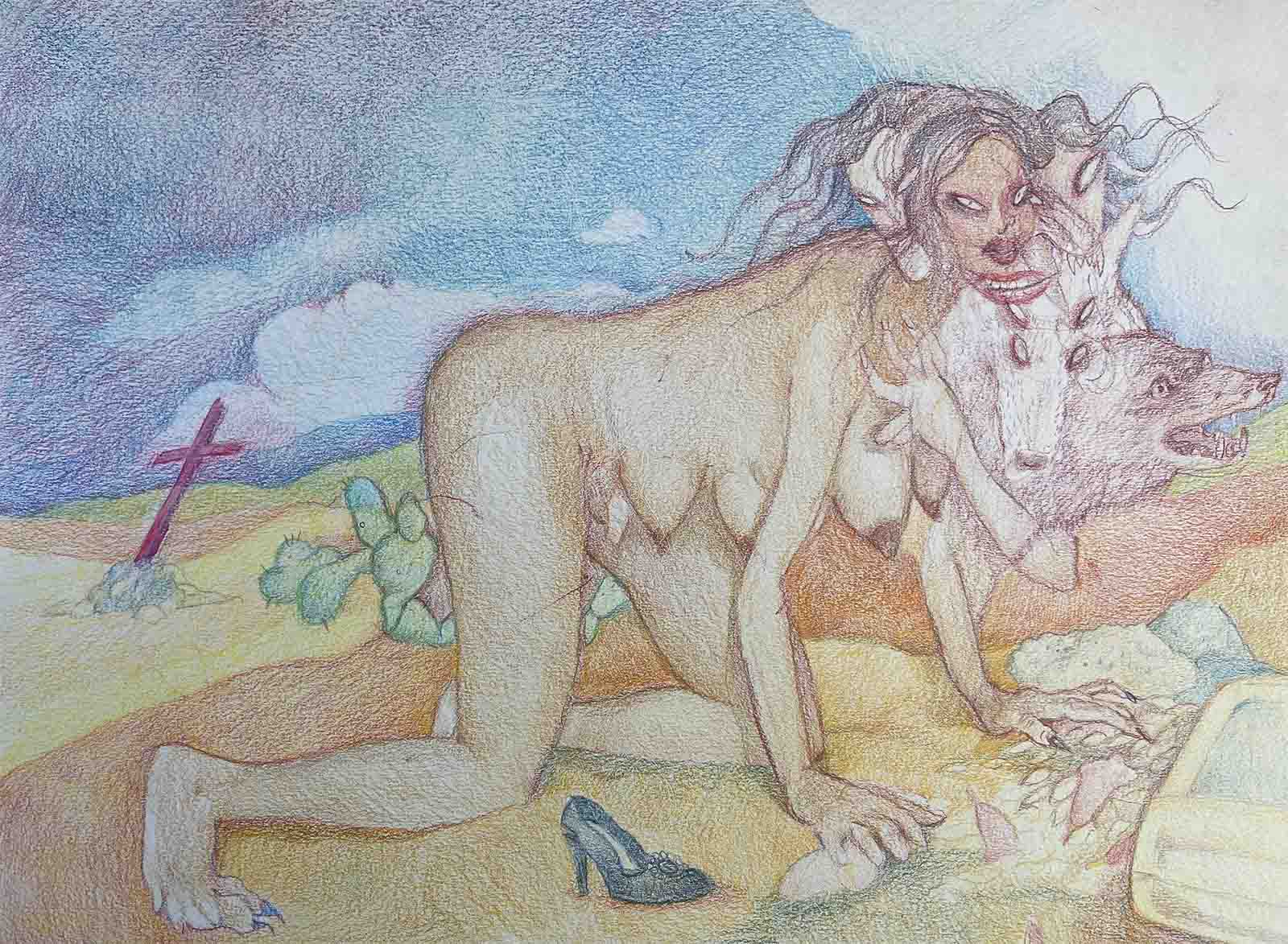
“My drawings, they’re my children. They’re my mother’s children, my grandmother’s children. We’re descendants of an important historical canon and we come from so many years of erasure. We are different. We were always different. People looted and then stole from us. I feel, in a lot of ways, this still happens to me. I always see myself as a snake woman. My indigenous background is one of hiding, like Medusa and like Ishtar, and through me, it’s all coming out. It’s the revenge of the snake woman. I’m really drawing that revenge. As a trans woman, a lot of the world still views me as a monster. I’ll give them what they want, I’ll make those monsters come to life and my power will be even scarier. A monster can transform into many things: my self-portraiture, my children, the girl I draw, she can be a cat, a flower, a reptile.” and, Sofía’s lips form the shape of a kiss as she breathes the next words “…she smells so good.”
“I know my work’s not for everyone. Those that appreciate it, see the layers of it, want to look at it, they’re a version of family to me and some of the kindest people I have ever met. They have empathy for the monster in me and all her daughters.”
Naively, I comment on her bravery. The gentle bestiary portrayed by Moreno thrashes and clings onto freedom found within an artistic hellfire. She debunks my assumptions.
“It took me years to feel like I could show myself and I still don’t know that everyone wants to see it. I took on this notion of a funerary death mask, it’s present in so many cultures. As I was transitioning I had to wear a mask and pretend I was something and someone else just to stay safe. I draw that mask now because it was my whole thing for so many years. Now my mask has shifted in power. I wear my mask to protect my spirituality and who I am as this person and artist. This version of me feels sacred and fragile.”
I make observations about her color palette, the holy innocence of child-like glee found within the pastel tones.
“The beasts are soft and they’re not mutants. They’re logical. My drawings don’t necessarily make it easy for trans women because I’m making monsters. The world already thinks I’m one so that’s what I’m essentially giving back. It’s complicated for a lot of women who think they should be seeing themselves represented in my work. I’m not necessarily trying to make it easy for myself, because it’s not easy being human. It’s not easy being a trans woman. It’s not easy to be alive.”
The speed of our conversation intensifies at the mention of codexes, inspirational Mexican deities, notions of rebirth, the divine. Are the children she draws her final form, I ask, or is she offering a new embodiment of a better ending for their story?
“It feels like a final form for us. It’s a paradise. The world I’ve created for these muses is the heaven they deserved. I can hear the monster’s voice. It’s there, all around me, speaking through me. I feel protected and in my element.”
I wonder about her alternate preservation. As she rewinds on stories that influence her and reworks the ending, she seems to offer solace and safekeeping for the essence of feelings she encounters in historical reference. I say I like the notion of a bestial Utopia for histories with sad conclusions. We touch on the notion of an archive within her drawings, and she lets me know she’s met certain contention regarding the support of some of her artwork and the disappointment felt when professionals have commented on the difficulty to archive her.

Courtesy of the artist.
Masks, Materials, and Preservation
“People often comment on the paper and materials I draw on. They seem to think that makes me unworthy of preservation.” In many ways this accompanies her story and the choice of bodies and stories the art market deems worth telling. Sofía Moreno, through intuitive choices of her own, challenges what this world chooses to keep and the forms it wants to cajole. “But you can’t put something distressing and difficult on beautiful glossy paper! It just doesn’t fit!” Henry Darger and the Vivian Girls gracefully enter the conversation. “His work is part of the Smithsonian, preserved on this very thin and crazy paper. I call him a prophet. It’s like he predicted what is going on in trans culture in the world right now. I see a huge representation of all the white supremacists and the erasure of transness through the Vivian Girls.”
With unparalleled agility, Sofía finds a way to gather all that sparked throughout our moving exchange.

“How does the world cope without being eccentric? I don’t want to focus on the heavy. I have softer things to do. I’m drawing flowers. I’m commenting on the beauty of things that are very easily destroyed. In our culture, the trans woman is fragile and also considered very scary.”
Today, Sofía is part of Deseos Diferentes at Museo Cabañas in Guadalajara, a group show curated by Dorothée Dupuis, that runs March 14–May 31, 2026. This anticipated cluster of works brings together myriad definitions of femininity in relationship to theory and nature, probed and scrutinised by contemporary artists. With Sofía in the mix comes performance and video. Unable to visit the exhibition in person, I received footage of Moreno’s performance titled Lucilia. I’m immediately charmed by an aerial sight of Moreno’s effortless enmeshment with nature she presents: virginal soil grows flowers, plants, herbs and fruit. Sofía, the top of her fountain-like head matching the swarm and growth found within the ecosystem she portrays, hides her face with a death mask of feathers. Delicately, her hands peel oranges and scatter flowers whilst she presses on the leaves. An unencumbered ritual takes place. Comfortably she interacts with foliage, adds heaps of colour and texture and finally, like an earth siren, she lies amidst this bed of branches. Though it was her gentle hands that summoned her crib into shape, nature now holds her and each of her deities in a lithe embrace. I see her furies surrounding her too, holding her within the soil their bodies and art have fed, the same way Sofía holds them delicately in the air that she breathes. No wonder Moreno feels our world doesn’t always listen to her: this is the language she speaks. It is a tongue continually spoken by her ancestors, sex-workers, and a final resting place with her “divas of the underground.” All have been regenerated in unison protected by Sofía’s mask of death and life.
”In my world, I rule, I do the things I want to do. This is my fantasy, not someone’s fantasy of me.”
Before interviewing Sofía for this piece, her place on the podium of “favourite artists alive” was unbeatable. I found myself regularly perusing her social media, sending her heart emojis in response to each new drawing shared and wishing, I too, possessed that wicked little pencil she was armed with, and hoped I could also become my own version of this ogress that “smells so good.” Dialogue with Sofía enhanced these feelings as she effortlessly placed herself even higher in my esteem. I go back to the transcription of our conversation daily, the sight of her specimens granting me my own muscle in the world. Just when I thought I couldn’t possibly find any more beautiful ways to look at her work, I spy one of the opening phrases in the catalog for Flores Nocturnas (s+s Project, 2024, curated by Rae Langes.)
“I’m reclaiming my body and that includes my sexuality. In my world, I rule, I do the things I want to do. This is my fantasy, not someone’s fantasy of me.”
Featured image: Transformista, en Pieles de Temporada, 2026. Courtesy of the artist.


![How To Talk About LGBTQ Awareness With Your Kids [+ Free Resources]](https://som2nynetwork.com/wp-content/themes/rehub-theme/images/default/noimage_336_220.png)