Five Takeaways for Medical Planners From PCMA’s Healthcare & Life Sciences Report


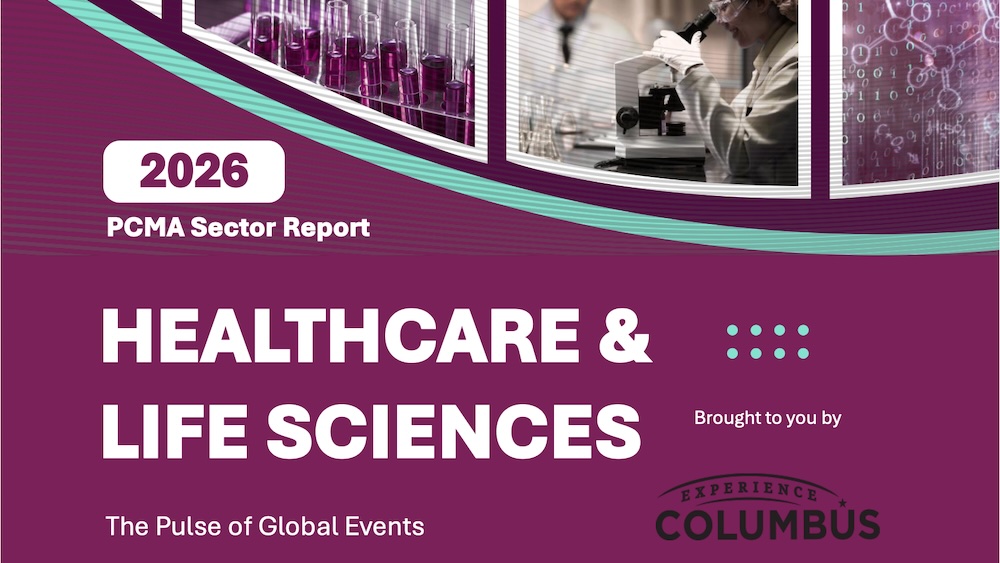
Here are five top takeaways for association medical meeting planners from the “2026 PCMA Healthcare & Life Sciences: The Pulse of Global Events” sector report, along with excerpts from the reports implementation toolkit, which makes recommendations for how meeting professionals can act on trends and market shifts it outlines:
1. Sponsors’ budgets are shrinking and under review.
Direct healthcare provider (HCP) engagement with pharmaceutical companies has fallen to 53 percent, with 62 percent of clinicians engaging with three or fewer companies, according to a 2024 Veeva study cited in the report [p. 10—found in sector report, could not find in Veeva study]. (The figure refers to industry contact overall, not meeting attendance.) As engagement drops and ROI scrutiny by sponsors increases, large-scale, lecture-heavy congress models are losing effectiveness, the report said. Recommendation: Redesign congress formats into smaller, accredited workshops and interactive sessions, and segment audience to deliver high-value HCP participation to sponsors (p. 52).
2. Meetings have more competition.
Healthcare corporate sponsors are organizing their own proprietary HCP education platforms, competing directly with professional associations. One example offered by the report: Johnson & Johnson’s Institute centers in Chennai and Mumbai in India conduct more than 850 education events a year, training approximately 25,000 clinicians in 20 specialties. (pp. 6, 42). Recommendation: Associations can leverage their advantage in offering peer-validated knowledge and compete with commercial models by designing end-to-end CME journeys rather than one-off certified sessions and extend engagement through digital and on-demand content. (p. 54).
3. Congresses are broadening their audiences beyond clinicians and researchers. Meetings that once were purely scientific exchanges now include patients, insurers and other payers, regulators, investors, and others alongside clinicians and researchers. For example, the Asia Pacific MedTech Forum, organized by the Asia Pacific Medical Technology Association, draws healthcare providers, policymakers, regulators, industry leaders, investors, and academics to its 2,000-person meeting. (p. 41) The broader audience mix raises the bar for content governance, the report pointed out, as compliance requirements extend across more participant groups and tracks. (p. 5) Recommendation: Create multi-stakeholder tracks alongside scientific sessions and facilitate cross-stakeholder conversations through forums and panels, while maintaining strong accreditation and compliance frameworks across all content. (p. 53)
 Subscribe to Convene.
Want deep-dive insights on events delivered to your inbox? Sign up for our newsletters
4. Flagship congresses are becoming portfolios of meetings.
In 2023, subspecialty meetings hosted by European Society for Medical Oncology (ESMO), which has more than 50,000 members, reached 52,000-plus oncology professionals in seven cities, with some gatherings as small as 400 people (pp. 5, 42). Those numbers demonstrate how HCP engagement is “increasingly distributed across focused congresses offering deeper clinical relevance,” the report said. Recommendation: Build a multi-year congress calendar anchored to the top high-growth therapy areas to align with where scientific and commercial momentum is strongest. (p. 54)
5. Attendance is losing ground as the primary number that counts. The evaluation of a meeting’s success is moving away from headcounts and the volume of abstracts toward measurable learning outcomes and impact on clinical practice. (p. 53) Recommendation: Create KPIs such as CME completion rates, conduct pre- and post-session assessments, send follow-up surveys at three to six months, and phase out formats that underperform. (p. 53)
About the report:
Chantal Sturk-Nadeau, PCMA’s vice president for innovation & insights, led the research for PCMA Insights, in collaboration with MCI. The “Healthcare & Life Sciences” report is based on published market data, government policy sources, PCMA surveys, analysis of large congresses and trade fairs, published interviews with event professionals, and social listening based on approximately 10,000 online audience members. (pp. 10, 19, 44).
The “Healthcare & Life Sciences” report is the second of four sector reports created by PCMA Insights. The first sector report, “Financial Services” was released in May. Upcoming sector reports include “Information Communications & Technology,” to be released in September, and “Retail,” to be released in November.
Barbara Palmer is Convene’s deputy editor.