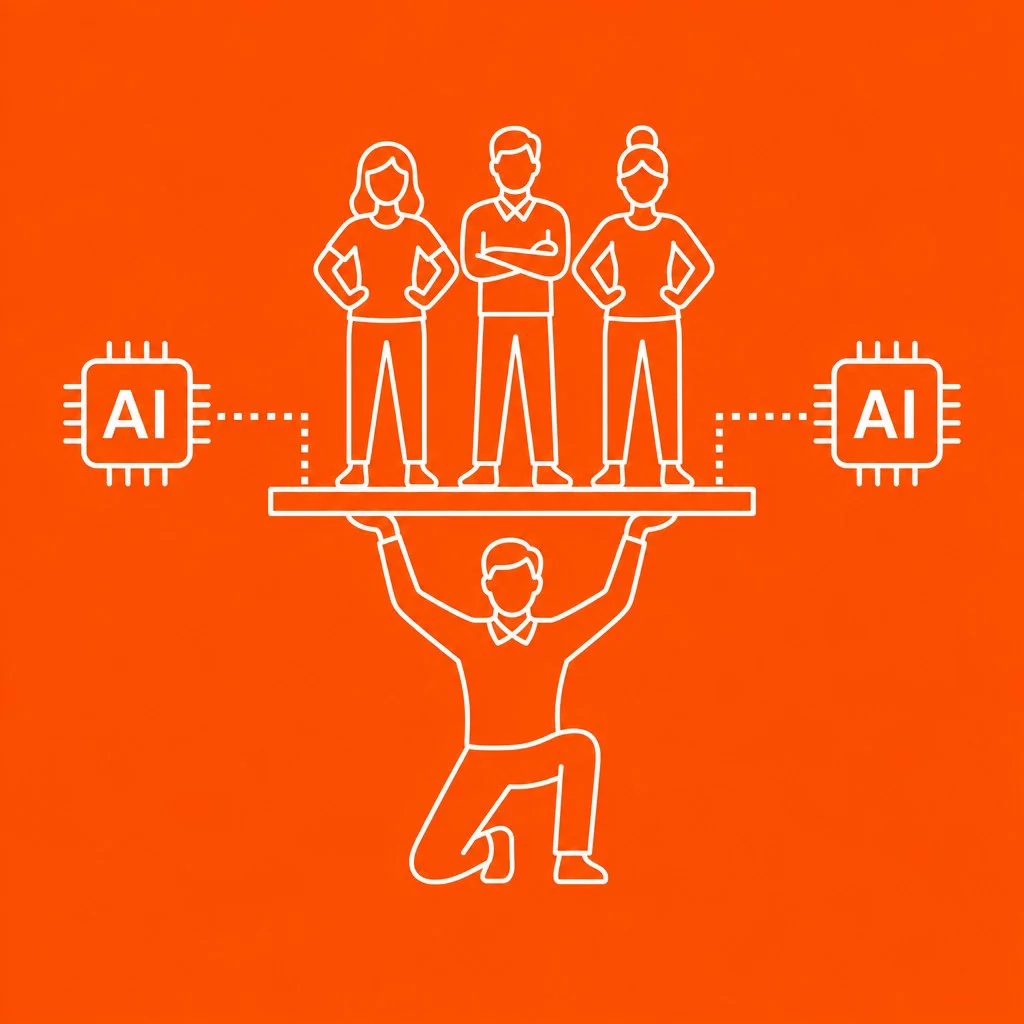
Here is the mistake a lot of companies are making right now: They are investing in technology like the future depends on AI while investing in people like leadership will somehow take care of itself.
It will not. And the cost is showing up in the daily experience of employees.
A recent HR Dive, “Dive Brief” article, based on new Harris Poll research, reported that 6 in 10 U.S. workers say they currently have a toxic boss, while 7 in 10 said they have had one before.
But the detail that stood out to me was this: 44% said their company invests more in AI than in one-on-one coaching for people managers or in developing the next generation of leaders.
That finding does not prove that AI investment causes toxic leadership by itself.
But it does expose a pattern businesses should take seriously.
When organizations pour money into tools and starve leadership development, they should not be surprised when pressure rolls downhill and shows up as micromanagement, blame-shifting, unreasonable expectations, and fear. That is not an AI problem. That is a leadership investment problem.
What the study says
The study is not saying every hard-driving manager is toxic. It is not saying AI is bad.
What it does show is that workers see toxic leadership as more than a personality issue.
In fact, 71% blamed systemic economic pressure more than pure character flaws. That means employees are saying, “The system is shaping the behavior.”
Stressed systems create stressed managers, and stressed managers often default to control. If a manager has weak coaching skills, limited support, unclear expectations, and nonstop pressure to produce more with less, the odds go up that leadership gets expressed in toxic ways.
That is why Libby Rodney’s framing is so important. Her point was that toxic leadership is an investment failure, not just a character flaw. I agree.
The false choice companies keep making
Too many businesses are acting like they have to pick a side. Both sides miss the point.
Anti-AI fear is lazy. AI is real. It’s useful. It can absolutely improve decision-making, execution, communication, analysis, and follow-through.
Naive pro-AI hype is just as lazy. If your main use of AI is to increase surveillance, compress timelines, reduce headcount, and squeeze managers harder, don’t call that innovation. Call it what it is: more pressure with better software.
The middle ground is not complicated, but it requires discipline: invest in AI, and invest in the quality of the people leading through that change.
Most companies do not need better technology. They need better leadership systems around the technology they deploy.
What servant leadership looks like in an AI-heavy business
From a servant leadership lens, the question is not whether to use AI. Instead, the question is what the use of AI is doing to people.
- Is it helping managers coach better?
- Is it helping teams follow through more consistently?
- Is it reducing noise so people can do more meaningful work?
- Is it creating clarity?
- Is it improving judgment?
- Is it developing people?
Or is it mainly being used to push for more speed, more control, and lower labor costs without building the leadership capacity needed to absorb the strain?
That’s a real business question, not a philosophical one.
Servant leadership is often misunderstood as soft. It is not soft. It is rigorous because it forces leaders to ask whether the system they are building is actually making people stronger.
That means using tools in ways that increase human effectiveness, not just managerial leverage. It means holding leaders accountable not only for output, but for how output is produced. It means refusing to confuse efficiency with maturity.
Why leadership training still matters more than people think
One of the clearest findings in the Harris Poll research is that 64% of workers said leadership training was the best way to reduce toxic behavior. Not better pay. Not more headcount. Leadership training.
For years, many organizations have treated people leadership as a secondary competency. If someone is smart, productive, technically strong, or loyal long enough, they get put in charge of people and everybody just hopes it works out.
None of that is fixed by giving managers access to better dashboards.
It’s fixed by training, coaching, standards, reinforcement, and a culture that treats leadership as a discipline.
If you’re going to ask managers to lead through AI transformation, then equip them to lead human beings through uncertainty, change, and rising expectations. Otherwise the technology gets smarter while the leadership climate gets worse.
The business case is straightforward
This is not idealism. It is basic organizational math.
If toxic bosses drive burnout, therapy, stalled promotions, turnover, disengagement, and overwork, then weak leadership is not just a cultural issue. It is an operating cost.
And when that cost is amplified during a major technology transition, businesses pay twice: once for the tools and again for the damage created by badly led implementation.
That is why the happy middle ground matters. Use AI aggressively where it truly helps. But do not let your AI strategy outrun your leadership strategy.
The goal is not to protect people from technological advances. The goal is to build leaders who can leverage technological advances without devaluing people.
Why I built Virtual Leadership Programs
This is one reason I built VLP. Not to help organizations replace leaders, pressure people more efficiently, or turn AI into a shinier command-and-control system.
I built VLP to help organizations use AI to strengthen follow-through, coaching, and human development. That’s the servant-leadership way.
If AI can help a leader be more consistent, more prepared, more attentive, and more effective at developing people, that’s a win.
The test
The real test of an AI strategy is not whether the software is impressive. It’s whether the people under that strategy are suffering or excelling.
This new data strongly suggests that many employees are experiencing a workplace where investment in technology is outpacing investment in leadership. That gap is dangerous.
If companies want the upside of AI without expanding the conditions that produce toxic leadership, the answer is not to slow down technology and it is not to worship it either.
The answer is to build leaders who know how to use powerful tools in ways that make people stronger.
Anything less is not modernization. It’s toxic leadership at scale.