

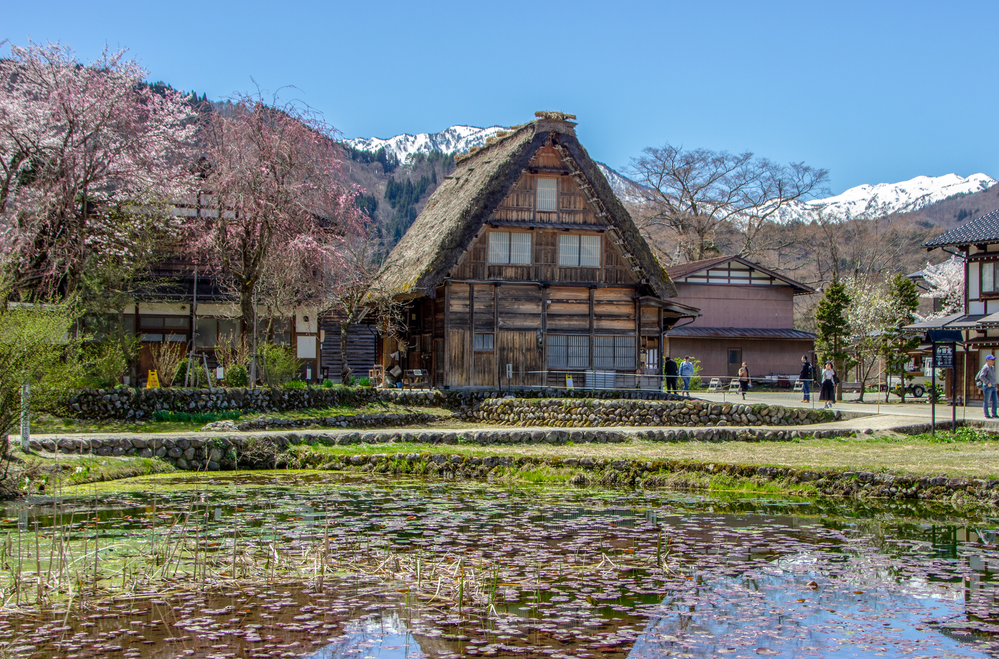

Nestled in the center of Japan’s largest island is the majestic Ryohaku Mountains, aka “Japanese Alps.” Approaching this region on road, I feel myself slipping into a dream, as though I am no longer in the “Land of the Rising Sun” and have mysteriously ended up in Switzerland. The snow-capped mountains overlap into the clear blue sky like a surreal painting to immerse my imagination. I arrive to spend a day at the traditional village, Shirakawa-go a UNESCO World Heritage Site in the Shogawa River valley. Shirakawa is best known for its unique buildings called Gassho-zukuri, with A-framed, thick thatched roofs, designed to manage the snow, as this region is the snowiest area in Japan during winter. (Above photo) I initially just take in the fresh alpine air from the valley, surrounded by beautiful mountains in which to explore this charming village, noticing pink cherry blossoms in full bloom, knowing this is going to be a splendid spring day. From the Visitor’s Center, I cross the hanging bridge (Above photo) over the Shogawa River to the village. The main attraction of this site is the village itself and its harmonious setting with the best way to explore being on foot, which is my favorite as an inquisitive peripatetic. The village is small and easy to explore where I wander through the labyrinth of unique buildings, gardens, colorful scarecrows, shops, shrines and cherry blossoms… Shirakawa-go is the largest concentration of Gassho-zukuri buildings in Japan used originally as farmhouses. There are over 110 houses with some being over 250 years old. The A-framed thick straw roofs were built to withstand the heavy snow of the region. Gassho-zukuri means constructed like hands in prayer, as the farmhouses steep thatched roofs look like the hands of Buddhist monks in prayer. The A-framed roofs (made without nails) provided large attics used for cultivating silkworms. Even though most of the buildings have been converted to museums, I still enjoy the setting for its rich cultural experience to feel what it was like to live this unique lifestyle hundreds of years ago. I inquisitively wander without much of a plan, except to just take it all in. The cherry blossoms are a beautiful accent to the rustic charm. The unfortunate reality is the touristy crowds (cannot complain because I’m one too). It’s vast enough to not feel overwhelmed by the crowds. (I read that tourists have increased the pollution in the river valley.) I take the 15-minute walk to the hilltop’s panoramic view, where the Shiroyama Tenbodai Castle used to be. From here, I see the cherry-blossom framed, snow-capped mountains and the picturesque village in the valley below, along the winding turquoise Shokawa River…Mt Hakusan looms at the highest elevation of 2,172 meters and has been known as a sacred summit for centuries. From here, I can easily imagine living here 200 years ago, as a farmer connected to the land and its surroundings living in harmony with Mother Earth. I continue to tirelessly wander throughout this idyllic village the rest of the day with no agenda. Visitors can rent the old farmhouses and have an extended stay to experience the essence of this valley, which is presumably more evident in the early morning and evenings with less tourist crowds. After 2 Matcha (green tea) ice cream cones and 4 hours of wandering, I meander back across the bridge leaving the village, feeling myself slowly transition out of this nostalgic dreamworld, back into the reality of modern Japan…taking with me a splendid memory of this unique Japanese heritage. Sayonara Shirakawa! #japantravel #travel #japan #traveltribe #shirakawa #travelling #bestintravel #solotravel #wanderlust


