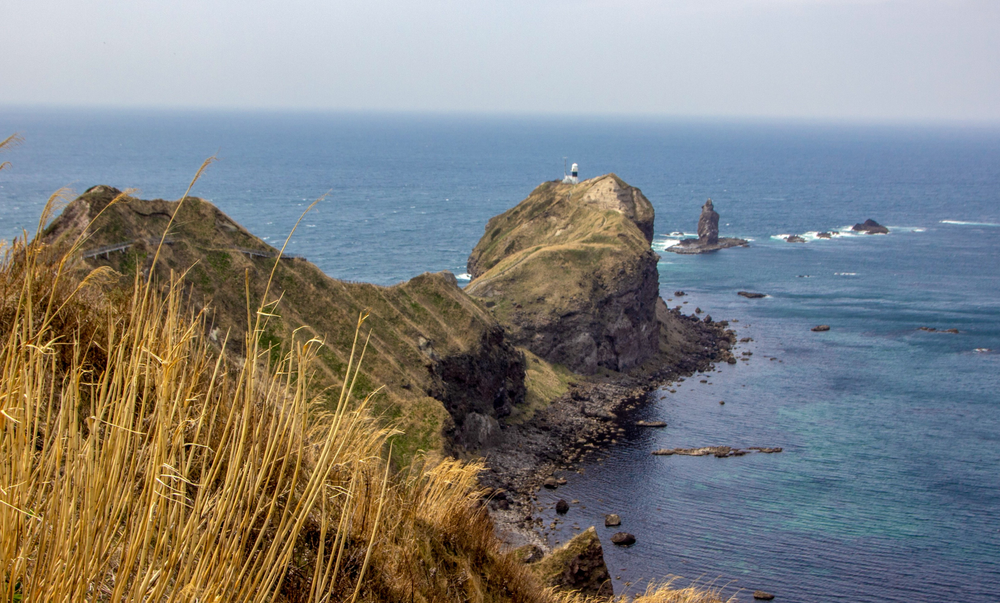
On Japan’s northernmost island, Hokkaido “North Sea Province,” is a dramatic landscape, known for its volcanoes (6 are active), hot springs (onsens) and rugged coastlines. In April 2019, I explored 3 top attractions on this intriguing island: Cape Kamui on Shakotan peninsula, Toya-Usu Global Geopark and the charming port city, Hakodate. I. Cape Kamui on Shakotan Peninsula Jutting out into the Sea of Japan along the rugged coastline is the Shakotan peninsula with its 3 great capes: Cape Kamui, Cape Shakotan and Cape Ogon. Its transparent waters are renown for a beautiful “Shakotan Blue.” I was blown away (literally) by my windy experience at the precipitous Cape Kamui. Because of the wind, the precipitous promenade “Small Path of Charenka” to the tip of the cape and its lighthouse was closed and the Shakotan Blue was muted by overcast skies. However, I was able to walk along the shoreline’s windy path to get a clear viewpoint of the cape and beyond, as well as the snow-capped mountains behind me. “The Legend of Kamui” can be summarized as a native Ainu chief’s daughter “Charenka” was so distraught by the sudden loss of her lover, that she ran to the tip of the cape and shouted a curse into the wind, that any woman passing the cape on ship would die. As the story goes, she then jumped into the sea and became Kamui Rock (right photo). Superstitiously, this area was historically off limits to women because of the curse with a signboard to remind. Because of the blustery wind, I was unable to cross the gateway to test this hex, but many women have proved it wrong over the years. However, everyone should visit with caution because of the moody weather and winds that frequent this intriguing vortex of nature, beauty and legends. II. Toya-Usa Global Geopark This geothermal hotspot is an active volcano zone (4 eruptions in the 20th century), along with caldera lakes and hot springs. With the most recent eruption in 1977, the theme here is Shintoism in its highest form, with humanity’s coexistence with the changing earth. On my daytrip, I went to the Volcano Village and first closely observed the nearby young and active Mt. Showa-shinzan “New Mountain in Showa Period” at 398 metres high. It was formed over a 2-year period, following the 1943 eruption of the stratovolcano, Mt. Usa. I took the Mt Usu Ropeway (5 minutes) to the Summit Station (733 metres) for a 360-degree panorama of the dramatic landscapes. To the north lies the transparent blue caldera, Lake Toya, nearly circular with a 9-10 km diameter and the Mt. Fuji-like Mt Yotei, dramatically looming in the distance at 1898 metres high. On the other side of the summit is the nearby Ginnuma crater basin (above photo), the largest crater created by the 1977 eruption and the vast Volcano Bay. Volcano Bay (approx. 50 km in diameter) was named by a British Captain at the end of the 18th century when he viewed the volcanic group (Mt. Esan, Mt. Komagatake, Mt. Usu, and Mt. Tarumae) releasing smoke and gas around the bay. The 17th century was a volatile series of eruptions that was cataclysmic with all the villages in the area buried in ash. After leaving the Volcano Village, I wandered along the shores of Lake Toya in the Sculpture Park. This pristine lake is considered Japan’s 2nd most transparent lake with Nakajima Island and the breathtaking backdrop of the Mt. Fuji-like Mt. Yotei (One of 100 Famous mountains in Japan). The open air Gurutto Chokoku Koen (Sculpture Park) displays 58 pieces harmoniously along the lakeside (right photo). III. Hakodate’s Kaiko St. & Ft. Goryokaku The charming port city, Hakodate, offers an efficient tram to get around and see the sites. Firstly, I strolled along the upbeat Kaiko Street to see their row of red brick warehouses facing the Hakodate Bay. These warehouses are iconic symbols of the past from over a century ago, restored and used for commercial use and restaurants. Then, I took the tram to Goryokaku, a vast star fort, the main fortress of the Republic of Ezo, where I was fortunate to discover that this is one of Hokkaido’s most famous cherry blossom viewing areas. This 5-pointed star shaped fort was based on the work of French architect, Vauban, allowed for more guns on its walls than a traditional Japanese fort. It’s now a restored pleasant park to wander, especially to see the 1600 cherry trees beginning to bloom along the moat. There is a tower nearby for visitors to look down upon the star-shaped moat, at its best with the cherry blossoms (I didn’t go in the tower). Overall, Japan’s northernmost island is an eclectic, natural wonderland to experience majestic mountains, volcanoes, caldera lakes, hot springs, colorful flowers and rugged coastlines amidst less crowds. It provides escapes into 4 distinct seasons of nature at its finest. My time in Hokkaido was just 3 days of compact sight-seeing in springtime, that only scratched the surface of this sparsely populated island. I would love to return and further explore its ever-changing landscapes through a solitary journey in coexistence with its primitive nature. #japantravel #hokkaido #japan #shakotan #hakodate #travelblog #travelbloggers #laketoya #traveltips