Portugal’s routes to goal may need to change – The Conventional Playmaker

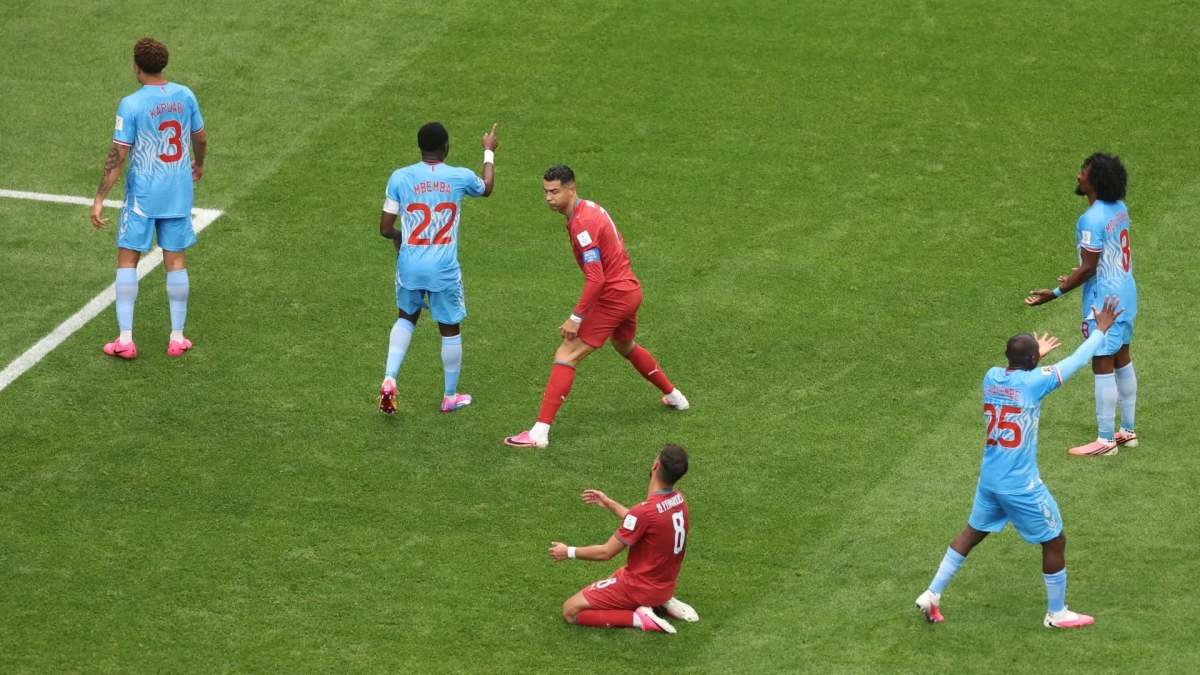
Whereas Germany, and Argentina, were both praised for their close combination play in their opening group stage matches, there were often large gaps between Portugal’s players when they had the ball, which in this case, did not help in their attempts to break down a sturdy DR Congo defence, especially as the encounter went on.
Portugal’s midfield has rightfully been lauded as one of, if not the best this latest edition of the World Cup has to offer. Vitinha, and Joao Neves – two of the three man midfield which starred as Paris Saint-Germain retained their Champions League crown, and Bruno Fernandes – Manchester United’s creator in chief, offered flexibility. Vitinha dropped beside, and even in between the two centre-backs to dictate build-up from deep. Neves would push forward into the penalty-area, whilst Fernandes floated across midfield, looking to pick out passes to those making runs in behind DR Congo’s back line.
With DR Congo’s 5-3-2 staying fairly narrow, there was plenty of space out wide for Portugal to send the ball too, from which crosses could be played into the box. This worked well enough in Portugal’s favour in the early stages, as shown by their goal. One cross from the right comes to no avail, but the ball is worked back to the left, where Pedro Neto is supplied, and his cross from the flank was met by an emphatic header from Neves, a route to scoring much like his all important goal against Bayern Munich in the Champions League. Neves was free to attack the ball unmarked with centre-forward Cristiano Ronaldo occupying two defenders.
Both full-backs, Joao Cancelo, and Nuno Mendes, pushed forward, but Portugal favoured attacking down the left side, as Fernandes would also find winger Neto, as well as Mendes making runs via the channels, with lofted balls over the top. Runs from both tested DR Congo wing-back Aaron Wan-Bissaka, but in one instance, his tackle on Mendes showed why he is one of the best in the world when it comes to last ditch recovery challenges.

Portugal had the lion’s share of possession with 75%, and could afford to control the tempo of the match as they pleased, because of how passive DR Congo were out of possession during the first-half. But with passes being sent out to the flanks, and not much close combinations on the edge of the box, DR Congo’s block was not challenged as much as it could have been. There was no need to push out, and close down tightly, with few passes played between the lines by Portugal, as their central players did not combine in close proximity, which could have attracted pressure, and create space elsewhere. There was a lot of movement and rotations in Portugal’s possession-play, both in the middle and out wide, but not much risk tasking with passes, and dribbles towards goal.
DR Congo themselves did not counter often, but when they did, they threatened. A switch of play to Bernardo Silva free out on the right, saw him bring the ball down, but also be outmuscled by wing-back Arthur Masuaku. Masuaku carried the ball forward, played it across to Samuel Moutoussamy, whose shot was deflected out for a corner. A series of corners resulted in DR Congo equalising on the stroke of half-time, after a corner was played short, with the in-swinging delivery that followed finding Yoanne Wissa as part of a 3v2 overload, and the fore unmarked to head the ball goal bound.
Portugal reacted by replacing Silva with Francisco Conceicao at the start of the second-half. Conceciao is more of an out and out winger than Silva, and offered more speed and incentive to take on the marker in 1v1s. And there were two scenarios, where Conceicao was picked out with threaded passes; inside the box by Cancelo, and then by Fernandes following a clever third-man run, resulting in two cut backs for Ronaldo. The first was passed behind Ronaldo’s right leg, making it difficult for the centre-forward to hit first time. For the second, Ronaldo could well have made a run across the six yard box to allow the pass to find Fernandes, but opted to drop off the defence, and shoot at goal. Portugal could have scored from this, and the perception of their approach, albeit no different, may have been perceived differently.
Ronaldo’s presence in the box invited crosses from the flanks, but these deliveries were consistently cleared by the DR Congo defence. Though Ronaldo is still an elite goal scorer, both on the ground, and in the air, the movement on the edge of the box and inside it from Ronaldo, and his teammates was lacking, barring the goal, and the cut back chance.
It seems that Portugal’s game plan is tailored to platforming Ronaldo, even if that means potentially limiting the full scope of how Portugal can create chances. Portugal looked more of a threat when Fernandes could pick out deep runs, and would be even more threatening if Fernandes can receive the ball even closer to goal more often, with more options, making more varied movements surrounding him.
Portugal could have afforded to take more risks with their passes, to challenge, and draw DR Congo out of their defensive shape, which was more assertive in the second-half; Wissa was more inclined to get tight to Portugal’s centre-backs, and the defence pushed up to congest the midfield. Rafael Leao would also be introduced, but he did not get the chance to properly assert himself, especially when fixed to the left flank. He is a dribbler who thrives in transitions where he can attack large spaces, and may have benefited the chosen approach.
The quality of service to Ronaldo could have been much better too, with only 6/23 crosses completed. But even when crossing into the box, and having larger distances between your attacking players can be effective, perhaps that effectiveness can depend on the opposition, and what is subsequently needed to outwit them, as well as the players you have at your disposal. On the social media platform X, The Athletic’s Jon Mackenzie noted on how Vitinha, Neves, and Mendes, would be used to playing in large spaces for PSG, but whereas PSG do this because they have attackers good at connecting over larger distances, and so they can attack directly, Portugal’s play was more patient. Portugal also only managed 7 shots, to DR Congo’s 8, and an xG of 0.65.
Wing-play, and supplying Ronaldo in the box got Portugal to the World Cup. But it did not work well in their Group K opener. Portugal may have been limited by Ronaldo’s role up front, but he was also limited by Portugal’s approach.
It is arguable that the same set up Portugal deployed on Wednesday would be more effective against a more open side, but it may be worth head coach Roberto Martinez making a big decision, and trying something different with regards to how they create chances.
Data: Fotmob