How Much Should I Spend on Rent: A Guide for Tenants

Money is like time—it’s limited, and how you manage it makes all the difference. Budgeting is all about taking control of your finances and making sure every dollar works for you. In turn, a huge aspect of this is figuring out how much you should spend on rent.
If it’s your first time renting or you simply want to brush up on your strategies, chances are you’re asking: how much should I be paying for rent? Stay with us while we go over the basics of rent budgeting, explain the classic 30% rule, and share some practical ideas to make life simpler.
Main Takeaways
- The 30% rule can provide a starting point for setting a rent budget, but renters should also consider their income, debt, savings goals, and other monthly expenses.
- Budgeting methods like the 50/30/20 rule, zero-based budgeting, or a personalized budget can help renters determine what they can comfortably afford.
- Rent is only part of the cost of renting, so tenants should also account for utilities, transportation, parking, fees, and other expenses before choosing a home.
The Rule of Thumb for How Much to Spend on Rent
As property management companies in Washington, DC, we know that budgeting for housing is crucial. That said, you may have heard of the 30% rule. The 30% rule is a commonly used guideline suggesting that households spend around 30% or less of their gross income on housing costs. However, it is only a general benchmark—not a requirement or a complete budgeting formula. How you use the rest of your income will depend on expenses like food, transportation, debt, utilities, savings, and other financial obligations.
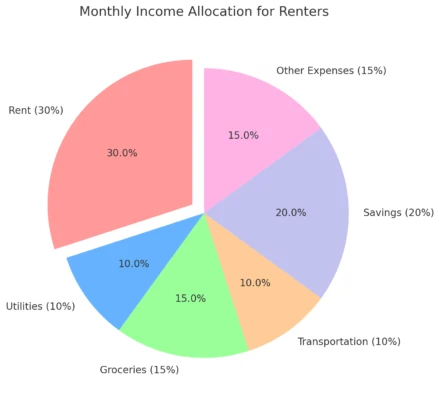
You can see how this might play out in practice, and that’s why it’s stayed so popular throughout the years.
Limitations of the 30% Rule
The 30% rule has long been used as a general benchmark for housing affordability. However, it was designed with 20th-century consumer spending patterns in mind, which means it doesn’t account for the economic conditions of today. To elaborate, it makes some pretty big assumptions about how much people earn, how they spend their money, and what their individual financial needs might look like. Let’s dissect this:
Doesn’t Consider Modern Costs of Living
The old 30% rule doesn’t count student loans, childcare costs, internet bills, and other expenses that seem to be more commonplace than ever. For instance, according to the rule, if your yearly wages are about $50,000, you could spend around $1,250 on your rent. That leaves you with a grand total of about $3,250 for everything else—sounds great, huh? Only, you’re forgetting taxes, loan payments, and so forth on the checklist. After that, you might very well be left with no room to save or have fun.
Not Applicable in the Higher Income Classes
If you earn a higher salary, the 30% rule might give you a disproportionately high rent amount for you to shoulder. For instance, if your annual salary is $150,000, the rule states you could afford to pay $3,750 a month for housing. Of course, if you have no choice but to rent a home costing that full amount, you’d have to do it. However, if you have cheaper options, it might be better to spend the leftover funds on investing, saving, or putting it toward some other financial goal.
Little Consideration of Choices and Needs
The 30% benchmark has roots in federal housing policy and was not designed to account for every household’s individual expenses. Renters today may have very different financial obligations, household structures, and living costs, which is why the guideline may not work equally well for everyone.
Today, household structures and financial situations vary widely. Some renters live alone, while others share expenses with partners, family members, or roommates. The list of possible lifestyles goes on and on.
Other factors, such as whether someone lives in a rural, suburban, or urban area, can also affect how far their income goes. Needless to say, the 30% rule does not consider all those drastically different situations.

Ways to Set Your Rent Budget
The 30% rule can be a fair starting point for how much you should spend on rent. However, when you consider all the factors above, other formulas might be a better fit. Consider some of these leading options:
50/30/20 Rule
The 50/30/20 rule divides your after-tax income into three general categories: 50% for needs, 30% for wants, and 20% for savings and debt repayment. This way, you can organize your budget by each part of your life and keep them all in good balance.
Zero-Based Budgeting
With zero-based budgeting, you base your spending budget on the exact amount of money you currently have. Your goal is to ensure the sum of all your expenses is exactly equal to your budget. Then, it should leave you with a balance of zero in the end. With this method, you can track how each and every dollar fits into your overall budget. You can make sure it’s all being used wisely.
Personalized Budgeting
If the standard rules don’t quite work for your lifestyle, personalized budgeting might be the way to go. This method is all about tailoring your budget to match your own financial goals, needs, and preferences. It means taking a closer look at your income, what you spend, and what you’re saving for to figure out what rent amount makes the most sense for you.
Factors That Influence Your Rental Budget
As you can imagine, when you’re working out how much you should spend on rent, there is no single answer. It varies according to the nuances of your personal situation. So, here are some other ways you can estimate how much you should spend on rent:
Income Level
As always, your income level is your starting point. If the 30% rule feels right for your situation, then it may just be the solution for you. However, it’s not set in stone–you may need to adjust it around your own circumstances.
Location
Where you live is an important determinant of what percentage of income should go to rent. For instance, if your residence is right near public transit, major highways, and big attractions, you may find that the rent is more expensive. Rent prices can also vary based on proximity to schools, shopping, entertainment, public transportation, and other local amenities.
Household Size and Space Needs
The amount of space your household needs can also affect your rental budget. Larger properties or homes with additional bedrooms may cost more, so consider how much space you need while staying within your overall budget.
Utility Costs
While local laws and lease terms vary, you could be responsible for paying the electricity, water, or gas and other utilities in your rental. Always do a calculated estimate of your utility costs as you run the numbers, because this can eat into your overall budget.
Transportation Costs
The farther you are from work or public transportation, the more you may spend on gas or parking. And if you do use public transit, bus and subway fares tend to add up quickly. So, when considering a rental, think about what it will cost to get around.
Parking Costs
As we just mentioned, parking costs can add up quickly. In many places, especially busier areas, you have to pay for parking. You could be saddled with those fees on a daily, weekly, or monthly basis. As such, you’ll need to add this into your calculations.
Maintenance and Repair Costs
Depending on the lease and applicable law, tenants may be responsible for certain minor upkeep tasks, such as replacing lightbulbs or performing routine cleaning. Furthermore, if an accident happens, like you break a light fixture, you may be responsible for the cost of repairing the damage, depending on the circumstances and applicable law. That said, you should include basic maintenance costs and potential accident costs in your budget.

Common Mistakes to Avoid
In the process of determining how much you can afford to pay for rent, avoiding mistakes is an important step. These missteps can make a big difference in your budget. Let’s go over some common mistakes to steer clear of.
Overlooking Additional Costs
Rent can come with additional costs that aren’t always included in the advertised monthly price. Parking fees, certain maintenance charges, pet-related costs, and other fees listed in the lease can affect your total housing expenses. As such, it’s best to ask about extra fees before signing a lease to avoid surprises later.
Ignoring Lease Terms
It’s easy to rush into signing a lease, but ignoring important terms on the length of the lease, breaking the lease early, rent increases, or other policies can lead to trouble. So, always read the fine print to ensure you’re fully aware of your rights and responsibilities as a tenant. Make sure you’re prepared to fulfill those obligations.
Choosing a Place Based on Looks Alone
It’s tempting to pick a place just because it looks nice, but it’s important to also think about the location, safety, and whether the space suits your needs. A beautiful apartment may not be the right fit if the location, commute, noise levels, or nearby amenities don’t work for your needs.
FAQs About How Much to Spend on Rent
Rent affordability looks different for everyone. These common questions can help renters decide how much room they realistically have in their monthly budget.
How much of my income should I spend on rent?
The 30% rule suggests keeping housing costs around 30% of your gross income. However, this is only a general guideline. Your ideal amount may be higher or lower depending on your other expenses, location, debt, and financial goals.
Should I calculate rent based on gross or net income?
The traditional 30% rule generally uses gross income, which is your income before taxes and other deductions. However, looking at your take-home pay can give you a clearer picture of how much money you actually have available each month.
What expenses should I consider besides monthly rent?
Consider utilities, internet, transportation, parking, renters insurance, pet-related costs, and any fees listed in the lease. Looking at the total monthly cost of living in a rental can help you avoid stretching your budget too far.
What if I need to spend more than 30% of my income on rent?
Spending more than 30% of your income on housing may place you above a commonly used affordability benchmark, but the percentage alone doesn’t determine what you can personally manage. Review your entire budget, including debt, savings, transportation, and other essential expenses, to determine what you can realistically manage.
How can I lower my monthly housing costs?
You may be able to lower your housing costs by choosing a less expensive area, renting a smaller property, living with roommates, or looking for a rental where some utilities or amenities are included in the rent.
 Some Additional Suggestions for Tenants
While the 30% rule is a good guideline for how much to spend on rent, it doesn’t work for everyone. Other methods, like zero-based budgeting, might work better for you. Furthermore, various aspects of your life, like your location and number of roommates, can complicate matters, so you should tweak your budget with those in mind.
Ready to find the ideal rental for your lifestyle and budget? At Bay Property Management Group, we believe each tenant should find a choice that is affordable and allows them to thrive. Reach out to us, and together we can find your new home!