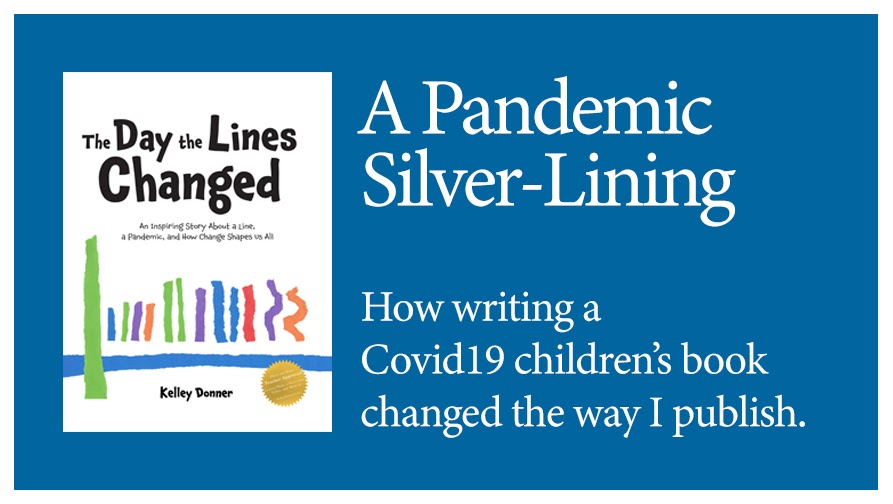

How Writing a Covid19 Children’s Book
Changed the Way I Publish
February
was not a good month to be sick with a cough. Nevertheless, I had one and it
ended up being one of the worst colds of my entire life. At the time, Covid19
was just becoming an issue and my continual coughing caused more fear than
sympathy. Therefore, I went into lockdown before it ever became a bad word. Then
my kids came down with my colds, homeschooling began, and questions about this
mysterious virus began to get real. It was impossible to keep the kids in the
dark. They began to worry and their questions became harder and harder to
answer. Will we get to go back to school? When can we see our friends? Why
can’t grandma visit? Is grandma going to die? Will you die? Can I die? These
are not easy questions to answer, especially when no one really knew that much
about Covid19.
Lockdown Inspiration
One
afternoon while playing around with torn construction paper, I suddenly
realized an easy way to explain to my six year old about the virus. Just as
many of my stories come to me out of the blue and overtake my thought
processes, this one wouldn’t let go. The story of a happy, carefree green line
whose life changes suddenly when one day some of the orange and purple lines in
her town begin to turn crooked. I began tearing paper, scanning it in, and
writing down the story that had appeared in my head. Within 24 hours, I had
assembled the beginning of a book which would end up becoming one of the most
popular children’s books about the coronavirus. I called it TheDay the Lines Changed.
My Advantage
By early
March stories about the notorious coronavirus began to arrive from all corners
of the globe. I began to realize that the story that I had written to console
my boys had marketing potential. Large publishers need months to years to bring
out a story as they require the collaboration of various people from book
designers and illustrators to marketing experts. As someone who had already
self-published a couple of children’s books and done my own writing,
illustrating, and book design, I realized an opportunity. I quickly got to work.
My last book had taken a year to write and illustrate. Nevertheless, within a
week I had published the first draft of The Day the Lines Changed on Amazon.
I decided to give the first two months earnings (March and April) to local
charities which support children’s mental health. After April, I figured if the
book was still making some money, I could use the extra cash to pay off my
Master’s degree. At the time, I thought I would be lucky if I sold a couple
hundred books and I never imagined that the pandemic would get so out of hand.
Learning by Doing
Unlike
most children’s books, coronavirus children’s books were an absolutely new idea.
I began to look on Amazon everyday. I would type in “coronavirus children’s
books” or “pandemic picture books” and see which books continually came up. I
began to get to know the competition, which grew by the day. Quickly I began to
see why some books sold more than others. The cover looked more professional,
you could look inside the book and read the story, the idea was great, or the
blurb especially appealing. I began tweaking my story. I improved the cover. I
improved my blurb. I increased the look inside function to 70% so that people
could read my story. I made a story-time video on Youtube. I began to advertise
and post on social media. I started doing interviews. I learned basic analytics.
Soon, my numbers began to improve.
I also
decided to contact other authors of coronavirus children’s books. I looked at
who was in the top ten and I sent them each a letter. I introduced myself and
asked them why they wrote their book and their story. Soon, I began to see a
trend. We were mothers, teachers, and all had some artistic experience. In
addition, we were all privileged enough to be able to have had the time to do
what we did. Writing, illustrating, book design, and marketing all take
precious time and usually amount to little income. None of us had a traditional
book contract, but we all had the ambition to venture into the unknown. We had
all decided that the benefits outweighed the risks. Interestingly enough, for many
of my colleagues, this was the first book that they had ever self-published.
As Covid19
began to really hit the US hard, teachers all over began to talk on social
media about what they were going to do when they went back to school. Having
worked as an educator for many years, I knew I could help out. I used my
research to write an article on my blog The Best Coronavirus Children’s Booksfor back to school. I began to receive more emails from teachers wanting to use
my lesson plans in their class. More than any newspaper article or interview,
social media post or podcast, word of mouth about my book began to fuel sales.
By August I began to sell 40 books a day and at its peak, I was selling well
over a hundred. In September, The Day the Lines Changed was featured in the
Washington Post as one of the top coronavirus children’s books on the market
and had made over 10,000 dollars. My book had gone further than I had ever
imagined possible.
Moving Forwards
Publishing
a coronavirus children’s book has taught me more in 6 months about publishing
than all of the writing classes and seminars I’ve been to in my lifetime. A
book is so much more than its text. When I wrote The Day the Lines Changed,
I didn’t know what would happen. But, I knew that if I didn’t take a chance I would
never know what could happen. The worst case scenario was that my book would
fail. I was willing to accept that. It is only after you have accepted that you
can handle the worst case scenario that you can begin to look at how you can
achieve the best. At that point, you can only move forwards. Thank goodness I
did.
For more info on The Day the Lines Changed: KelleyDonner.com