Little Chef by Pista House Turns a Factory Visit Into a Hands-On Learning Experience for School Children

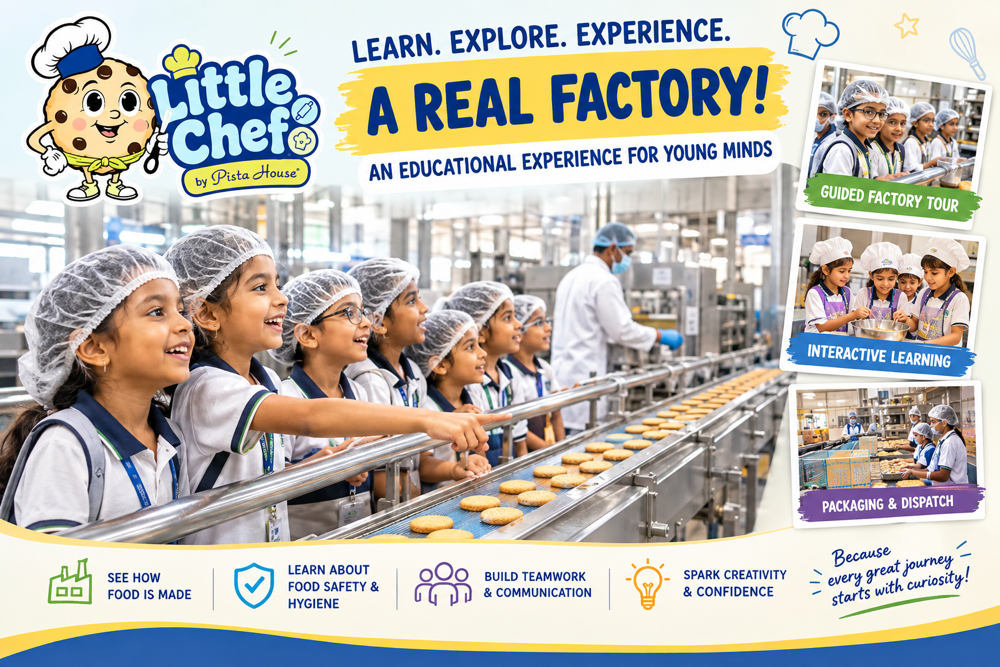
HYDERABAD: What happens inside a large food manufacturing facility before a biscuit or other bakery product reaches a store shelf? Little Chef by Pista House is giving schoolchildren an opportunity to see the answer for themselves through a structured factory experience at the Pista House facility in Shamshabad.
Designed as a school partnership programme, Little Chef takes students beyond the classroom and into a working production environment, where they can observe how ingredients are prepared, how products are made, how quality is maintained and how finished products are packaged and dispatched.
The initiative is built around the idea that children can learn differently when they are able to see a real process in front of them. Instead of simply talking about how food is produced, the programme allows students to explore selected areas of the Pista House factory and understand the journey from ingredients to finished products.
Inside a Working Food Factory
The Little Chef experience begins with a guided factory tour. Students are taken through selected areas of the facility under supervision and introduced to different stages of the operation.
The tour includes an opportunity to observe ingredient preparation, bakery production processes, quality-control practices, packaging operations, and dispatch and logistics systems.
For students, the experience offers a closer look at the amount of work that goes into producing and delivering the food products they see every day. It also introduces them to the different people, processes and checks involved before a finished product leaves the factory.
It Is More Than Just Watching
The programme is designed to keep students involved throughout the visit. Along with the factory tour, Little Chef includes interactive learning activities covering ingredients, food safety, basic baking principles and how different ingredients work together.
Students can participate in ingredient-discovery activities, food-safety games, question-and-answer sessions, team activities and fun bakery challenges.
The broader objective is to use the factory environment to introduce children to practical lessons in hygiene, food safety, teamwork, communication, creativity and confidence.
From Production to Packaging and Dispatch
One of the interesting parts of the experience is that students get to see that food production does not end when a product is made.
The programme introduces students to the packaging and dispatch process, showing how products are safely packed, correctly labelled, checked for quality and prepared for delivery.
This gives children a wider understanding of the journey a product takes inside a factory — from the initial ingredients and production process to quality checks, packaging and eventually dispatch.
Little Chef Adds a Memorable Touch
The factory experience also has its own set of activities designed to make the visit memorable for students.
Children can take part in a Little Chef oath, collect stamps during the Little Chef Factory Passport ceremony and participate in a graduation celebration at the end of the experience.
The programme also includes an applause tunnel as a celebratory send-off for participating students.
Every student receives an official Little Chef certificate, a Little Chef Factory Passport, a special Pista House cookie box and a group photo as part of the experience.
Designed for School Groups
Little Chef recommends 25 to 40 students per visit, with one teacher for every 20 students. The factory experience is designed to last approximately 90 to 120 minutes.
A complimentary meal is also provided to participating students. Learning materials and the programme’s take-home items are included as part of the visit.
Safety and Supervision
Since students are visiting a working factory, safety and controlled movement are an important part of the programme.
According to the programme details, children are provided with guided supervision throughout the visit, age-appropriate activities and hygiene-focused learning. Visitor movement is controlled, dedicated Little Chef coordinators assist with the programme, and teachers accompany students throughout the tour.
Making a Factory a Classroom
There is something different about seeing a production process in person. A classroom can explain how ingredients are transformed into a finished product, but walking through a real factory allows students to see the scale, organisation and different stages involved.
That is the space Little Chef is trying to occupy. The programme uses the Pista House factory in Shamshabad as a real-world learning environment, while keeping the experience engaging and accessible for schoolchildren.
It also gives students a chance to ask questions, participate in activities and understand concepts such as food hygiene and quality control in a setting where those practices are actually being followed.
An Experiential Learning Opportunity
For schools, the programme offers an alternative to a conventional field trip. Rather than simply visiting a facility, students are taken through a structured experience that combines factory exposure, interactive learning and activities designed around food production.
For Pista House, the initiative opens the doors of its manufacturing environment to students and gives them a closer look at the work behind the products they know.
At its heart, the Little Chef concept is simple: take children into a real factory, let them see how things work, encourage them to ask questions and turn that experience into a lesson they are likely to remember.
Little Chef by Pista House is inviting schools to participate in its school partnership programme at the Pista House Factory, Shamshabad, Hyderabad.
For a generation growing up around packaged food and increasingly technology-driven classrooms, getting to see a real production line up close can be a lesson in itself.