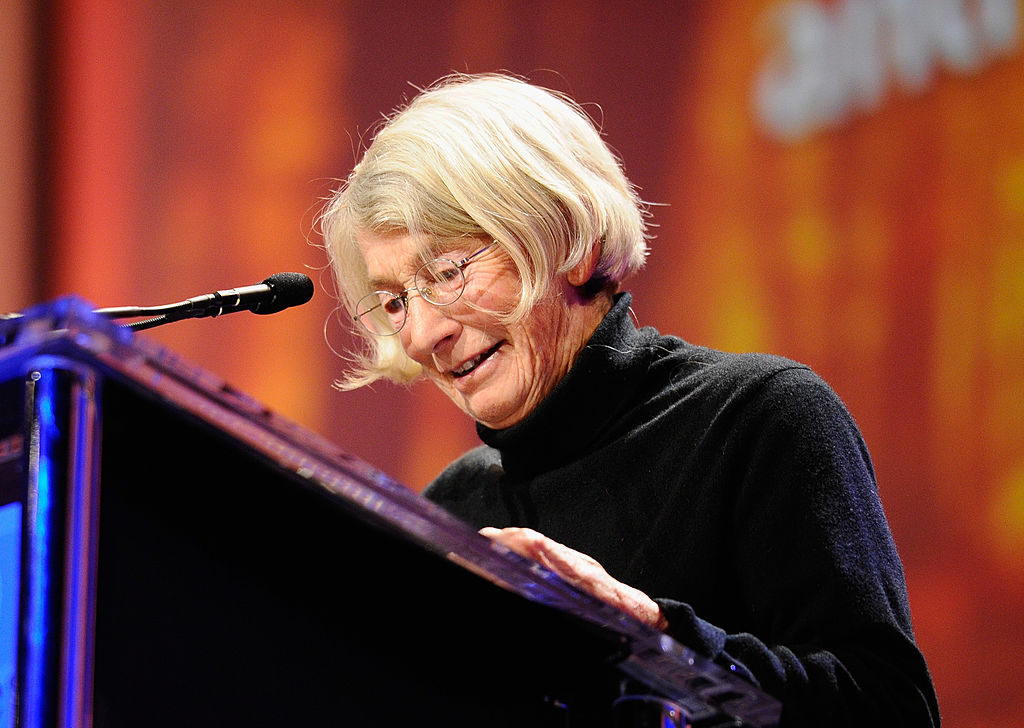
A new documentary Mary Oliver: Saved by the Beauty of the World reveals the complicated woman behind the beloved poetry—and the deeply feminist values she embodied, even if she never officially claimed the label.
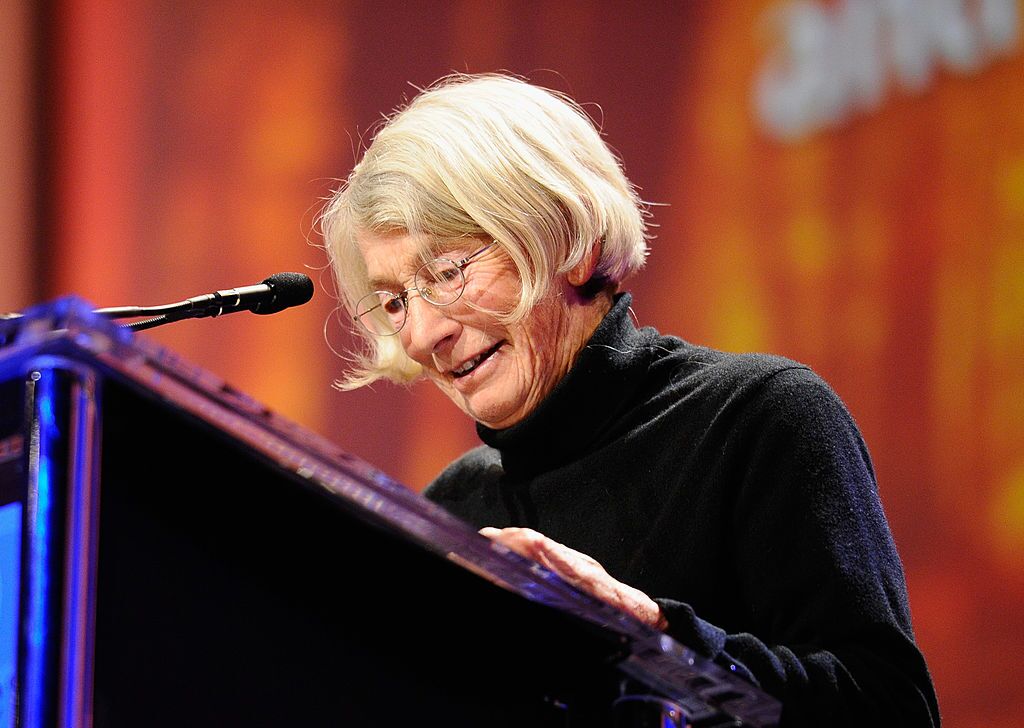
The day Mary Oliver died, I was sitting with my lifelong friends in my high school literature class. Nestled in the Sawatch Range in Colorado, we knew nature’s power well. We lived our lives by the snow on the mountain and the eventual rise and fall of the Arkansas river. The world was always beautiful to us because we were fortunate to be raised in a beautiful place. We loved the natural world—Oliver’s poetry reminded us that we belonged in it.
And now that I live in New York City, I cling to Oliver’s poetry like the muggy east coast summers stick to my skin. Her words remind me that nature exists everywhere. It lies in the pigeons who have never known wildness, in the swans on the East River and the cottonwoods as they turn yellow in the fall and even in the rain as it soaks the seemingly always damp sidewalk.
As a writer and poet, I am first and foremost a feminist. Oliver never claimed that same title. Whether or not she’d own that title today is more complicated.
A new documentary Mary Oliver: Saved by the Beauty of the World, directed and produced by Sasha Waters, presents Oliver with that often untapped complexity, hoping that more people will read her poetry with the poet behind it in mind.
Our enjoyment of the natural world is, in the long run, political.
Mary Oliver

“Particularly with older women, we kind of want to put them in this box, and Mary won’t stay in the box,” says Waters, who described herself as less of a documentarian and more of an artist.
From Pinterest boards to classroom walls, Oliver’s words have become popular in a way that most poets could only dream. People have even gone as far as to call her “Saint Mary.” But, Waters urges us to remember that there is a whole woman behind the words.
“I think there’s also this way in which she becomes a little flattened and one-dimensional through the way that she circulates now,” says Waters. “Understanding that she was very much a complicated person and woman until the end of her life is what I hope people take away from her.”
Oliver’s explosion of success came later in her life; she won the Pulitzer at 48 and didn’t start to go on tour until her 70s. She drew diverse audiences across the country as people fell in love with her writing.
The documentary tells this story. But it also tells the story of a layered person: a smoker and someone who struggled with an alcohol disorder later in life. She had a deep and intense relationship with her partner of 40 years, Molly Cook. After Cook’s death in 2005, she continued to look for love and companionship, both of which she found in complicated ways, according to her friends.
Oliver never agreed to be in anthologies that included only women writers or queer writers, resisting any kind of categorization. During the time Oliver was writing—she published her first poetry book in 1963—poetry editors and reviewers were almost all men. That said, she never made any attempt to hide who she was. Oliver was always out and in queer relationships, it is just perhaps not what she wanted to be known for.
“It was shocking. I was a girl in Ohio and I wanted to write poems. Unheard of, even boys didn’t do that,” said Oliver.
“I think she wants to be accepted on her own terms, and her own terms are her own terms, but they are also embedded in the structure of the society that we inhabit,” says Waters.
In the documentary, Oliver’s friends say that she was a feminist even though she never called herself one. She did, however, see the world through a feminist lens.
“All of her values were deeply feminist, but she would never have called herself a feminist. I think there is this way in which dominant culture is by default a patriarchy, and at some level we internalize that no matter what. It’s just the air that we breathe,” says Waters.
A Symbol of Independent Thought
Oliver’s poetry and story can not exist outside of its own cultural moment. In a time of so much division—that which targets women and queer people disproportionately—she was aware of what her poetry and her life story had to offer. She may not have been a lesbian activist, but she was a beacon of hope for young people—a symbol of independent thought and living.
With the exception of abortion rights, women have made enormous strides both professionally and politically since Oliver emerged as a writer. Since then, feminism’s popularity has grown significantly, with over 60 percent of women in the U.S. identifying as feminist.
“It is really important for these stories to be embedded in their political and historical moment, because we can’t take anything for granted. Clearly, we can’t take any of our rights for granted. I mean [women] are not even citizens in more than half of the country. If [Oliver] had seen that, or could imagine that maybe she would feel differently now,” says Waters.
Connecting to a More-Than-Human World
While Oliver’s poetry holds its own place amongst queer communities, it overlaps too with environmental ones. She has a way of connecting her readers to a more-than-human world. She reminds us, poem after poem, that we not only belong in our community, but we belong in the world—in spite of society’s constant removal from nature.
The ability to take up space in outdoor communities is something that women have historically been excluded from. Oliver reminds women a positive relationship with the earth does not always come from treading lightly. We should instead dig our heels into the mud and play in the wet and messy landscapes.
In the midst of an anthropogenic climate crisis, Oliver’s poetry has found a new home, reminding us that even a wounded world holds us, cares for us and loves us.
“The best poems that are rooted in the natural world remind us over and over again that we are one family—not just one human family, but literally one planet of living beings on the earth,” says Waters.
“We’re all better people for literature, meanwhile the world burns,” said Oliver, quoted in the film. “Our enjoyment of the natural world is, in the long run, political.”
There is “ongoing devastation of the earth, which we need both spiritually and materially,” lamented Oliver, “and we’re not dealing with it. I worry about little children. Are they going to know what the earth looked like?”
Doesn't everything die at last, and too soon?
Tell me, what is it you plan to do
with your one wild and precious life?
—Mary Oliver
Poetry as a Tool for Change
Oliver also wrote poems that can be read through the lens of power, who has it and how people choose to use it.
Jason Raynolds, author and MacArthur fellow interviewed in the documentary, points to the poem, “Was It Necessary to Do It?” about an ant being stepped on.
“So many people that I know know what it is to be the ant—whether it’s people of color in this country, whether it’s women, whether it’s folks from the LGBTQIA+ community, whether it’s disabled people. And the assumption is, that either the ant does not exist because it is not seen or that the ant is easy to kill. … The ant is not dead. It is fighting for its life.”
Oliver’s poetry has a way of reminding me of the beautiful world feminists imagine—a world where we all belong, where we all flourish. When the skies turn dark and the seas get rough, her words remind me of what and who I’m fighting for. They have carried me through graduations, celebrations of life, and nights spent under the stars.
Oliver knew what it was like to exist in a world not built with her rights in mind. Poet David Keplinger said, “The last thing that she said was ‘no moping.’ … You could look at the underlying message here, no moping: Meanwhile the world goes on.”
Mary Oliver: Saved by the Beauty of the World is available for streaming on: