Retired NBA player, Enes Kanter, declares himself for WNBA Draft

Former NBA Center’s Announcement Challenges League’s Self-Identification Framework
Enes Kanter Freedom has declared himself a WNBA prospect, challenging the league’s eligibility rules by citing its framework around self-identification and inclusion. The was posted to X by Kanter. Now, it has accumulated over 18 million views. In addition, it has stirred debate about the intersection of gender identity and competitive sports.
The former NBA center played 11 seasons in the league. He stated that he meets every requirement to compete in the WNBA under its current guidelines. So, he framed the declaration as a test of consistency rather than a personal transformation, calling for the rules to be applied equally to everyone.
A Formal Declaration, A Calculated Challenge
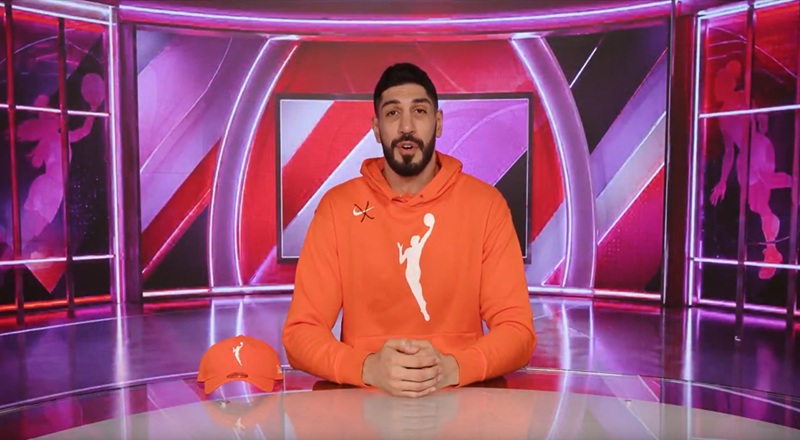
Freedom appears in a controlled studio environment wearing an orange hoodie featuring a WNBA logo, with a matching cap placed on the desk in front of him. The professional sports-broadcast-style set includes neon lighting and basketball silhouettes, presenting the statement in a formal, league-adjacent production context.
He begins by stating that after careful consideration and reviewing the current eligibility guidelines, he is officially declaring himself a WNBA prospect. Enes asserts that if simply declaring who you are is all that is required, then he meets every single requirement necessary to compete in the league.
He explains that his team and he have carefully examined the WNBA’s eligibility criteria and governing framework surrounding self-identification and inclusion. Based on the current guidelines, he can and is officially declaring his eligibility for the upcoming WNBA draft in April 2027.
The Closing Shot That Got Attention
Freedom acknowledges that his presence on the court will stir up strong opinions. He states that he is definitely not here to mock, make fun of, or disrespect any community or personal choices. He explains that he is simply asking that the current rules be applied equally to everyone.
Enes adds that his team and he are prepared to ensure these guidelines are applied equally, consistently, and without exception. With that said, he looks forward to the WNBA honoring its stated principles. He concludes with “See you at training camp.”
The rhetoric is formal, deliberate, and structured as a logical challenge rather than an emotional appeal. Key claims center on the sufficiency of self-declaration under existing guidelines, the existence of a governing framework for self-identification and inclusion, equal application of rules, and alignment with values publicly supported by WNBA participants.
What the League’s Contract Actually Says
WNBA eligibility is governed by its collective bargaining agreement. Article XIII, Section 1(a) states that only players who are women are eligible to play in the WNBA. The document does not define “woman.” Additionally, it does not reference gender identity, self-identification, hormone criteria, or a separate transgender policy. Also, it contains no clause granting eligibility solely through declaration.
Draft requirements also include age thresholds and education or professional-eligibility criteria. No biological male has played in the WNBA. The league has not issued a public response to Freedom’s announcement as of press time.
The declaration places the league’s stated eligibility language under direct public scrutiny by testing whether self-identification language can be applied uniformly or whether biological sex remains the operative criterion in practice. Because the CBA limits eligibility to “women” without further definition, the announcement highlights a potential gap between public advocacy for inclusion principles and the formal contractual text.
The Debate That Preceded This Moment
What led to the declaration from Kanter Freedom is the ongoing public discussion of transgender athlete participation in women’s sports. It has intensified within the WNBA by comments from Indiana Fever guard Sophie Cunningham. In her recent ESPN profile, Cunningham stated she wanted to protect young girls in locker rooms and in sport who should not have to compete against biological men.
These remarks prompted fan protests and rallies at Fever games. In addition, there were public responses from figures such as Minnesota Lynx coach Cheryl Reeve, and media coverage framing the issue as a distraction from on-court play. Cunningham has since called for renewed focus on basketball.
Freedom’s announcement functions as a consistency challenge rather than a formal draft entry process. League offices and teams retain discretion over recognition of prospects, and age or prior professional status would not automatically qualify a player even under broader interpretations.
X Responds to the Announcement
Enes Kanter Freedom’s post rapidly gained high engagement, exceeding 18 million views, more than 130,000 likes, and over 13,000 reposts within hours. Reactions skewed heavily toward approval among users critical of transgender inclusion in women’s sports categories.
Riley Gaines posted “Thank you @WNBA for allowing this to happen.” This aligned the announcement with her advocacy on sex-based categories in sports. Michele Tafoya stated “The ball is in your court, @WNBA.” Congressman Greg Murphy and Senate candidate Andy Barr referenced the announcement in the context of protecting women’s sports.
Eric Daugherty’s post describing the league as “stunned” and highlighting physical metrics. Meanwhile, he also called the move a “masterclass” received tens of thousands of likes. Other viral commentary included sarcastic endorsements treating Freedom as already transitioned for rhetorical effect.
Critical or dismissive reactions characterized the move as a publicity stunt, mocked the seriousness of the claim, and rejected the premise that self-declaration alone confers eligibility. Neutral posts focused on the formal CBA language and the distinction between social-media declaration and actual draft procedures.
Final Thoughts
The declaration places the WNBA’s stated eligibility language under direct public scrutiny. Any formal response from the league—clarification of rules, non-response, or legal engagement—would be interpreted against the backdrop of Title IX history, recent state and federal policy shifts, and athlete testimonies on both sides of the issue.
Potential consequences include intensified media and political attention on the league’s governance, possible legal challenges if eligibility decisions are framed as discriminatory, effects on fan engagement and sponsorship amid polarized public opinion, and precedent-setting pressure on other sports organizations.
The episode intersects with broader cultural and political divides over the definition of sex and gender, the role of professional athletes as advocates, and the enforcement of rules in environments that publicly emphasize equity and inclusion.