A panel at Advantech’s Edge AI Conference made the case that the gap between promising pilot and production rollout is where the real engineering work begins.
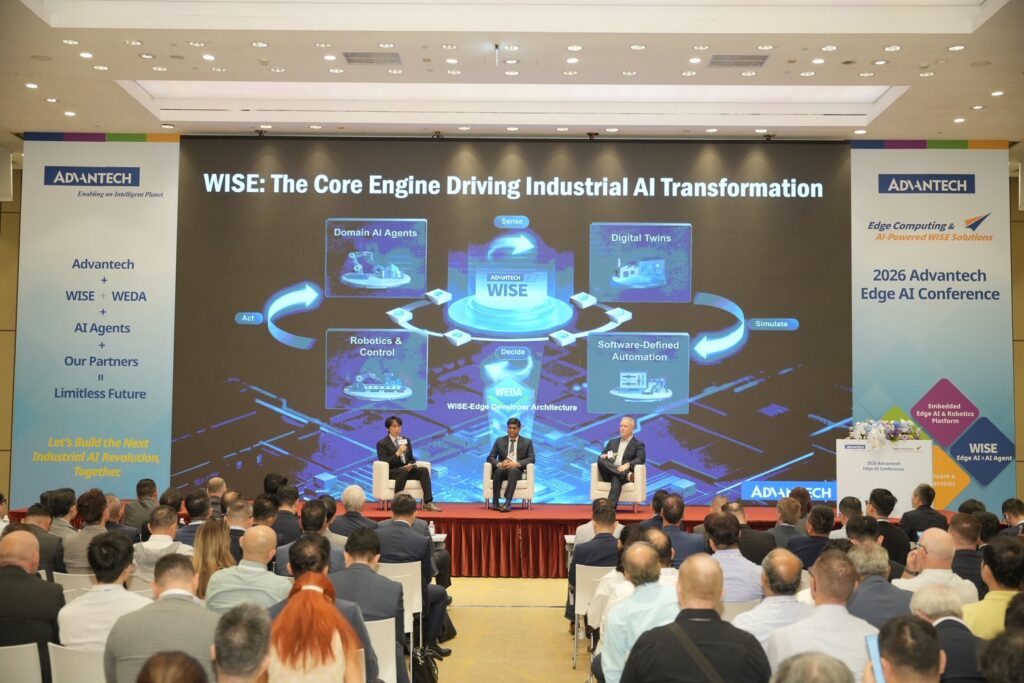
The phrase “edge AI” gets thrown around a lot, but there’s a version that matters to engineers building real-world systems, and it looks nothing like a research demo. At Advantech’s recent Edge AI Conference, a panel featuring Ed Doran, PhD, VP of Strategy at the Edge AI Foundation; Umang Garg, Managing Director at Nagarro; and Richard Huang, Chief Software Architect at Advantech, spent just about 30 minutes cutting through the hype. The result was one of the more technically grounded conversations on edge deployment I’ve heard lately.
Doran opened with a framing worth keeping. Edge AI isn’t just “AI running somewhere other than a data center.” It’s the extension of centralized intelligence into environments defined by real constraints: limited bandwidth, tight power budgets, hard latency requirements, and security boundaries that make cloud connectivity either impractical or unacceptable. That means the shipping container packed with inference hardware sitting outside a mine in Western Australia. It means a vehicle making safety-critical decisions with a degraded radio link. It means a surgical suite where patient data cannot leave the room. Each of those scenarios demands something different from the AI stack, and that diversity is both what makes edge AI valuable and what makes it genuinely difficult to build.
“It’s really hard to do edge AI in that shipping container,” Doran said. “It’s really vital to do edge AI well in the surgical suite.” The implication is that edge AI is not one problem. It’s dozens of constrained optimization problems sharing a name.
That complexity deepens when you layer in physical AI, the convergence of edge AI with robotics, digital twins, and autonomous systems operating directly in the physical world. Physical AI isn’t just processing data at the edge; it’s closing the loop between perception, decision-making, and real-world action in environments where the stakes are high and the tolerance for latency or error is low. It’s what moves edge AI from passive inference into active, embodied intelligence, and it’s where much of the architectural discussion at the session ultimately landed.
That’s part of why Garg’s contribution was useful. Nagarro works across more than 20 countries on industrial edge deployments, and his read on why pilots stall is empirical rather than theoretical. His team has catalogued more than 60 distinct failure points across the journey from proof-of-concept to production rollout. The short list includes the usual suspects: ROI modeling, feasibility assessment, scalability planning. But the ones that kill deployments tend to cluster around solution strategy and enterprise integration. Choosing whether to build custom software, use off-the-shelf tooling, or deploy configurable accelerators isn’t a procurement question, it’s an architecture decision that determines whether you can scale from one facility to 50.
Edge AI is not one problem. It’s dozens of constrained optimization problems sharing a name.
Garg walked through a machine manufacturer case study that illustrated the gap between pilot success and production reality. The customer had been in business for 400 years, operated roughly 250 machine types, and dealt with equipment that could have a 25- to 30-year field life. Machines deployed in the last decade often lacked modern sensor capability, meaning engineers had to physically travel to diagnose failures. The solution layered in edge-based predictive analytics alongside a parallel stream of real-time telemetry, using AI throughout the development process itself. What typically took six months compressed to about six weeks. The rollout now covers 11 machine types across 200 customers, with predictive maintenance running entirely on the local edge device.
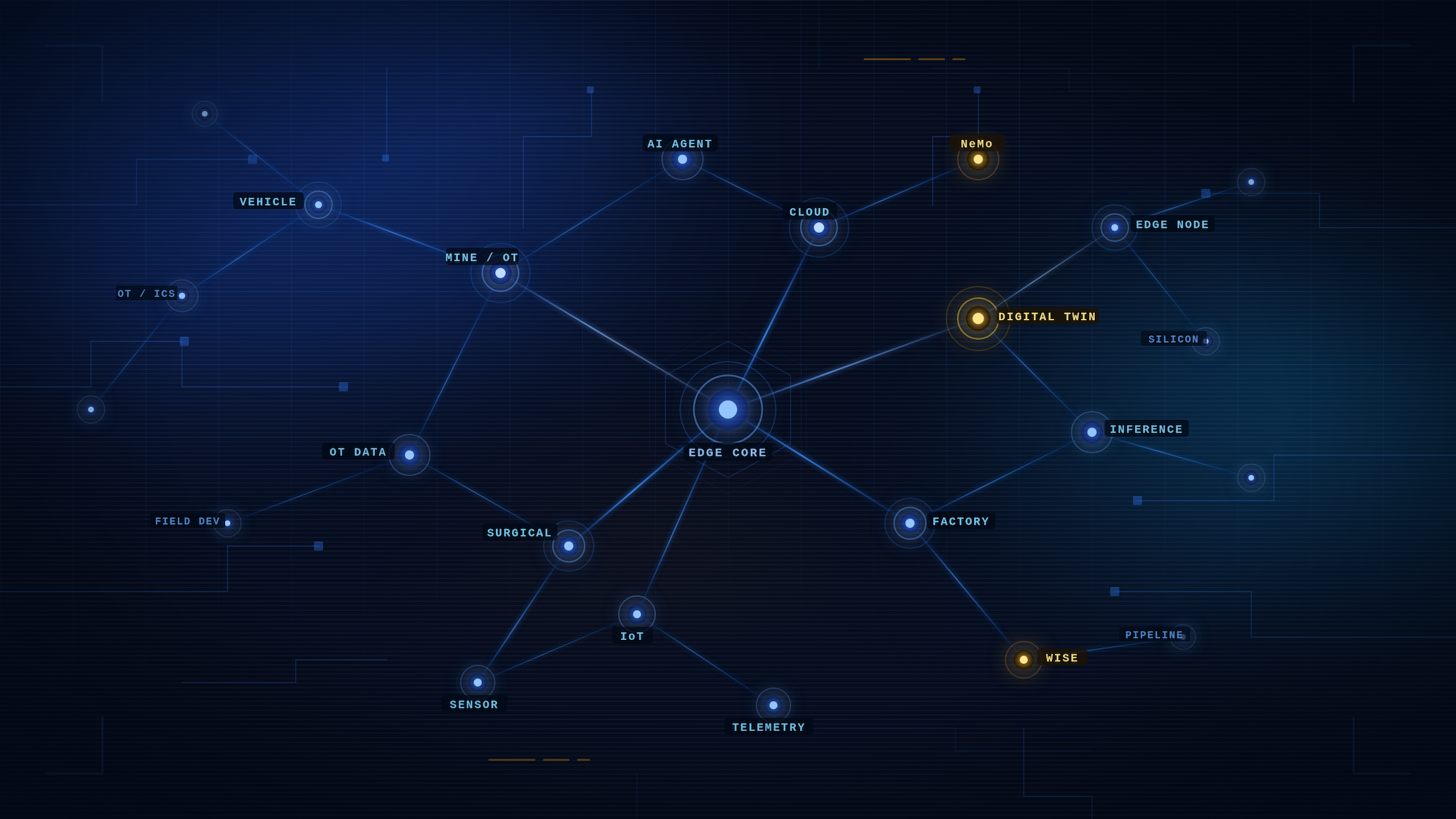
On the architecture side, Huang walked through the cross-platform challenge in practical terms. Edge deployments span a range of silicon targets, from Intel and NVIDIA to NXP and Rockchip, and moving an inference application between them is not trivial without an abstraction layer. Advantech’s WISE platform (Wireless IoT Sensing Embedded) addresses this through containerized, pre-validated AI workloads that handle platform migration overhead. It also extends traditional OT data handling beyond numeric streams, supporting image data, binary payloads, and tagged datasets through digital twin protocols, so the same data can be consumed on the edge or passed to the cloud without re-engineering the pipeline. Model lifecycle management and zero-touch device onboarding round out the stack, addressing most of the infrastructure friction that burns development cycles before a single line of application logic gets written.
The AI agent layer sits on top of all of this, and it runs on NVIDIA NeMo, an agent-first, open suite of libraries with built-in skills for accelerating AI agent specialization, optimization, and governance. NeMo integrates with existing AI tools and agent frameworks to optimize specialized agents across cloud, on-premises, or hybrid environments, which maps directly to the deployment diversity Doran described at the session’s open.
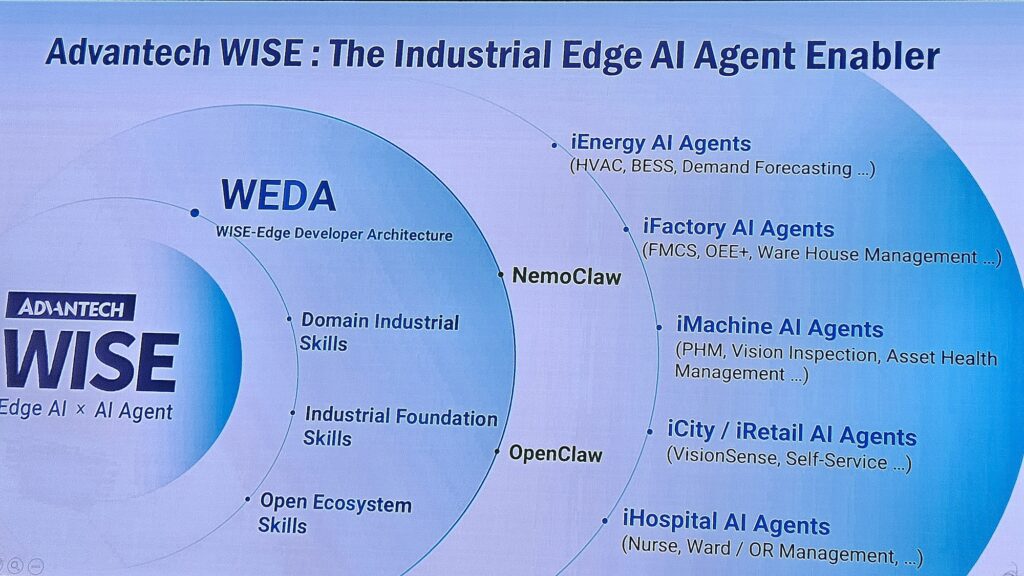
The panel closed on AI agents more broadly, and Doran’s framing was blunt: intelligence without action has no value, and action without intelligence is a liability. The two are not sequential, they’re codependent. Edge AI enables agents to act with low latency and high reliability in environments where cloud roundtrips are not viable, but the outcomes those agents produce will also feed the next generation of edge models. The loop is already running. The question isn’t whether to start building agents into industrial stacks. It’s how to build them stably enough to trust in the field.
That’s the part none of the tooling fully solves yet. But the conversation suggests the pieces are closer to assembly than they were two years ago.
Filed Under: AI Engineering Collective, Communications, Featured