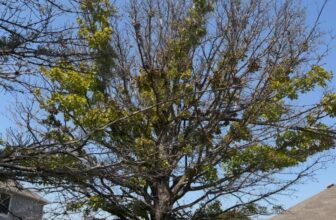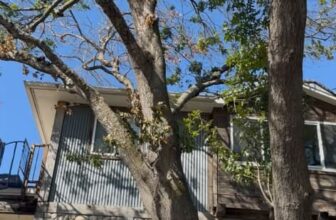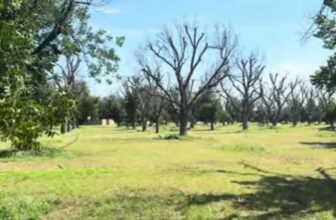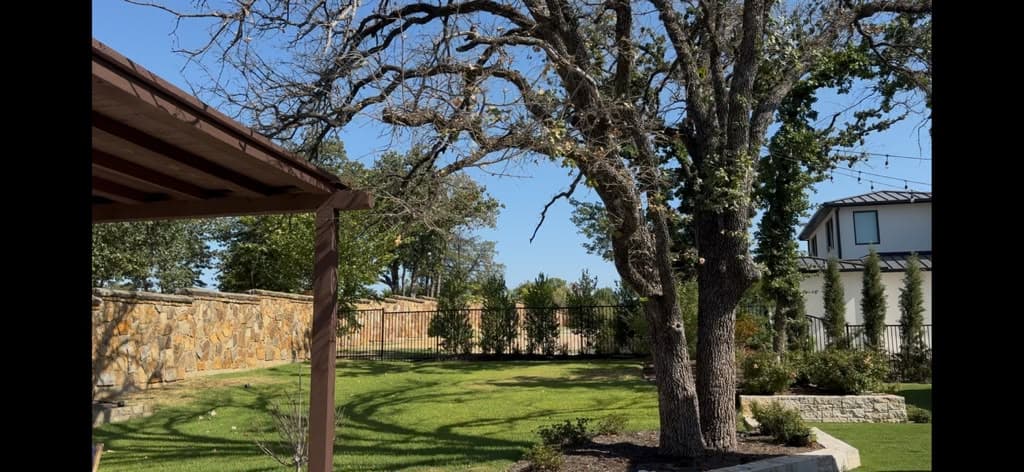
Today we’re here in Southlake, Texas, inspecting a mature Savannah Post Oak (Quercus stellata) that has suffered significant construction trauma following major changes to the property.
This is one of the most serious types of tree damage we evaluate because much of the injury has already occurred below ground. By the time the homeowner begins noticing leaves dropping, canopy thinning, or branches dying, the original root damage may have happened months—or even years—earlier.
On this property, contractors entered the tree’s critical root zone during construction and severed major structural and absorbing roots. The surrounding landscape was then modified further with artificial turf, while other trees on the property experienced changes in soil grade.
Now we’re beginning to see the consequences.
The Savannah Post Oak is losing significant amounts of foliage and showing signs of severe physiological stress. But canopy decline is only part of my concern.
When major structural roots are removed from one side of a mature tree, we also have to consider mechanical stability.
Those roots don’t simply absorb water.
They help anchor a massive living structure into the ground.
Once enough anchorage is lost, a severe windstorm, saturated soil event, or other extreme weather event could potentially result in partial root-plate failure or complete uprooting.
When homes, vehicles, roadways, pedestrians, or other high-value targets are within the potential impact zone, construction damage becomes both a tree-health problem and a tree-risk problem.
Construction Damage Often Begins Before Anyone Notices
One of the most dangerous misconceptions about construction trauma is expecting a damaged tree to immediately turn brown.
Trees don’t always respond that way.
A mature Post Oak contains stored carbohydrates and an extensive vascular system that may allow it to continue producing foliage after substantial portions of its root system have already been damaged.
The tree can essentially survive for a period of time on its remaining biological resources.
That creates a false sense of security.
The house gets completed.
The landscaping gets installed.
The tree remains green.
Everyone assumes the tree survived construction.
Then several growing seasons later, the canopy begins thinning.
Dead branches appear.
Leaves become smaller.
Premature leaf cast develops.
The homeowner naturally asks:
“Why is my tree suddenly dying?”
But the tree may not have suddenly started declining.
The decline may have started the day heavy equipment entered the critical root zone.
What Is the Critical Root Zone?
The critical root zone is the area surrounding the tree containing a substantial portion of the roots necessary for water absorption, nutrient uptake, respiration, carbohydrate storage, and structural support.
One of the biggest mistakes made during construction is thinking the tree’s roots exist primarily underneath the trunk.
They don’t.
A mature oak develops an extensive lateral root system extending outward through the surrounding soil.
Many of the physiologically active absorbing roots occupy the upper portions of the soil profile where oxygen is readily available.
That means excavation, trenching, grading, compaction, concrete installation, utility work, driveways, retaining walls, and landscape modifications can all affect roots far away from the trunk itself.
Protecting the trunk while destroying the root system does not protect the tree.
Major Anchorage Roots Were Severed
The most concerning finding on this Southlake property is the removal of major roots during construction.
Large structural roots perform an entirely different function from the small absorbing roots farther out in the soil.
They help physically anchor the tree.
Think about the engineering involved.
A mature Savannah Post Oak may support thousands of pounds of trunk, branches, and foliage above ground.
Wind pushes against that canopy like a giant sail.
Those forces are transferred downward through the trunk and into the root system.
The structural roots distribute those forces into the surrounding soil.
When contractors excavate through major roots, they aren’t simply cutting off part of the tree’s water supply.
They may also be changing the structural foundation supporting the entire tree.
Root Loss Creates Two Separate Problems
After major root severance, I evaluate two different questions.
Can the tree remain biologically functional?
And:
Can the tree remain structurally stable?
Those are not necessarily the same question.
A tree can remain alive while simultaneously becoming less mechanically stable.
The canopy may remain green while the root system has lost part of its anchorage.
That distinction becomes extremely important when evaluating trees around high-value targets.
Why Uprooting Becomes a Concern
A mature tree remains upright because of the relationship between the root system, soil strength, trunk architecture, canopy distribution, and environmental forces.
Remove a substantial portion of the structural root system and that relationship changes.
Now introduce:
- High winds
- Severe thunderstorms
- Saturated soil
- Extreme weather
- Increased canopy loading
and the forces acting against the remaining root system increase dramatically.
Saturated soil is particularly concerning because soil strength and root anchorage conditions can change when the soil becomes heavily waterlogged.
This does not mean that every tree with a severed root will uproot.
But it absolutely means that significant structural root loss deserves careful evaluation and continued monitoring.
When the potential failure zone contains a house, vehicles, people, or other valuable property, the consequences of failure become substantially greater.
Artificial Turf Creates Another Root-Zone Challenge
After the construction damage occurred, artificial turf was installed around portions of the root environment.
This creates another concern.
Tree roots are living organisms.
They require oxygen.
The soil beneath a healthy tree contains microscopic pore spaces containing both air and water. Oxygen moves through those pore spaces and becomes available for root respiration.
When the soil surface is heavily modified, especially following construction compaction, normal soil-atmosphere gas exchange and water movement can be altered.
For a tree whose root system has already been compromised, additional changes to the soil environment can compound the original injury.
This is what I call a cascade of stress events.
One problem begins the decline.
The next problem makes recovery harder.
Then another stress is added.
Eventually the tree’s biological system can no longer compensate.
Construction Compaction Can Be Just as Destructive as Excavation
Heavy construction equipment doesn’t necessarily have to cut a root to injure it.
Simply driving repeatedly across the root zone can dramatically change soil structure.
Healthy soil contains pore space.
Compaction compresses those pores.
As soil density increases:
- Oxygen diffusion decreases
- Water infiltration changes
- Root elongation becomes more difficult
- Fine-root production declines
- Biological activity can be disrupted
The tree may still have roots underneath the equipment tracks, but those roots are now attempting to function in a dramatically different environment.
A tree cannot move away from construction trauma.
It must survive with whatever root environment remains after construction is finished.
Soil Grade Changes Affect the Other Post Oaks
The other Savannah Post Oaks on this property also deserve attention because portions of their original soil grade have been changed.
Changing grade around an established tree can be extremely disruptive.
Adding soil above an existing root system can bury roots deeper than the environment in which they originally developed.
That additional soil can change:
- Oxygen availability
- Moisture movement
- Soil temperature
- Drainage
- Root respiration
Removing soil can be equally damaging because roots may be physically removed, exposed, or placed into a dramatically different moisture environment.
A mature native oak has spent decades adapting to a particular soil profile.
Changing that profile during construction forces an established biological system to suddenly function under completely different conditions.
That is one reason the surrounding trees may not look as healthy following construction.
Why the Tree Is Beginning to Lose Its Leaves
The canopy symptoms we’re seeing today are the above-ground expression of what has already happened below ground.
Leaves require a continuous supply of water.
Water enters primarily through the absorbing root system and moves upward through the xylem into the canopy.
When significant portions of the root system are lost or impaired, the remaining roots must attempt to support the same massive canopy.
During a Southlake summer, that becomes an enormous physiological challenge.
As temperatures climb, transpiration demand increases.
The canopy is losing water while the compromised root system struggles to replace it.
Eventually the tree begins reducing demand.
One of the ways it does that is by dropping foliage.
Premature Leaf Cast Is a Survival Response
When a severely stressed Post Oak begins shedding leaves during the growing season, the tree is attempting to reduce the amount of water it must support.
Fewer leaves mean reduced transpiration.
But there is a major tradeoff.
Fewer leaves also mean less photosynthesis.
Less photosynthesis means fewer carbohydrates.
And carbohydrates are the energy currency that keeps the tree alive.
They support:
- Root growth
- New foliage
- Defense responses
- Compartmentalization
- Vascular maintenance
- Recovery from injury
The tree begins consuming stored carbohydrate reserves to compensate for what the remaining canopy can no longer produce.
That is why severe defoliation in a mature Post Oak concerns me tremendously.
Once the tree begins losing both roots and foliage, the biological equation becomes increasingly difficult to reverse.
Construction Damage Can Have a Long Fuse
This is the part every property owner, builder, landscape architect, and general contractor needs to understand:
Construction damage does not always show up immediately.
A mature tree can continue functioning after root injury because it possesses stored energy reserves and a large existing vascular system.
But those reserves are finite.
As damaged roots decline and carbohydrate reserves are consumed, canopy symptoms may gradually become more apparent.
Depending on the severity of the damage, species, weather, remaining root system, and subsequent site conditions, construction-related decline may become apparent years after the original project.
That delayed response is exactly why someone can build a beautiful new home, preserve several mature trees during construction, and then begin losing those same trees several years later.
The original injury may have happened before the homeowner ever moved into the house.
Some Construction Damage Cannot Be Reversed
There is an important distinction between stress that can be mitigated and physical damage that cannot be undone.
We can improve soil conditions.
We can manage irrigation.
We can reduce competing vegetation.
We can improve organic matter.
We can support remaining root function.
We can monitor the canopy.
What we cannot do is reconnect a major structural root that was excavated and removed.
Once that root is gone, it is gone.
The tree may produce new roots over time, but those new roots do not instantly recreate the original mature structural architecture.
This is why prevention before construction is so much more valuable than remediation afterward.
Why an Arborist Should Be Involved Before Construction Begins
The best time to protect a mature Post Oak is before the first piece of heavy equipment arrives.
Not after the driveway has been poured.
Not after utilities have been trenched.
Not after the grade has been changed.
Not after the roots have been severed.
Before construction begins, an Arborist can evaluate the existing trees and help the property owner determine which specimens are realistic candidates for preservation.
From there, a tree-protection strategy can be incorporated into the construction plan.
That may include establishing protected root zones, restricting equipment traffic, determining acceptable locations for utilities, preventing material storage beneath trees, protecting existing grade, and coordinating landscape installation around preserved specimens.
That conversation can potentially save decades-old trees.
Tree Protection Needs to Be Part of the Construction Plan
Tree preservation cannot be an afterthought.
If mature trees are important to the finished property, they need to be treated as existing infrastructure.
The house has a plan.
The electrical system has a plan.
The plumbing has a plan.
Drainage has a plan.
The trees should have a plan too.
Once a mature Post Oak’s critical roots are destroyed, there may be no treatment capable of returning that tree to its original condition.
The most effective construction-trauma treatment is preventing the trauma from occurring in the first place.
Our Approach Moving Forward
For the surviving Savannah Post Oaks on this Southlake property, our objective is now mitigation and monitoring.
The remaining root systems need the best possible environment we can provide.
That means evaluating:
- Soil compaction
- Existing grade
- Root flare condition
- Irrigation
- Drainage
- Artificial turf placement
- Remaining canopy density
- Structural stability
- Continued leaf loss
Plant Healthcare may help support the physiological function that remains, but it cannot replace major structural roots that were physically removed.
That distinction is extremely important when setting realistic expectations.
Final Thoughts
These Savannah Post Oaks in Southlake, Texas provide an important lesson about new home construction and mature tree preservation.
What happens below ground matters just as much as what happens above ground.
Contractors severed major roots within the critical root zone.
Artificial turf changed the root environment.
Construction activity compacted soil.
Other trees experienced changes in grade.
Now the canopy is beginning to tell us what the root system has already experienced.
Leaves are dropping.
Tree vigor is declining.
And because major anchorage roots were removed, structural stability must also remain part of the conversation.
Some construction injuries can be mitigated.
Others are permanent.
And some may not reveal their full consequences until years after construction has ended.
If you are planning a new home, addition, swimming pool, driveway, utility installation, retaining wall, or major landscape renovation around mature trees, involve an Arborist before construction begins.
The cost of planning around a mature tree is usually insignificant compared with the value of losing a tree that took generations to grow.
At Arborist USA, we would much rather protect a healthy tree before construction than explain five years later why that tree can no longer be saved.
For general tree-care best practices, homeowners can also reference guidance from the Texas A&M Forest Service, https://tfsweb.tamu.edu/trees/, a trusted authority on Texas tree health.
Schedule a professional inspection. Early detection and scientific intervention are the difference between preservation and loss. If you’d like to speak to an arborist, please call us at 817-880-6130 or visit https://www.arboristusa.com/
Today we’re in Southlake, Texas inspecting a mature Savannah Post Oak (Quercus stellata) suffering from severe construction trauma after major portions of its critical root zone were disturbed during new home construction.
The damage we’re seeing today started underground.
Contractors excavated within the critical root zone and severed major roots responsible for both water absorption and structural anchorage. Artificial turf was also installed over portions of the root system, while soil grades around other mature Post Oaks on the property were changed.
Now the trees are beginning to respond.