By Bjorn Fehrm: Aerospace Analyst
October 16 2026
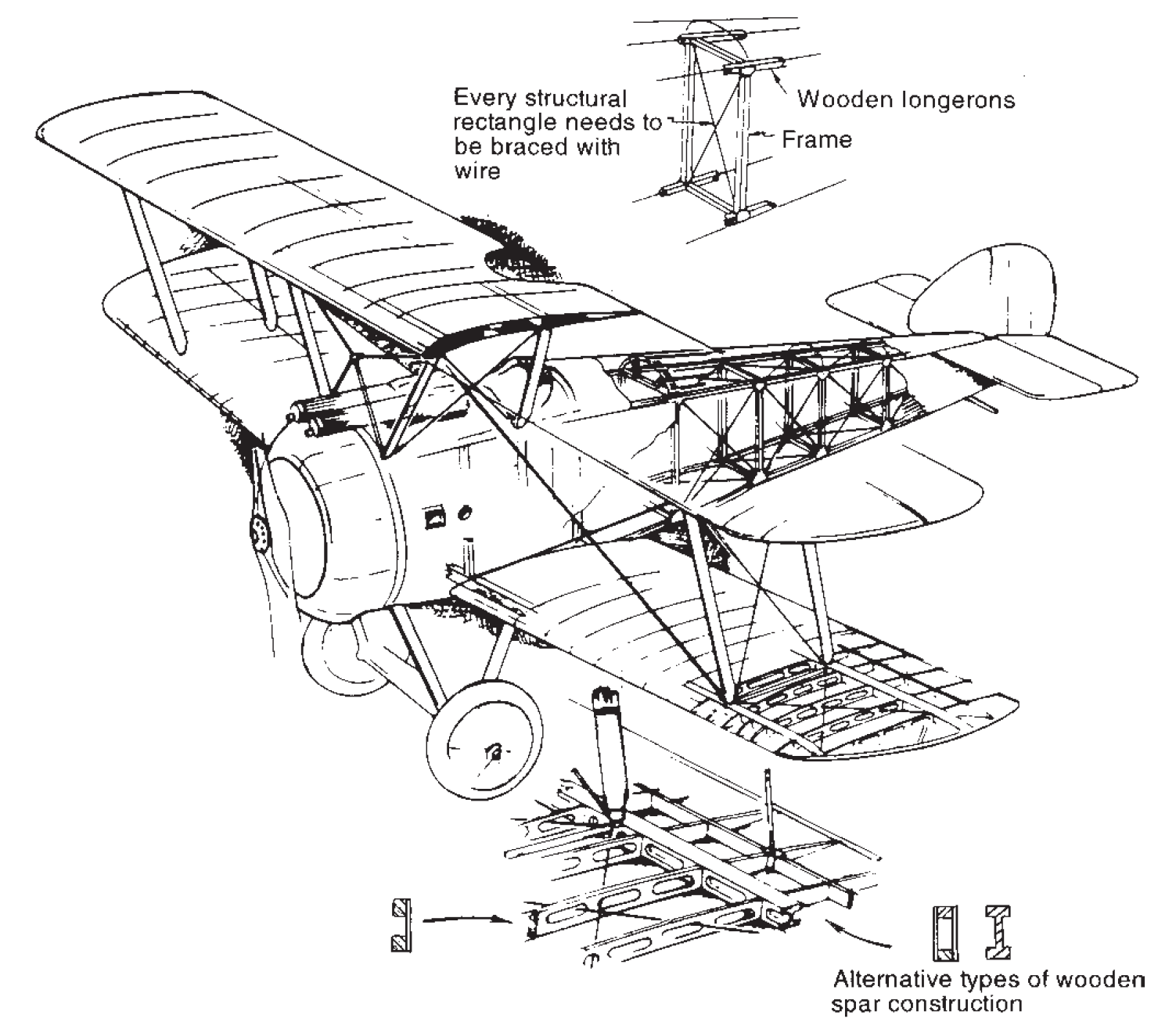
After 22 parts and five months, it’s time to summarize what we have covered in our aircraft structures series. We started with aircraft structures that were skeleton-like and then covered with fabric to create a smooth aerodynamic surface (Figure 1).
This was how gliders and motored aircraft were built before and through the First World War and up to just before the Second World War, when the advent of the high-strength Duralumin created a skin that could be reinforced and absorb aerodynamic, engine, and other forces.

Figure 1. The Sopwith Camel structure. Photo credit: Understanding Aircraft Structures by Cutler.
The development of the stressed skin structure
A good example of the crossover from skeleton structures to stressed-skin structures is the Hawker Hurricane, designed just before World War two. Its conservative design combined a braced skeleton fuselage and wing structure with a stressed-skin leading edge (Figure 2). The wing was gradually developed into a more stressed-skin structure with each version of the Hurricane.

Figure 2. The Hawker Hurricane structure. Photo credit: Understanding Aircraft Structures by Cutler.
The structurally more modern Supermarine Spitfire outlasted the Hurricane with its all-stressed-skin duralumin design, as its stronger build principle allowed it to be upgraded with engines that produced over 2,000 hp by the end of the war (the Hurricane and Spitfire started with Rolls-Royce Merlin engines producing less than 1,000 hp).
The parade example of an outstanding stressed-skin aircraft is the Douglas DC-3, designed in the 1930s using Alclad 2024-T3 duralumin (Figure 3). It’s a 2024 alloy core metallurgically bonded with a thin layer of pure aluminum. The cladding provides exceptional corrosion resistance for duralumin variants that otherwise have some corrosion problems.

Figure 3. The Douglas DC-3 structure, with the stringer and frame lattice reinforcement of the fuselage skin highlighted. Photo credit: Wikipedia.
During WWII, alloying elements in duralumin variants like 2024 were scarce (mainly copper, Cu), so engineers tried other elements. With Zinc, engineers developed an even stronger alloy, now called the 7000 series. It had hidden problems, like stress corrosion, that caused wings to fall off aircraft in the late 1940s and early 1950s.
The introduction of pressurized cabins to allow higher cruise altitudes with turbocompressed piston engines, gas turbine turboprops, or jets brought a major metal-fatigue problem, as the aluminum fuselage structure was stress-cycled on every flight.
The first commercial jet airliner, the De Havilland Comet, had nasty crashes in the mid-1950s that led to a large investigation revealing the airframe’s fatigue life was about a tenth of the estimated and tested life (Figure 4).

Figure 4. Rupture of the tank-tested fuselage around the port escape hatch. Photo credit: Wikipedia.
The fatigue tests were done on structures previously used for ultimate load testing (150% of the highest in-service loads). They hid the fuselage’s vulnerabilities by cold-working sensitive areas before the fatigue tests. This lesson and research led to the first predictive material fatigue models in the early 1960s. Fatigue has been a primary focus of structural design since.
Understanding the sources of fatigue cracks and the fatigue sensitivities of different aluminum alloys led to the creation of a large array of alloys and their heat treatments (tempers). The Boeing 777 alloy choices are a good example of modern airliner structural alloy selections (Figure 5).

Figure 5. The choice of aluminum alloys for the Boeing 777. Photo credit: Boeing.
Composite structures
The search for stronger structural materials with good fatigue characteristics led to composite structures made from a polymer matrix reinforced with fibers. By choosing the matrix and fiber combination, different material properties could be achieved:
- Epoxy resin has been a dominant matrix for aeronautical composites, first combined with fiberglass fibers, which are still used today for radio-magnetic wave-transparent structures (radomes) and structures with moderate stress levels, like wing-join fairings.
- Epoxy combined with aramid fibers (often called Kevlar fibers) forms a very tough composite used in engine nacelles as fan-blade-out protection around the fan case.
- The dominant form since the 1980s has been an epoxy matrix reinforced with carbon fibers.
Airliner composite content increased from 10% to 20% in the Airbus A330 and Boeing 777 generation, to 50% in the Boeing 787, the first all-composite main-structure airliner (Figure 6).

Figure 6. The use of materials in the Boeing 787 structure. Photo credit: Boeing.
Carbon Fiber epoxy composites have met all expectations in terms of strength, durability, corrosion resistance, and fatigue life. There have been no “unknown unknowns” like the corrosion-fatigue sensitivity of zinc-based aluminum alloys.
The one disappointment has been the cost of carbon composite structures. It was supposed to come down to being modestly more expensive than an equivalent aluminum structure. It has not. The 787 and A350 composite structures are significantly more expensive to produce than if the aircraft were produced with an aluminum structure.
How to produce a cost-competitive carbon composite structure has been the focus of the last decades of development, with Airbus’ Wing of Tomorrow, MFFD, and Boeing/NASA’s HICAM projects leading the search for a cheaper way to build a composite structure.
That it’s not a problem of the base materials being too expensive (they are more expensive than aluminum alloys) is shown by the fact that the major cost-down hope of the complex fuselage structure rests on an even more expensive matrix than epoxy, the thermoplastic PAEK family of plastics that can be welded instead of bolted (fastened) together like for the 787 and A350, Figure 6.

Figure 7. A 787 thermoset composite fuselage join with an array of fasteners. The brown cleco fasteners are temporary. Photo credit: Boeing.
Welding thermoplastic composites is a big step toward reducing structural costs, but producing large thermoplastic structural parts still presents many challenges. For epoxy matrix composites, called thermoset composites, cost reduction involves shifting from prepreg materials to resin infusion processes that allow oven curing instead of slow, expensive autoclave curing of the matrix.
The next generation of narrowbody aircraft that will replace the Airbus A320/A321 and Boeing 737 MAX needs these advancements if they are to use composite main structures, as do eVTOL projects, since these are all built with the current slow, expensive thermoset prepreg and autoclave process.
Related