Free for nonsubscribers
By Charles Alcock
Aug. 27, 2026, © Leeham News and Analysis/AIN: More effective use of data could unlock production bottlenecks at aerospace and defense manufacturers, according to 3D design and product lifecycle management specialist Dassault Systemes. The sister company to the France-based builder of Falcon business jets and Rafale fighters is stepping up efforts to effectively use data to safely support the increased manufacturing rates needed to clear delivery backlogs that are frustrating customers.
“This will continue to be a stubborn problem, but the technology now available gives manufacturers the potential to introduce incremental efficiencies without impacting safety,” David Lovejoy, Dassault Systemes vice president for industry sales, told AIN. In his view, the industry also needs to make better use of data to attract new employees who may otherwise gravitate toward sectors where they feel more at home with working practices.
“The younger generation is used to information finding them, and they can find navigating to information very arduous and frustrating,” Lovejoy commented. “If Amazon is paying as much, they might go there to work instead.”

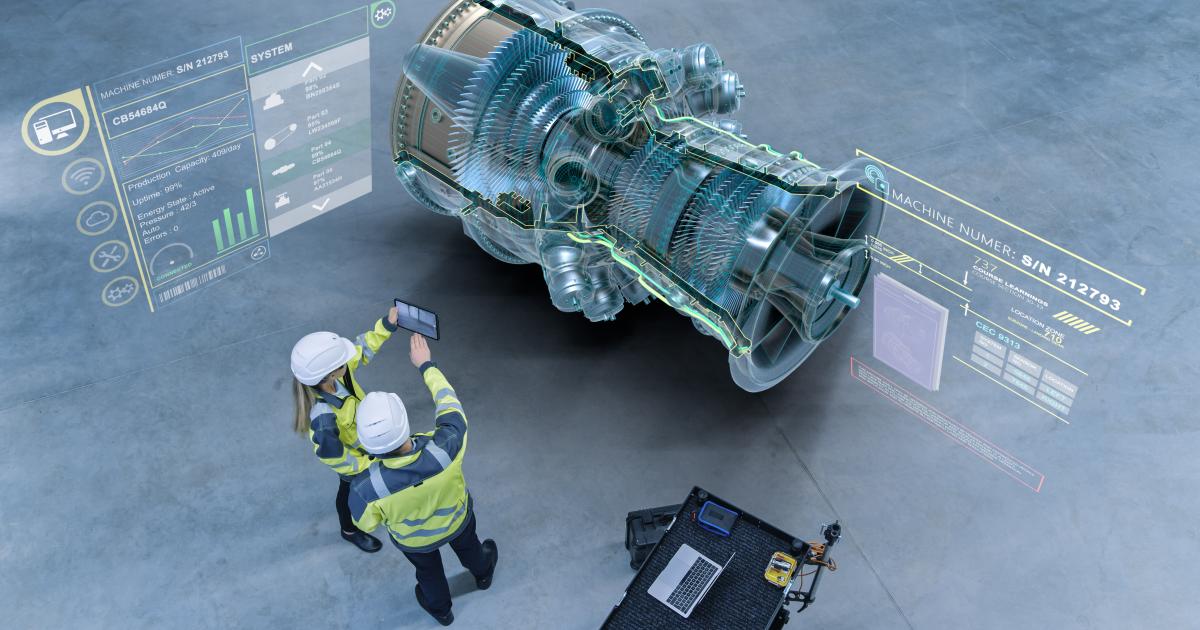
Dassault Systemes is helping aerospace and defense manufacturers introduce augmented reality technology on the shop floor, but this requires effective use of 3D data. Photo credit: Dassault Systemes
A significant part of the challenge is that some companies now have four generations of employees on the shop floor, each of whom consumes and responds to information differently. “There needs to be a focus on what makes each generation efficient, and how the various [data] systems can be navigated with the right [safety] checks in place,” he explained.
One of the main stumbling blocks Dassault Systèmes is helping clients navigate is that much of the underlying data for existing aircraft and their systems is in outdated 2D or paper formats, having been generated, in some cases, decades ago. Progress requires 3D data that can be used for augmented reality functions, such as validating manufacturing processes.
Inspections, Training and Limitations
French tier-one aerostructures supplier Latécoère, Boeing subsidiary Spirit AeroSystems, and Textron Aviation are all now using augmented reality for various quality and production inspection tasks. The latter two companies are also tapping the technology to train new workers.
Dassault Systèmes is also helping the National Institute for Aviation Research at Wichita State University convert legacy information into modern digital data compatible with 3D tools and digital twin models for programs such as the sustainment of B-1 Lancer bombers. In Europe, Deutsche Aircraft is using the company’s digital platform to design and develop its D328eco regional airliner and a family of uncrewed platforms.
According to Lovejoy, some manufacturers are now making significant investments to get actionable 3D data to the shop floor where the technology can be leveraged for quality control tasks that quickly identify incorrectly installed or missing parts.
“For example, tasks such as checking the number of brackets needed to hold a wire harness and how it might need adjusting to fit an aircraft interior can be validated with augmented reality,” he explained. “But you cannot do that with a 2D drawing. Model-based data is more efficient and avoids the confusion of using supplemental documents in a way that can introduce errors, especially with legacy and when outsourcing is involved.”
With its Generation 7 technology, Dassault Systemes is introducing agentic artificial intelligence to support engineers in product development. “It can be used to digitally define all the various stages of manufacturing and how these can be verified,” Lovejoy said. “It can create synthetic data to find the optimal approach, rather than just remembering what was done before. For instance, where cameras are used to inspect holes, they compare this with a virtual record so that errors get flagged and have to be resolved.”
While more large tier-one aerospace and defense groups are embracing this technology, Lovejoy feels regulators have been reluctant to understand and accept the new approach: “That could be a limitation in improving the supply chain.”
Charles Alcock is managing editor of AIN.
Related