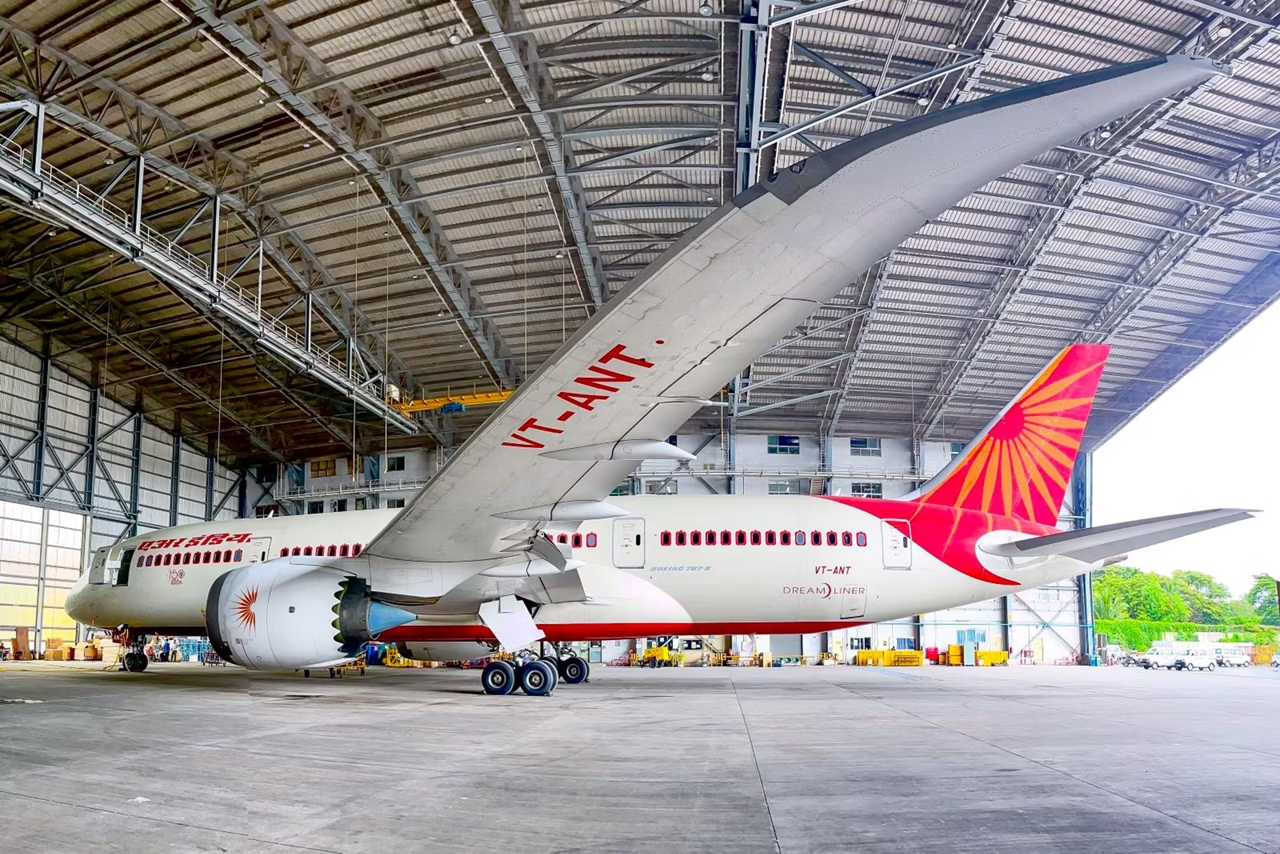
Air India is swapping the Airbus A321LR for the legacy Boeing 787-8 Dreamliner on its Delhi-Manila route, a change that trades away the Premium Economy cabin the route has had since launch in exchange for a meaningfully larger aircraft. The A321LR flies in a 188-seat, three-class configuration: 12 Business, 24 Premium Economy and 152 Economy. Air India’s legacy 787-8, in its current un-retrofitted form, seats 259 in just two classes: 18 Business and 241 Economy (or 256 seats with 238 economy seats). That is a jump of 71 seats, or close to 38% more capacity per departure, even as the middle cabin disappears entirely.
Delhi-Manila is barely a year old. Air India launched the route on October 1, 2025, becoming the only carrier flying non-stop between India and the Philippines, operating five times weekly with the A321LR, inherited from Vistara after the merger. Demand proved strong enough that the airline added frequencies just over two months later, taking the route to seven-times-weekly, effectively daily, from December 11, 2025. The upcoming 787-8 swap is a capacity response to one that has outgrown the aircraft originally assigned to it.
This information was first reported by NetworkThoughts contributer BOMLHR on X (Formerly Twitter)
From Vistara’s A321LR to Air India’s Dreamliner
The A321LR itself has an interesting back story on this route. Air India’s fleet of four A321LRs are the only aircraft of this type flying in Indian skies, inherited from Vistara, which took delivery of them between February and May 2023. These jets were engineered for thin, long routes that don’t justify a widebody, and Manila fit that profile perfectly when the route launched. But the same four aircraft also fly Delhi-Bali and Mumbai-Mauritius, both of which have also been growing. Delhi-Bali went from seven to ten weekly frequencies from December 1, 2025, the same schedule change that boosted Manila. With just four A321LRs in the fleet and multiple growing routes competing for their time, something eventually had to give, and Manila’s move to the 787-8 frees up valuable A321LR hours for the network, which could also be due for checks.
The choice of the 787-8, rather than a newer or retrofitted Dreamliner, is also telling. Air India is currently retrofitting 26 legacy 787-8s with new interiors that add Premium Economy and reduce total seating to 250 (20 Business, 25 Premium Economy, 205 Economy), but that programme won’t be complete until mid-2027. Until a retrofitted aircraft becomes available for Manila, the route will fly with the older, denser configuration: more seats, but only two cabins.
A widebody trade-off, and rising competition
The traffic numbers make the case for a bigger aircraft on their own. Quarterly point-to-point data released by DGCA, corelated with planned flights, shows the route’s load factors sitting consistently in the high-70s to mid-80s on the 188-seat A321LR, well above the level at which an airline typically starts looking to upgauge:
| Period | DEL-MNL pax | MNL-DEL pax | DEL-MNL LF | MNL-DEL LF |
|---|---|---|---|---|
| Oct-Dec | 10,928 | 9,871 | 75% | 83% |
| Jan-Mar | 13,132 | 13,383 | 79% | 78% |
| Apr-Jun | 14,508 | 13,338 | 77% | 84% |
Passenger volumes have grown in both directions every quarter since launch, and load factors on the return Manila-Delhi sector in particular have twice touched the low-80s, a range where an airline is regularly turning away bookable demand on peak dates. It’s worth flagging that this is point-to-point data and doesn’t isolate connecting traffic feeding onward from Air India’s Delhi hub, so the true demand picture, and the case for more seats, could be even stronger than these numbers alone suggest. Data also shows that the cargo potential has not been fully tapped, possibly as a compromise for passenger baggage and passenger weight as the route is long.
For Air India, this is a straightforward yield-versus-volume call. Manila’s traffic clearly skews towards price-sensitive leisure and visiting-friends-and-relatives segments, especially since the Philippines introduced 14-day visa-free entry for Indian nationals last year, a policy shift Air India explicitly cited when launching the route. A bigger, two-class aircraft lets the airline chase that volume more aggressively, even if it means a short-term step back for the small set of travellers who specifically wanted Premium Economy on this sector.
The timing also lines up with a market that is likely to get more competitive. Various news reports have indicated IndiGo having applied to the Philippines’ Civil Aeronautics Board for a foreign carrier’s permit, with a hearing scheduled for September 16, and has flagged interest in flying non-stop to both Manila and Cebu, the country’s two busiest gateways, as part of its broader push into island leisure markets following Seychelles, Mauritius and Bali. Separately, Philippine Airlines is trying to re-enter the Indian market. PAL flew Manila-Delhi in 2011 before pulling out in 2013 when the market was judged too small, and it ran the sector via a technical stop in Bangkok as well since its A320s of that era lacked the range for non-stop service. A planned 2019 relaunch was pulled at the last minute after India-Pakistan border tensions spooked bookings just weeks before the scheduled restart. News reports also indicate that PAL has now filed again under the bilateral, which allows up to 28 weekly flights between New Delhi, Mumbai, Kolkata and Chennai and four Philippine points.
What could be driving the timing
Air India hasn’t publicly explained why now, so the reasoning has to be pieced together, and a few plausible drivers stand out, none of which are mutually exclusive. The most obvious is the demand and yield picture already laid out above: load factors touching the low-80s on a 188-seat aircraft is about as clear a signal as an airline gets that it’s leaving bookings, and revenue, on the table on peak dates. On pure network economics, this alone would justify the swap.
A second, less obvious driver is fleet constraint rather than route strategy. With only four A321LRs in the entire Indian fleet, spread across Manila, Bali and Mauritius, there is very little slack. Any one aircraft going in for scheduled heavy maintenance removes a quarter of that rotation overnight, and something has to absorb the disruption. Manila, being the newest and smallest of the three commitments, is also the one Air India can most easily move to a widebody without unwinding an already-mature schedule on Bali or Mauritius. Freeing up an A321LR from Manila gives the airline more headroom to protect the other two routes through any future maintenance cycle.
Competitive pre-emption is a third, more speculative possibility. IndiGo’s Philippine permit hearing is scheduled for September 16, and Philippine Airlines has its own filing pending under the bilateral. Locking in a bigger, cheaper-per-seat aircraft now, ahead of either rival actually starting service, lets Air India build share and travel-agent habit while it still has the market to itself, rather than reacting to a competitor’s launch from a position of a sold-out narrowbody. Whether this factored into the timing or is simply a convenient coincidence is hard to say from the outside, but the timing does line up.
Finally, there’s a simpler reading: the 787-8 swap may just be the least-bad option available today, rather than the ideal one. With the Premium Economy retrofit programme not reaching Air India’s 787-8s until well into 2027, the airline effectively had to choose between staying capacity-constrained on a well-performing route for another year, or taking the near-term hit of dropping a cabin in exchange for immediate volume. Air India appears to have chosen volume now, with the expectation that Premium Economy returns to the route once a retrofitted aircraft becomes available.
Network Thoughts
Air India’s Manila upgauge is a small but useful case study in how the airline is managing a widebody fleet that is still catching up with demand. The narrowbody A321LRs, all four of them, are now stretched across three of the airline’s best-performing thin-and-long routes, and something on that roster was always going to be bumped up to a widebody once traffic justified it. Manila drew the short straw on Premium Economy timing purely because the retrofit programme hasn’t reached its 787-8s yet, not because Air India sees no room for a premium narrowbody product on the route long-term.
Air India is also replacing the A321LR to Mauritius from Mumbai starting January and erstwhile Vistara had upgraded Delhi – Denpasar flights to the Dreamliner within months of launch. What makes the Delhi – Manila route worth tracking closely over the next year is not the aircraft swap itself, but who else shows up. Air India has enjoyed months as the sole operator on India-Philippines, and that window is closing fast. IndiGo entering with A321neos or its incoming A321XLRs would bring low-cost competition on price, while a returning Philippine Airlines would bring a Philippine flag carrier’s home-market strength and its own Bangkok-honed institutional memory of exactly why the market failed twice before. If PAL’s third attempt succeeds, and IndiGo’s permit clears its September hearing, Delhi-Manila could go from a route with one operator and a capacity problem to one of India’s more closely watched Southeast Asian battlegrounds within a single winter schedule.
Found this article informative? Think of supporting Network Thoughts with Power of 10

Running this website incurs some cost, along with the data sourced for analytics. If you have liked this article, consider paying INR 10 via UPI. The site will continue to be free. This will help with the maintenance, upkeep and funding the research. You can also pay via Debit or Credit card by clicking on this link.
You can support Network Thoughts by ordering Network Thoughts baggage tags and lapel pins !
Follow NetworkThoughts on X (Formerly Twitter), Bsky, Facebook and YouTube
Related