1. Audience: Know Who You’re Helping and How
Creating a powerful data product starts with empathy—understanding the end-user and what success looks like from their perspective.
Ask yourself:
-
Who is the primary user of this product?
-
What pain points are they experiencing today?
-
How can this solution make them look like a rock star in their organization?
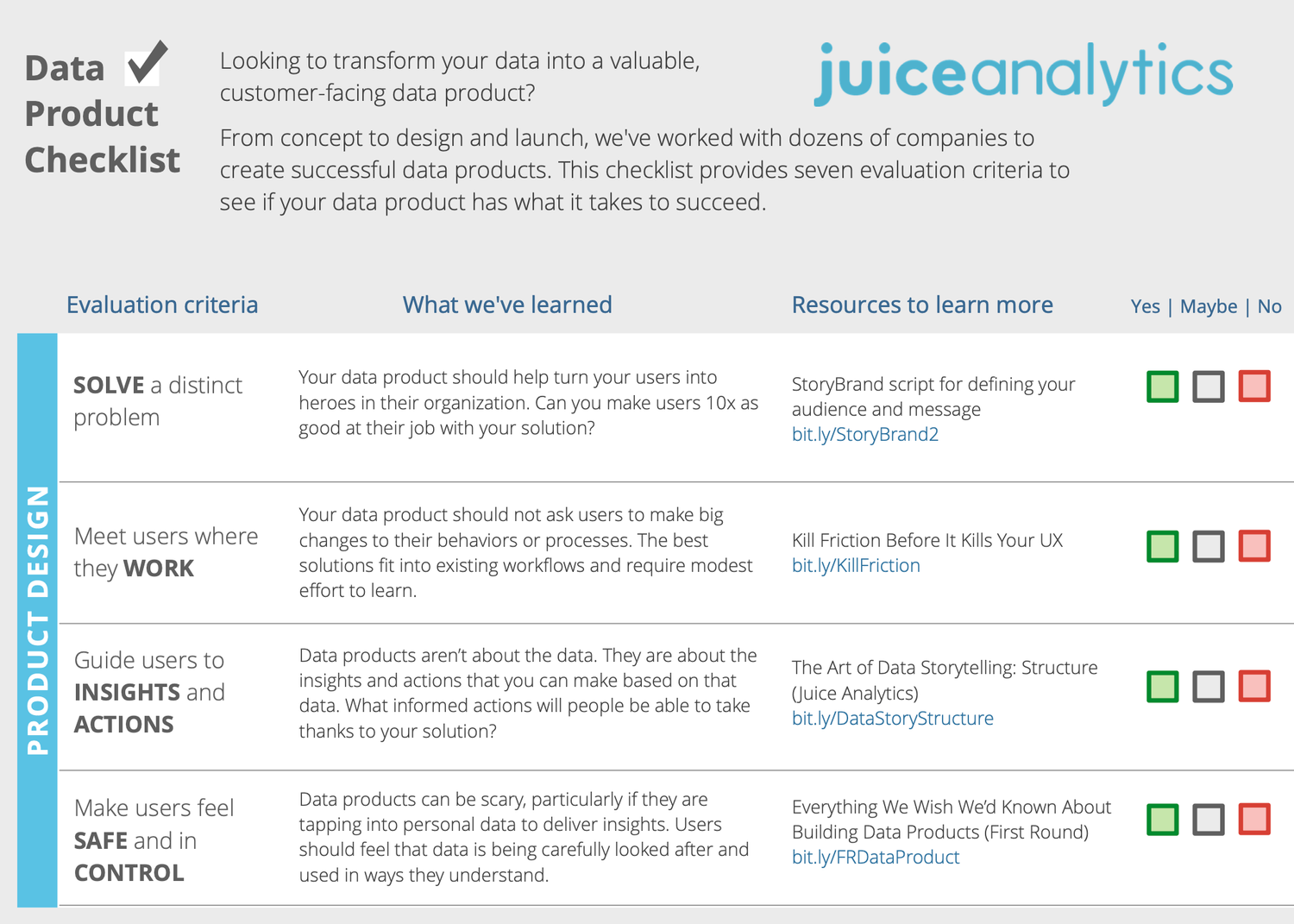
Great data storytelling starts here. Before you visualize or design anything, create a “user story” that identifies goals, challenges, and decision points. The StoryBrand framework is a great tool to get clarity.
Checklist Prompt:
✔️ Does your product solve a distinct, high-value problem for a specific audience?
2. Data: Define It, Trust It, and Make It Work
Let’s be honest—your data isn’t perfect. But that doesn’t mean it can’t form the backbone of a great product. The key is to clean, enrich, and shape it for a specific purpose.
What to consider:
-
Is your data credible and bias-free?
-
Can you transform it into insights users can trust?
-
Are your metrics transparent and well-defined?
Related resource: 8 Ways to Determine the Credibility of Research Reports (EAIE)
Also, remember: data storytelling isn’t about dumping numbers into a chart. It’s about guiding users to the insights that drive better decisions. For help structuring this approach, check out The Art of Data Storytelling.
Checklist Prompt:
✔️ Does your product bring credibility to the data and make insights accessible?
3. Design: Solve Problems, Not Just Present Data
Dashboards are easy. Solving real problems with data? That’s much harder.
Strong data products fit seamlessly into a user’s workflow. They don’t ask for big behavioral changes. They guide users toward actions, not overwhelm them with visualizations.
Here’s what top-performing products do:
-
Meet users where they work. Embed into daily tools or processes.
-
Kill friction. Every extra click or unclear label erodes trust.
-
Prioritize usability. Simple is powerful. Smart defaults, helpful onboarding, and progressive disclosure go a long way.
Recommended read: Kill Friction Before It Kills Your UX (UXPin)
Above all, make users feel safe and in control—especially when personal or sensitive data is involved. Transparency about data usage builds long-term loyalty.
Tip: Check out Everything We Wish We’d Known About Building Data Products from First Round for real-world lessons.
Checklist Prompts:
-
✔️ Does your product guide users to specific actions or outcomes?
-
✔️ Is the UX low-friction, intuitive, and built into existing workflows?
-
✔️ Do users feel their data is respected and protected?
4. Delivery: From Launch to Longevity
You’ve designed a great product. Now what?
The real test isn’t whether it works—it’s whether it keeps working, at scale, under pressure, and with real users.
Operationalizing analytics means:
-
Your models and metrics update in real time (or near real time)
-
Your product can handle growing data volume and user load
-
You have a clear, repeatable delivery process
Resource: Productionalizing Machine Learning Models (Irina Kukuyeva)
And don’t forget about ongoing support. Data products are not “set-it-and-forget-it” tools. They need feedback loops, support structures, and community.
Helpful link: How to Create an Exceptional B2B Customer Experience (Hubspot)
Checklist Prompts:
How to Use This Checklist
We recommend using this framework as a self-assessment or team activity early in the development process. You can rate each of the seven key criteria as:
-
Yes = 1 point
-
Maybe = 0.5 points
-
No = 0 points
Score yourself:
-
6–7 points = Ready to launch
-
4–5 points = Fill in the gaps first
-
0–3 points = It might just be a fancy report
Wrapping It All Up: Build What People Actually Use
Too many data products never get adopted because they’re built from a “data first” mindset rather than a “user first” one.
If you focus on:
-
Understanding your audience
-
Enhancing data for clarity and credibility
-
Designing for action and adoption
-
Delivering support and scalability
…you’ll build a solution that tells a compelling story and truly solves a problem. In other words, not just another dashboard, but a data product.
Want help putting your checklist into practice? We’ve refined our own process for data product design based on years of working with companies to create interactive, high-impact solutions.
Happy drilling.