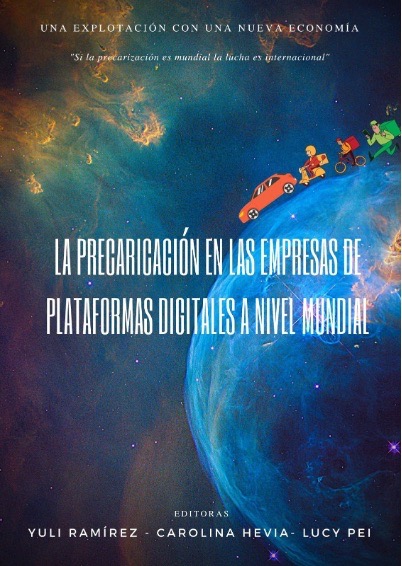
One day in November 2022, I was meeting with Carolina, one of the main activists of the gig worker union Frente de los Trabajadores de los Plataformas Digitales del Ecuador (FRENAPP) in Ecuador. Carolina was using Canva (a free online graphic design website) to create sample book covers. She had just found a template featuring an epic-looking rendering of the Earth. “Let’s add the different types of gig workers to the top of the world,” she said. She took her time scrolling through different free clipart websites until she was satisfied with the images she pasted on top of the globe (Figure 1). She inserted a placeholder title for the book: “La Precarización en las Empresas de Plataformas a Nivel Mundial” (Precarization in Digital Platform Companies at the Global Level). She included slogans at the top of the sample book covers which translated to “An [old] exploitation with a new economy,” and “If the precarization is global, the fight is international.” She credited the slogans to an international alliance of gig worker organizations of which FRENAPP was a part. In the sample book cover Carolina created, the viewer and the clipart gig workers lie outside of the stylized image of the whole earth. The globe becomes the prominent scale, superseding national borders, buildings, and neighborhoods. Images such as this call the scale of the global into being and visually assert the connection between the cause of gig workers and the scale of the world as a whole. The title of the book reinforces the idea of the global scale.
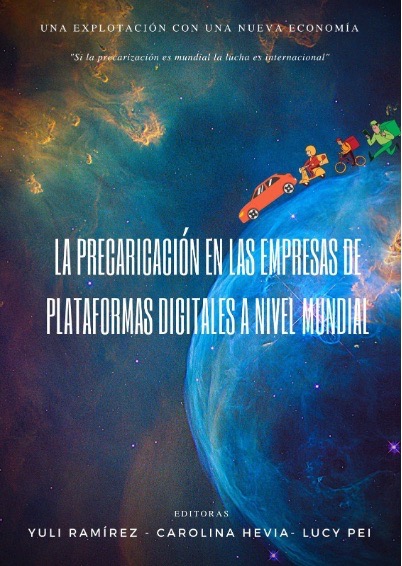
This is the sample book cover that was submitted as part of the proposal to
get funding for FRENAPP’s book project, showing gig workers of different transportation
types on top of a stylized image of the whole earth. The book’s cover includes sample
titles and riffs on slogans which Carolina credited to an international alliance of gig worker organizations of which FRENAPP was a part: “An [old] exploitation with a
new economy,” “If the precarization is global, the fight is international,” “Precarization in
platform companies at the global level.” She had included me as a co-editor in the proposal,
so my name also appears on the sample cover.
Following Anna Tsing, I consider scale to be “not just a neutral frame for viewing the world” but instead as something that “must be brought into being: proposed, practiced, and evaded, as well as taken for granted. Scales are claimed and contested in cultural and political projects,” (Tsing, 2005, p. 58). The sample book cover image and slogans are examples of how activists self-consciously claimed the global scale. A gig worker’s complaints can be viewed as a personal-scale problem to be solved by finding a new job or getting reinstated. A union can assert itself as focused on the scale of the factory, the company, the city, or the nation. A social movement can style itself as being local or it can argue that the issues it addresses are global in scale. In addition to the book’s sample cover image and slogans, the book’s contents are the result of a process of scale-making. Relationships made and interviews conducted via Zoom and WhatsApp across borders and languages made the testimonies collected in the book possible, showing common threads of struggle as well as the different contexts faced by activists in different countries. The article “Scalar Devices of a Global Movement of Gig Worker Activists” (Pei, 2025) further details the contingent work that activists did to enact the global scale of gig worker resistance in a manner that did not mirror the monocultural scaling of platforms but rather left room for transformative encounters and internal diversity. Monocultural scalability refers to a project’s ability to expand “without rethinking basic elements” (Tsing, 2012, p. 505). The moniker “monocultural” comes from the exemplar of the sugar plantation: unlike a permaculture ecosystem that adapts to what was already there and holds internal diversity of life forms, the sugar plantation expands pixel by pixel with the same crop and tightly controlled slave labor that is meant to be replaceable. Gig work platforms fit this definition well: they are meant to incorporate workers and expand into new places with minimal change to the architecture of the project. Workers are micro-managed via algorithm and made as replaceable as possible, with essentially no training and a walk-on application. On the other hand, the gig worker organizing I saw was changed whenever new groups joined in. The solidarity demonstrated did not require homogeneity, but rather sought common ground while recognizing workers’ varied contexts and experiences.
What is the significance of gig worker activists’ claim on the global scale in relation to reclaiming the futures of work?
Conversations about the future of work that are pegged to policy and projections at the national scale fail to leave room to analyze hierarchies in global divisions of labor (e.g. Irani, 2019) and the ongoing effects and acts of colonialism and imperialism. Focus on national competitiveness in a globalized economy (e.g. Sims, 2017) acknowledges ever-present transnational ties, but forecloses solidarity among workers across national borders. Even within one location, border regimes lead to the “multiplication of labor” (Mezzadra & Nielson, 2013): people given different forms of precarious status in their migration journey are willing to accept different forms of exploitation, multiplying the number of workers who will take jobs which do not meet local labor laws and standards.
FRENAPP’s activists and I are not alone in calling attention to the global scale. In the 1990s, the concept of ‘globalization’ was “in the air” and on the minds of both activists and academics (Cunningham, 1999). Transnational solidarity in social movements and labor movements became an important research topic (Edelman, 2001; Cunningham, 1999). Sociologists of labor as well as scholars in business schools, industrial and labor relations, and development studies theorized the potential for transnational labor movements to provide a “vital counterweight to unfettered global capitalism,” (McCallum, 2013, p. 4) though their work largely did not provide empirical analysis of the actual workings of transnational labor organizing. Calls for attention to globalization have been taken up by scholars since then. Efforts at transnational labor solidarity have included anti-sweatshop movements and solidarity campaigns against the persecution of union leaders in the Global South. These have been able to animate Global North activism and create some gestures toward fair trade, but have often failed to change structural conditions for workers in the Global South (e.g. Buhlungu, 2008; Gill, 2009; Seidman, 2007). The tool of the Global Union Federation has been able to secure some agreements for workers across borders who are organized and able to sign agreements directly with companies; however, these require the continued real threat of organized strikes to ensure enforcement of agreements, since these are not under the jurisdiction of national governments (McCallum, 2013).
Beyond a focus on labor, the alter-globalization movement is understood to have begun from transnational solidarity for the Zapatista uprising in 1994, protesting the enactment of the North American Free Trade Agreement (NAFTA) (Rovira, 2019). The massive protests at the World Trade Organization meeting in Seattle in 1999 brought alter-globalization into the spotlight around the world. These protests united “Teamsters and Turtles,” bringing oftentimes opposed forces together in their analysis of the way that neoliberal globalization was harming nonelite communities (Brand & Makal, 2022). While the media referred to the movement as an “anti-globalization movement,” the movement was intentionally global in nature. Rather than eschewing it, alter-globalization also demonstrated a commitment to the global scale as a means for resisting capital rather than as a paradigm for unfettered capital. As pioneers in online organizing, alter-globalization movements coordinated more closely across locations than was previously possible among groups ranging from NGOs to anarchist and grassroots groups (Juris, 2008).
The declaration of the War on Terror and the invasion of Iraq led by the US military marked the end of the prominence of the alter-globalization movement, as repression against protestors increased and the ten million people mobilized in February 2003 did not stop the war (Rovira, 2019). From its peak as a mass movement that was making headlines with spectacular protests, the legacy of alter-globalization still remains in the World Social Forum processes and the global Occupy movements after the recession of 2008 (Brand & Makal, 2022).
Unfortunately, the legacy of alter-globalization’s critiques have also been taken up by global extreme Right political movements, which have combined the analysis of the harms of neoliberal globalization with racism and reactionary nationalism (Brand & Makal, 2022). Right-wing movements are connected across borders, too, with political leaders touring on behalf of one another’s campaigns and flags and slogans shared across protests around the world (e.g. Kim, 2026). Meanwhile, globalized capitalism has continued to consolidate. Multinational corporations continue to dominate consumers’ everyday lives and platform economics further encourage monopoly dynamics, as can be seen with companies like Amazon and Temu’s global reach and the venture capital backing of food delivery platform companies (e.g. Punit, 2026; Zhou & Guest, 2021). The scalar claims of right-wing nationalism make activists’ solidaristic claim on the global scale even more urgent as an opposition to both neoliberal globalism and reactionary nationalism.
Just as the “future of work” should be broken out of the frames given to it by corporate billionaires and supportive nationalist policy, the “global” needs to be taken as a frame that doesn’t imply free trade and restricted labor movement, but an opportunity to take responsibility and develop solidarity across already entangled histories. Activists facing new forms of exploitation facilitated by emerging technologies are already making claims on the global scale, and academics should continue to amplify their voices and train our attention on how scale is claimed and contested. Reclaiming the futures of work requires unpacking how colonial histories and unequally oppressive conditions across global supply chains have made “good” jobs possible in the past, and intervening into current working conditions with solidarity across borders.
This post was curated by contributing editor Eva Rose Steinberg, and reviewed by Melina Campos Ortiz.
References
Brand, U., Makal, P., 2022. A Brief History of the Alter-Globalization Movement – Rosa-Luxemburg-Stiftung. Rosa Luxemburg Stiftung. https://www.rosalux.de/en/news/id/46700/a-brief-history-of-the-alter-globalization-movementBuhlungu, S., 2008. Transnational labor activism: solidarity or philanthropy? Labor History 49, 353–358.
Cunningham, H., 1999. The Ethnography of Transnational Social Activism: Understanding the Global as Local Practice. American Ethnologist 26, 583–604. https://doi.org/10.1525/ae.1999.26.3.583
Edelman, M., 2001. Social movements: changing paradigms and forms of politics. Annual review of anthropology 30, 285–317.
Gill, L., 2009. The limits of solidarity: Labor and transnational organizing against Coca-Cola. American Ethnologist 36, 667–680. https://doi.org/10.1111/j.1548-1425.2009.01202.x
Irani, L., 2019. Chasing innovation: making entrepreneurial citizens in modern India, Princeton studies in culture and technology. Princeton University Press, Princeton, New Jersey ; Oxford, United Kingdom.
Juris, J.S., 2008. Networking futures: the movements against corporate globalization, Experimental futures. Duke University Press, Durham, N.C.
Kim, C., 2026. Hitting the Streets With the MAGA Youth of South Korea. POLITICO. Retrieved August 13, 2026, from https://www.politico.com/news/magazine/2026/03/27/young-maga-south-korea-00844877
McCallum, J.K., 2013. Global unions, local power: the new spirit of transnational labor organizing. ILR Press, Ithaca.
Mezzadra, S., Neilson, B., 2013. Border as method, or, the multiplication of labor. Duke University Press, Durham.
Pei, L., 2025. Scalar Devices of a Global Movement of Gig Worker Activists. Proc. ACM Hum.-Comput. Interact. 9, 1–22. https://doi.org/10.1145/3757654
Punit, I. S., 2026. I went to the Maldives. Everyone wanted to talk about Temu. Rest of World. https://restofworld.org/2026/china-consumer-dependence/
Seidman, G.W., 2007. Beyond the boycott: Labor rights, human rights, and transnational activism. Russell Sage Foundation.
Sims, C., 2017. Disruptive fixation: school reform and the pitfalls of techno-idealism, Princeton studies in culture and technology. Princeton University Press, Princeton.
Tsing, A., 2005. Friction. An ethnography of global connection.
Tsing, A. L., 2012. On nonscalability: The living world is not amenable to precision-nested scales. Common knowledge, 18(3), 505-524.
Zhou, Y., & Guest, P., 2021. The investors pushing the gig model around the world. Rest of World. https://restofworld.org/2021/global-gig-workers-investors-behind-gig-work-model/