One inbox for every community – how managers stop losing resident threads across text and email


Communication problems in community management are never a shortage of channels. It’s the opposite. Residents text, email, and message through the portal, sometimes about the same issue on the same day, and none of those channels know the others exist. And what worsens the problem is scale. Community associations are now home to 78.1 million Americans across roughly 373,000 associations nationwide.
CAI‘s numbers put the professional manager population serving all of that at just over 60,000, which works out to an industry-wide average of roughly six associations riding on every manager, before you even separate out the managers running a single large property full-time. If you carry a portfolio, your real numbers are almost certainly worse than that blended average suggests. In fact, the industry salary data estimates portfolio sizes run anywhere from 8 to 12 smaller associations.
That means you’re not tracking one household’s communication habits. You’re tracking hundreds, and each one reaches for whatever channel is closest at hand. A good example of how communication easily breaks down is a Florida condo owner who received a collection notice tied to a special assessment they said they’d never seen. The association had sent it by email weeks earlier, but it landed in a spam filter and sat there until $600 in interest had piled up.
Nobody in that chain was careless. The notice went out on schedule, through a channel the association had every right to use. It just had no backup, and no one confirmed it had actually been opened before collections kicked in. And the opposite also holds true. Residents reach out to the management, but because everything lives in threads across text and email, you never get to see the message on time. In this guide, I’ll walk you through why you need one inbox for every community, and then show you how to set up one.
Why can’t managers standardize one channel?
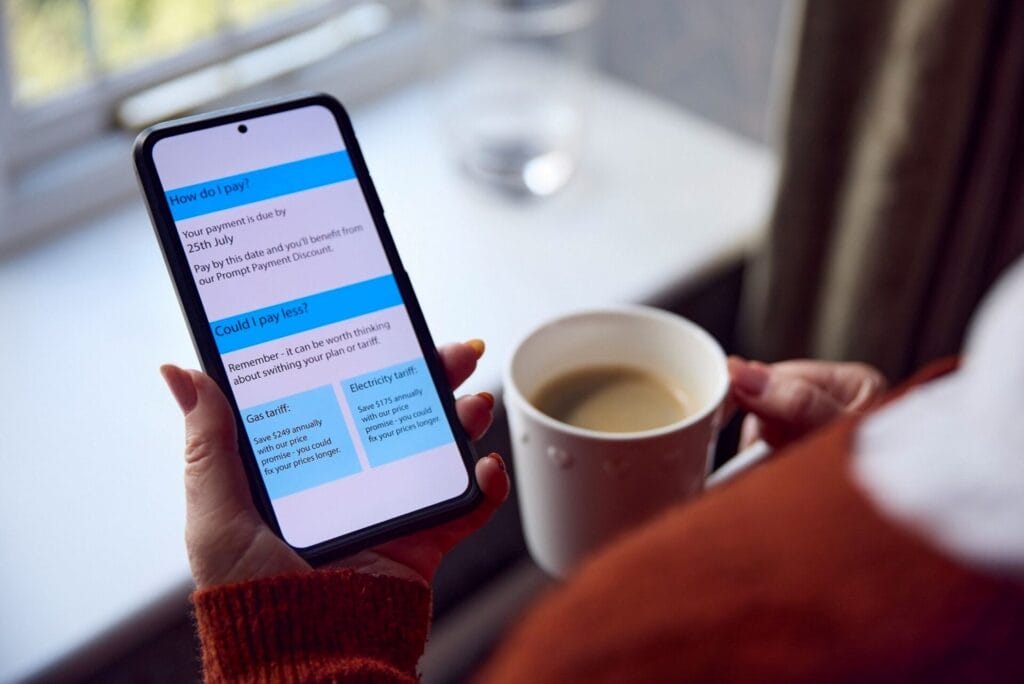
At some point, almost every manager lands on the same idea: pick the best channel, get the whole community to move onto it, and the fragmentation disappears. In my experience, that instinct runs straight into a wall of generational habit. Let’s look at each channel on its own, and the case for keeping all of them.
Text
Text is the channel most residents under 55 check first, often within the hour. A 2025 study on generational communication found that texting is the most-used daily method for the large majority of working-age adults: 80% of Gen X, 74% of Millennials, and 69% of Gen Z rank it above phone calls, email, and every app on their home screen.
Email holds the same ground at the other end of the age range, with 98% of the Silent Generation and 95% of Baby Boomers using it regularly. It also carries legal weight that the others don’t. Under the federal E-SIGN Act, a board can decide to go paperless if each homeowner actively opts in, in writing. After that, an email can substitute for a mailed legal notice, something that a text can’t.
Portal
The portal is supposed to solve all of this at once, but only if residents actually log in. A 2026 report on resident communication preferences found 84% say they want portal access, yet only 59% currently have it, leaving roughly four in ten residents outside the system before adoption even becomes a question.
What scattered threads cost you
As you have seen, you can’t force one channel, but have to track all three. But before we get into how you can do that, let’s first see what scattered threads cost you.
The problem of tracking one issue across multiple channels
This isn’t a quirk of community living, but it’s baked into how service interactions work almost everywhere now. Zendesk’s customer experience research found that 74% of people say repeating themselves to someone new is one of their biggest pain points in getting an issue resolved, and 81% would rather pick a conversation back up where they left it than start over. The data also shows that typical service issues now touch three separate channels before they’re actually closed out.
For you, that’s a resident or board member reaching out to you through the portal, email, and text over the same issue, such as maintenance, architectural requests, noise complaints, and amenity bookings. And because these channels are disconnected, you’ll never pick a conversation back up from where it was left, always forcing residents to repeat themselves.
The staff turnover problem
Turnover makes it worse. The National Apartment Association puts annual turnover in property management at close to 33%, against a national average of roughly 22% across all industries. In any given year, something like one in three people holding context on your open resident issues won’t be there twelve months from now.
If someone’s filing system were a personal phone loaded with resident texts, that context leaves the moment they do. One large workplace survey found 42% of institutional knowledge exists only in the mind, or the phone, of whoever’s holding it, meaning the next person has to rebuild it from scratch, often while a resident is still waiting on an answer.
It’s not only an efficiency problem either. Courts have consistently held that text messages sent for business purposes are subject to discovery and must be preserved, whether they lived on a company device or someone’s personal phone. Companies have been sanctioned, in one case $10,000, simply for letting business-related texts get deleted. When a resident dispute eventually lands in front of a board or an attorney, nobody cares whose phone the original conversation happened on. They care whether it still exists.
The visibility gap
Then there’s the cost of duplicated effort. Without one shared view across every channel, you have no reliable way to check whether a resident’s question was already answered on another channel, so you either answer again just to be safe or assume it’s covered and let it sit, which is worse. Even when nothing is actually lost, finding it again eats a chunk of the week. On average, employees spend eight hours a week just hunting for information they need to do their job. That would have been time saved if the information were easily visible in a unified inbox.
The legal problem
All of that costs time, patience, and goodwill. But having a good communication trail is also a risk management and compliance issue. It’s about whether you can prove, months or years from now, that you did what your governing documents and state law actually required.
Start with the most basic obligation: producing your own records, on a clock. For example, Florida’s Homeowners’ Association Act, California’s Davis-Stirling Act, and the Texas Property Code each require associations to maintain official records, violation notices, meeting minutes, and financial statements, and make them available to owners within a set window upon a written request.
Now, imagine a notice that went out as a text from someone’s personal phone, with nothing that you can produce months later. You can’t prove whether or not it was sent. That’s how easy a communication trail split across a manager’s personal phone and disconnected inboxes can land you in legal issues.
Record preservation
A conversation history saved on a manager’s personal phone belongs to whoever’s name is on the phone bill, not to the association paying them. We’ve already seen how often that turnover happens. When you have one inbox, the conversation history survives that kind of turnover because it was never tied to a person in the first place, but filed against the unit instead, accessible to whoever picks up the caseload next.
Shared visibility
Shared visibility fixes the bottleneck that remains even without turnover. If you’re the only one who can see a conversation, it’s stuck the moment you’re out sick or buried in back-to-back meetings. With one inbox, whoever’s actually available can step into a live thread, see the full history, and respond without making a resident start over. In fact, teams that move from single-owner inboxes to shared, collaborative ones see resolution times drop by roughly 33%.
Timestamped record of communication
A system that timestamps every message the moment it arrives solves your retention problem, too. Several states require associations to hold onto violation-related records, correspondence included, well after a dispute is resolved. Florida sets a seven-year minimum for HOA meeting minutes and other official records, and attorneys generally advise holding onto resident correspondence for at least four to six years, depending on the state.
With scattered threads, you’ll have a difficult time tracking whether the email came before the text to try to reconstruct the flow of the conversation across channels. But with one inbox, a record files itself the moment a message lands, whether through email or text.
Keeps every community identifiable across your portfolio
Every idea above assumes a single community in isolation, but as we saw from the industry statistics, you’ll probably be handling multiple communities. Without one inbox for every community, it’s very easy for one community’s conversation to bleed into another’s, as all resident and board conversations sit in the same inbox, regardless of the community.
It’s even unprofessional to sit in a board meeting, a question is asked, and they see you scrolling hundreds of emails from other communities trying to locate their community’s email. But with one inbox for every community, you’ll be opening each community’s inbox separately, keeping its affairs private. You’ll also save yourself from the mental caseload of remembering which community you’re even responding to.
How technology can help you
Portfolio-wide view
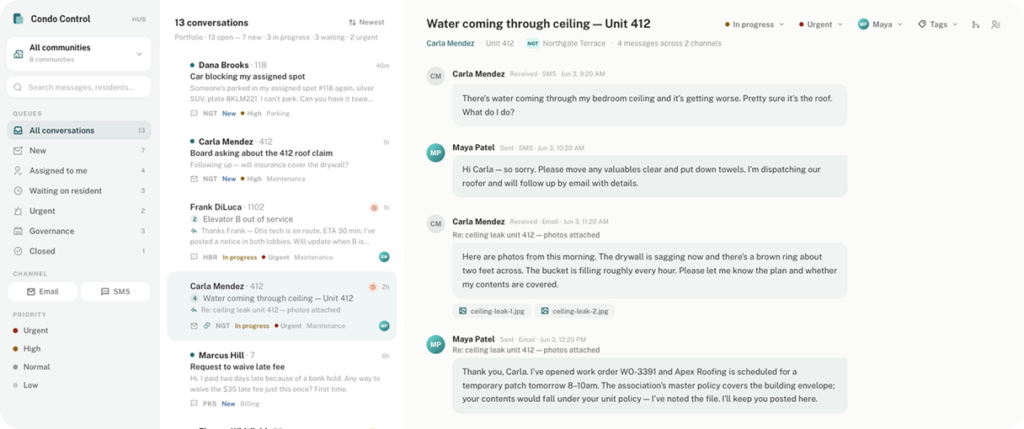
You do not need to log in and out of different accounts. All incoming structured data, such as service requests, architectural requests, and online forms from every property, flows into a single, unified operations dashboard. And from that one window, you can use AI-powered tools to draft a single notice and push it out simultaneously across multiple channels.
Automated answers to repeat questions
Research shows that between 60% and 80% of everything arriving in a service inbox isn’t new. It’s a version of the same handful of questions asked again. An AI-powered system detects those repeated questions and answers them automatically, without a single person touching them.
On the financial side of things, an automated answer costs somewhere between fifty cents and a little over a dollar, versus $8 to $12 once a live person is the one fielding it. Multiply either number across your portfolio, and see how much you’ll be saving.
Trend detection
Without that separation built in from the start, tracking down the full picture on a single dispute means mentally filtering out everything you happen to know about the other properties on your list. And when a board member asks how many maintenance requests came in last quarter, and how quickly they were handled, you’ll have to go back and try to track. But a system that organizes the inbox by community can easily pull out all maintenance messages for a given time and show the trends.
Final thoughts
Let homeowners reach out to you through their most convenient channel: texting, emailing, and posting requests on the resident portal. What has to change is what happens on your end once the message arrives. Every thread should land somewhere central, logged against the right resident, the right property, and the right community. That way, you’ll stop losing resident threads across text and email. And when you use an AI-powered community management platform to do this, you’ll have the added advantage of automated replies to common questions.