Quotes And Leadership Lessons From The End Of Oak Street

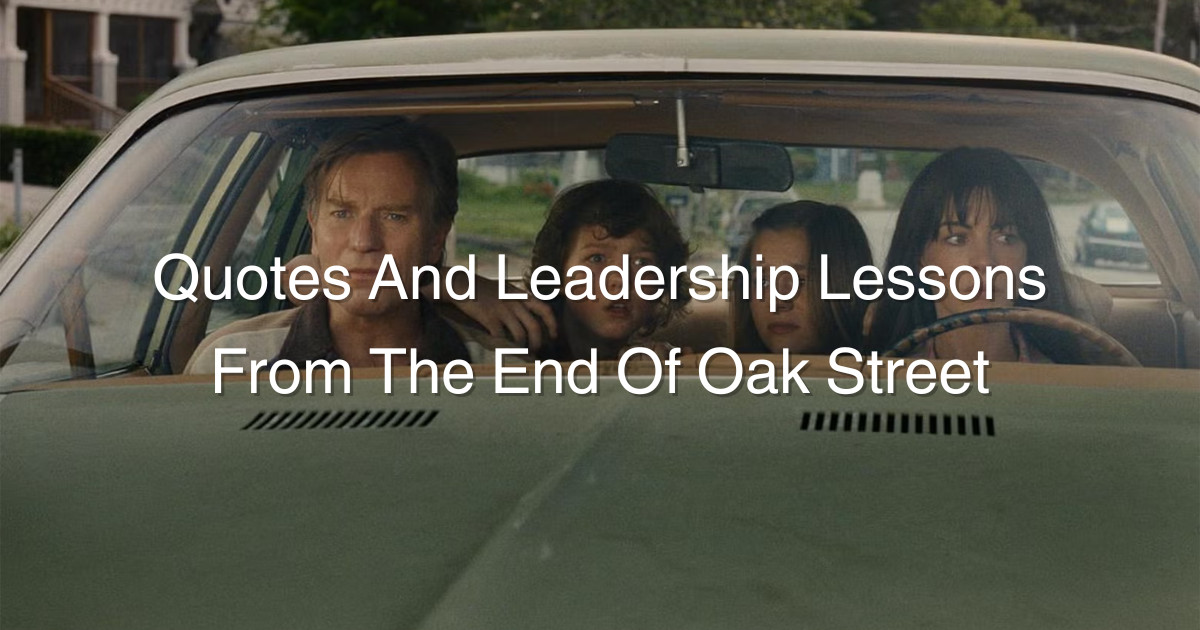
When I saw the trailer for The End Of Oak Street, something stood out to me. J.J. Abrams directed the movie. He was the producer of Lost, Super 8, and other films and TV series. More importantly, he produced Cloverfield, 10 Cloverfield Lane, and The Cloverfield Paradox.
Something about this film’s trailer reminded me of the Cloverfield films. It felt as if this film could be connected to those films. While no one has said it outright, fan theories are flying around that this is a Cloverfield film. Regardless, The End Of Oak Street was a fun thrill ride.
What is The End Of Oak Street? A family is struggling to stay together. Denise Platt (Anne Hathaway) has been unhappy in her marriage to Greg (Ewan McGregor). She’s an aspiring author who’s been weaving her life into her forthcoming book. Then there’s the coming of age of their children, Audrey (Maisy Stella) and Brian (Christian Convery).

Their challenges are amplified when their block is whisked away to the prehistoric past. They wake up to find dinosaurs roaming the streets and skies. They attempt to drive, only to find jungles and an extreme drop-off.
Soon, they can tell they’re not in Michigan anymore… They’re somewhere dangerous. And they’ve all got to grow up and put their differences aside.
Let’s take a look at how this sci-fi/thriller can help us become better leaders.
1. Greg Platt:
Why’m I doing this again?
The Platts were attending a neighborhood block party. Remember those? They were extremely common in the 1980s.
Greg was participating in a sack race. He wonders out loud why he’s doing this again…
Denise gives him a simple reason: Fatherly duty.
Leaders should regularly ask themselves why they’re doing what they’re doing. They put themselves in the crosshairs of their employees, especially when there are issues.
More importantly, you have to have a reason for what you’re doing. Greg’s was fatherly duties.
What’s your reason for continuing to lead?
2. Focusing on what others are doing will cause you to mess up:
There was a balloon toss at the block party. Audrey is participating in it with her friends.
At one point, she’s talking to one of her friends. That friend’s boyfriend arrives. Audrey’s focus switches to the couple. And that’s where she messes up.
Splat!
Audrey is hit in the face with a balloon. She’s out of the game.
Be careful. We can get distracted by what others are doing.
You may see:
Our focus has to be on the people we lead, our organization, and what we can do. Make sure you’re not distracted by others and what they’re doing.
3. Things can appear normal when they’re not:
The family experiences something strange one night. There’s a loud noise. There are abnormal lights.
They wake up the next morning, and everything looks normal. Their neighbors are still there. The street still looks the same.
Except everything wasn’t normal.
Their block had been moved back in time. No one noticed for a while.
Your organization is going to change. Things are going to appear normal. Then you’ll realize just how messed up things have become.
You’ll have to watch for the small changes no one notices. They’re the sign that things aren’t normal.
4. Your questions can scare the people you lead:
The power goes out in the Platt household. Everyone noticed this. That’s when Audrey started to ask questions.
They weren’t offensive or dangerous questions. However, the questions could scare Brian.
Denise noted this. She asked Audrey to stop asking the questions.
Your questions can begin to scare those you lead. It’s not because the questions are scary or dangerous or harmful.
People get scared when you ask questions. Especially when there are no clear-cut answers.
Know this. Ask questions anyway.
5. Brian Platt:
What happened to us?
Greg gets his family into their car. They begin to drive around Oak Street. That’s when they realize something has happened.
The roads are overgrown. Houses and the road were cut off. Things were weird.
Asking what happened to us is a great question for leaders to use. You share that you notice something has changed. There’s a good chance that something isn’t good. But you want to figure out what changed and what can be done about it.
When was the last time you asked, “What happened to our organization?” “What’s changed?” “How can we make it better?
Recognize that things change. Ask the right questions. Make things better.

6. Leaders don’t want to make their people worry:
Denise was made at Greg for delivering pizzas. She felt it was beneath them. But she didn’t know something…
Greg had lost his job. He was delivering pizzas to help pay the bills.
The situation all came to light. Denise was upset. Then she wondered why Greg hadn’t told her.
Greg didn’t want Denise or his kids to worry.
Situations don’t get better by hiding the truth. I’ve seen it happen in organization after organization.
Leadership knows there’s a problem. They’re trying to work on a solution. Yet they haven’t told their teams what’s going on.
Your team knows something is amiss before you tell them. I know you don’t want to worry your team members; however, you need to share with them what’s happening. They need to be in the know.
7. Great leaders hunt down their lost employees:
The Platts had a dog, Starbuck. Ever since the move, Starbuck had been lost. Then it happened…
Brian is in his room. He hears Starbuck outside. He sees Starbuck.
Boom!
Brian grabs his bow and arrow. He’s out of the house. He’s tracking down his lost dog.
You’ll hear a lot of leaders go on and on about how you have to let employees, especially underperforming employees, go. What if that wasn’t the case?
I believe you can hunt down your wayward employees. You can show them that they matter to you and the organization.
Be willing to hunt down employees. Help them to see they can turn around and come back.
8. The problems around you may be bigger than you realize:
Audrey soon realizes her brother has left the house. Soon, she’s out the door looking for Brian.
We see Audrey wandering the neighborhood. She’s carrying a knife. But what’s out there wouldn’t be taken down by a little knife.
The camera pans out. We see gigantic dinosaur prints. Yup, the problem is bigger than Audrey realizes.
You’re going to wind up in a similar situation. You’re going to notice a problem and act. Then, you’re going to realize the problem is much larger than you thought.
Be ready to deal with the big problems. You can tackle them; you just might need bigger tools.
9. There is tragedy in leadership:
A T-Rex had chased Denise down. She’s about to be eaten when Greg makes his move. He uses a sledgehammer to wallop the T-Rex in the head. It’s down for the count.
Or is it?
The T-Rex is soon back up. It’s after Greg. The gigantic dinosaur bends over and devours Greg.
The bigger tragedy? It was in front of his family and a straggler, Jeannette Christiansen (Jordan Alexa Davis), whom they’d picked up.
Hopefully this kind of tragedy never happens in your leadership. Still, there will be tragedy.
- A team member will pass away
- The business will hit hard times
- You will be slandered
Whatever comes your way, keep moving forward. Don’t let tragedy stop you.
10. Help others with your knowledge:
Before Greg’s death, they theorized the random bubbles appearing around their block were time-travel portals or wormholes. They thought they could use them to get back home.
Now, on their own without Greg, the family has to find one of these bubbles and attempt to get back home. They find one blocks away. There are plenty of dinosaurs to get past, but they get there.
They start jumping through the bubbles. They wind up in the past, just before their block was transported to the past.
What does Denise do? She first calls Greg’s pizza company to order a delivery. Then she calls her neighbors. She saves many of them.
Denise used her knowledge to help others. You can, too!
Put what you know to good use. Find ways to make the lives of the people you lead better. Work on creating solutions to problems around you.
You have knowledge. Use it.

Joseph Lalonde is the owner of JMLalonde.com. He shares leadership insights from movies, extreme sports, and life experiences.