Morocco’s ‘loneliness paradox’ highlights the feeling of isolation in close-knit communities

Mohammed Abu Obeid, a 28-year-old tailor in Tangier, Morocco, hung out by himself on a sunny day near a downtown beach. He said that when he’s feeling lonely, he’s learned to just keep quiet about it.
“The people close to me will only say, ‘What about me? I’m here. Am I not concerned for you? Why are you bringing this problem up?’” Abu Obeid said.
“People say that we, Moroccans, are surrounded by so many loved ones,” he said. “I have friends I hang out with, and I have my family, too. But when I go to them and tell them, ‘I feel lonely,’ they don’t like it.”
Loneliness is a growing global health issue. And many countries around the world have created programs to tackle it. But in countries where families and communities are tight-knit, loneliness can be harder to spot, much less to address. In Morocco, for example, people are rarely alone. They eat, pray and celebrate events together. Family and friends are everywhere, all the time, and sometimes all at once.
And yet, people can still feel lonely.

In this file photo, beachgoers are engulfed by mist on a beach in Tangier, Morocco, Sept. 18, 2018.Mosa’ab Elshamy/AP/File photo
Nearby, on the beach, a young woman named Naroh, who shared only her first name, sat under an umbrella by the sea. She said she has felt lonely at times and has been reprimanded when expressing it out loud.
“I went to visit a friend and his family,” she recalled, “and I told them I was feeling lonely. They called me ungrateful.”
This is Morocco’s “loneliness paradox,” said Moroccan sociologist Safae Ben Fraiha in Casablanca. She is part of a team working with a French research center called the Annecy Behavioral Science Lab, which has been studying loneliness around the world.
“How dare you, for example, feel lonely while you are surrounded by this number of people,” she said, explaining society’s attitude toward the issue. “You have your family; you have everything. Don’t you dare be lonely.”

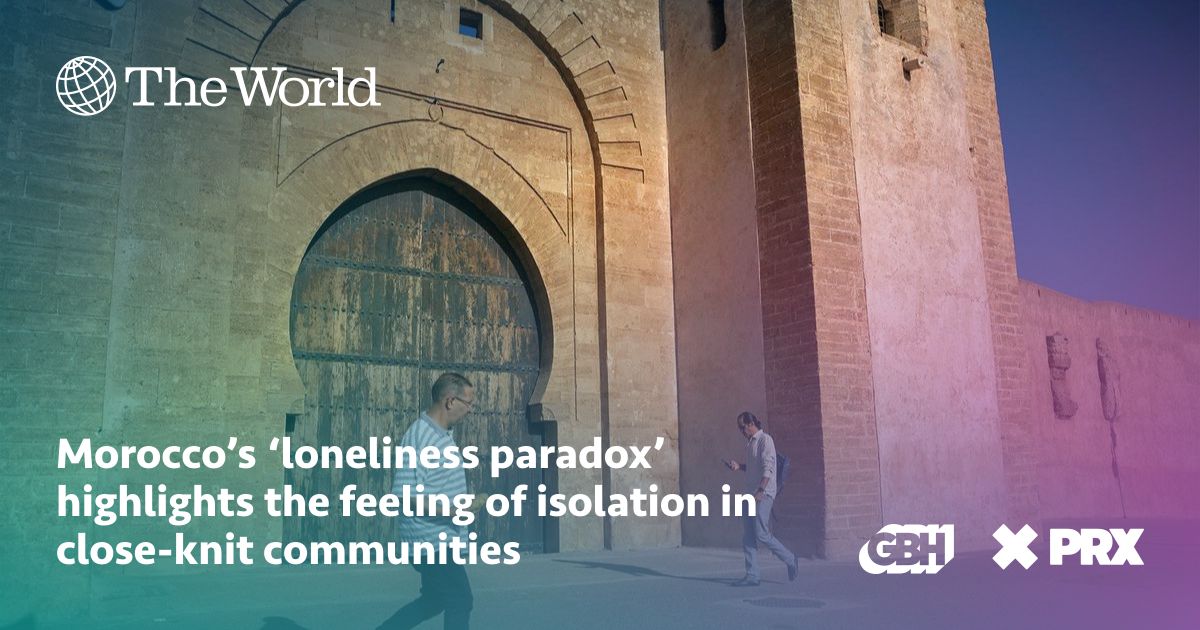
In this file photo, people walk through a gate of the ancient Medina of Fez, a UNESCO World Heritage Site, Morocco, April 25, 2017.Mosa’ab Elshamy/AP/File photo
In 2025, the Annecy Behavioral Lab conducted a global survey on loneliness. In Morocco, researchers learned that loneliness itself is a taboo subject — sometimes even denied altogether.
“If someone tells you they’re lonely, they’re out of their mind,” said a local basket seller in Casablanca’s main outdoor market. “You go out, you work. You work, you make money. If you stay in and sleep,” he said, “you’re going to get what’s coming to you.”
This view that loneliness is something akin to laziness, or even immoral, is widespread, said co-researcher Mohammed Zouiri from the University of Fez. He said it’s made loneliness an invisible problem.

This file photo shows the reading room of the Al-Qarawiyyin mosque in Fez, Morocco, April 14, 2016.Samia Errazouki/AP/File photo
“You go to a certain person, they don’t look lonely, they don’t have symptoms of loneliness,” he said. “And they, themselves, believe that they are not lonely.”
But when you put them in certain situations, he said, and ask the right questions, their view changes.
“They find out that they are lonely,” he said. “Maybe they need help. Maybe they lack connections.”
The Moroccan researchers interviewed 50 people of different ages, genders and economic backgrounds, both in cities and in the countryside.

In this file photo, a vendor selling Ramadan sweets speaks to customers in the ancient Medina of Fez, a UNESCO World Heritage Site, in Rabat, Morocco, May 22, 2019.Mosa’ab Elshamy/AP/File photo
Sociologist Ben Fraiha said it was like they’d cracked open some lid for the first time. The one-hour sessions, she said, often went on for two or three hours as people poured out their feelings.
“They were happy because it felt like, ‘Oh, finally we will have this environment in which we don’t just have to pretend,’” she said. “’We just have to be ourselves.’”

A family walks through the ancient Medina of Fez, a UNESCO World Heritage Site, in Rabat, Morocco, May 22, 2019.Mosa’ab Elshamy/AP/File photo
For the Annecy study, loneliness was defined as the gap between what you want from your relationships and what you actually get. For Morocco’s younger generations, notably Gen Z, that gap has been widening in recent years. Last year, things boiled over.
In October 2025, tens of thousands of students took to the streets to protest, in essence, against a society that they say doesn’t reflect their needs. They demanded more spending on education and healthcare — including on mental health.
Police quelled the unrest. But that gap is still there.

People protest against corruption and call for healthcare and education reform, in Casablanca, Morocco, Oct. 2, 2025.AP/File photo
Ben Fraiha said it’s partly because Morocco’s older generation remains traditional and pious.
“The younger generation cannot really talk about this with the older generation,” she said, “because they are going to be seen as not religious. Or not close to God.”
The Annecy global study is meant to help find solutions to the problem. But in Morocco, there are currently no government programs to combat loneliness. Because loneliness is still not part of the public debate.
So, for now, the solution — among young people at least — is just to talk to each other.

People shop for vegetables and fruits at a stall in the ancient Medina of Fez, a UNESCO World Heritage Site, in Rabat, Morocco, May 22, 2019.Mosa’ab Elshamy/AP/File photo
Abnur Saberi, a 27-year-old PhD student, also took part in the study. He said he counts himself lucky for having trusted friends.
“They occupy this special position in your life where you can just pour your heart out. And so, I never really felt the need to discuss this stuff with my parents.”
Saberi said he was depressed for a while when he got bogged down with his dissertation. But his friends helped him through it.
Meanwhile, researchers say that for such a tight-knit society to do the same for its people, it must first recognize how alone someone can feel — even if they’re seldom by themselves.