Gordon Dalton won the Acrylic Runner Up Award in Jackson’s Art Prize this year with his work The Stranger. In this interview, he discusses how creative blocks can signal necessary change, feeling like an outsider in a once-familiar landscape, and the link between coastal erosion, paint, and memory.
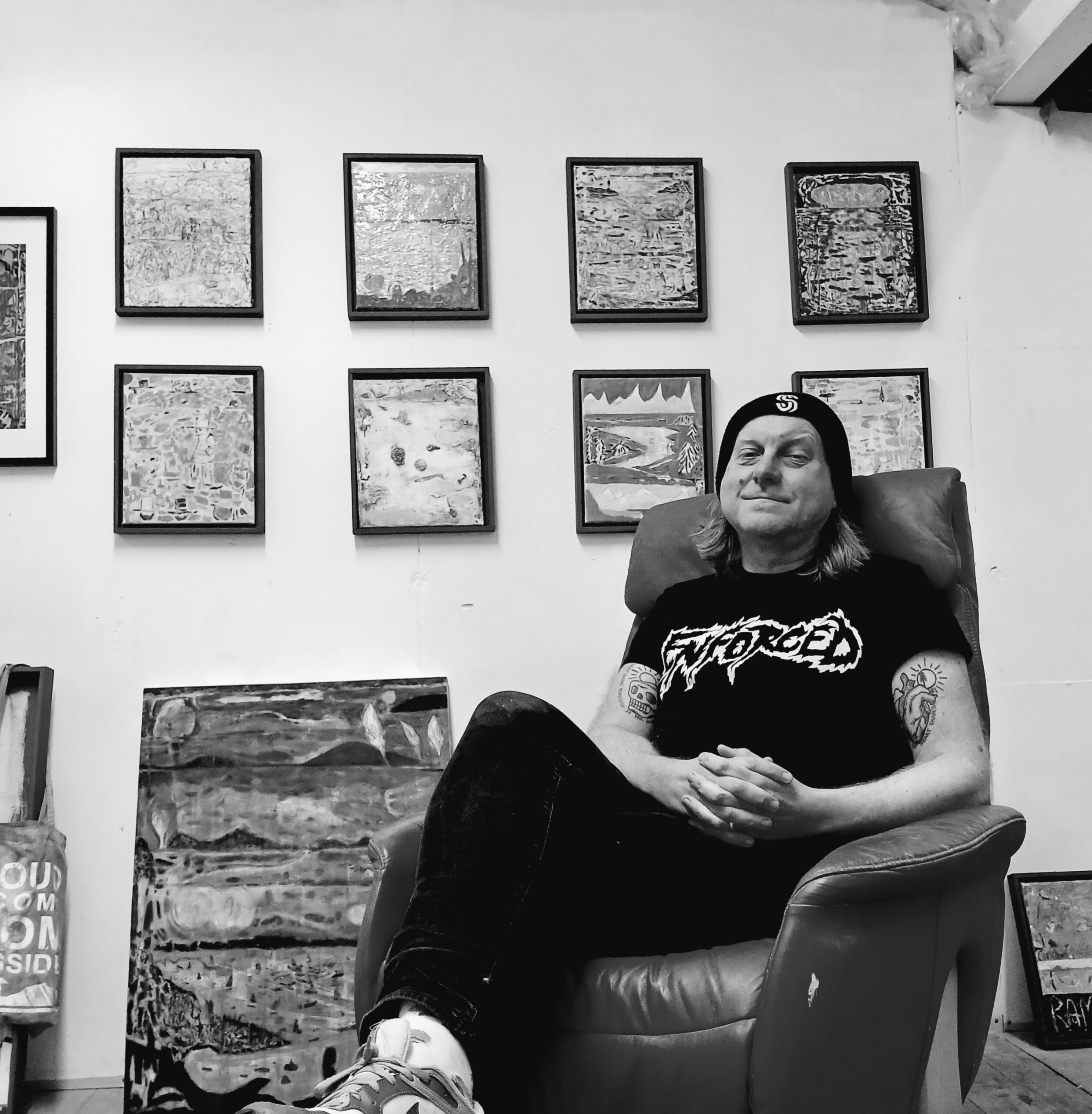
Above image: Studio portrait of Gordon
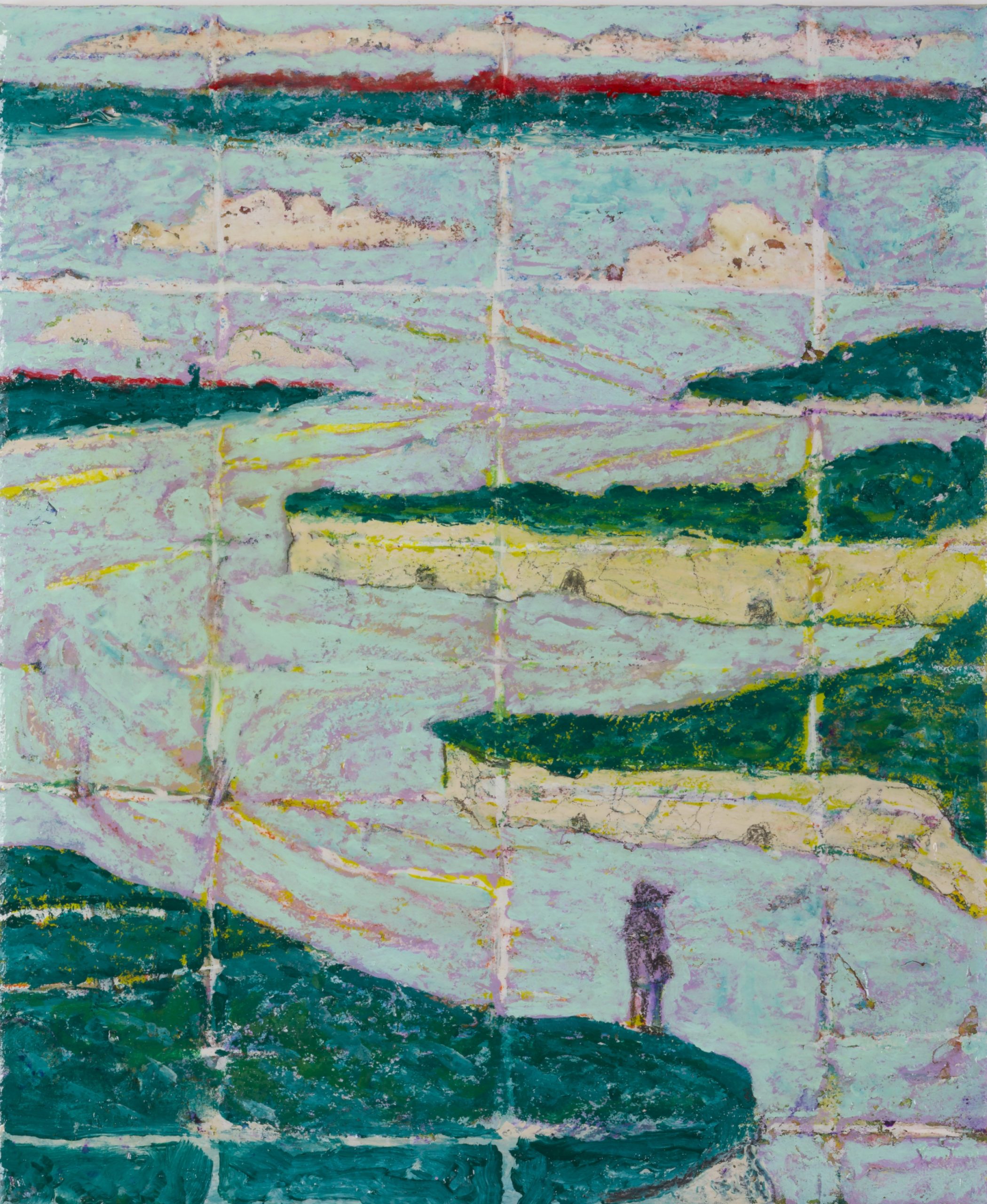
Gordon Dalton
Acrylic on canvas, 30.5 x 25.5 cm | 12 x 10 in
Josephine: Could you share the story of how you became an artist and tell us more about your artistic background?
Gordon: I don’t think there was ever a single moment when I decided to become an artist. Drawing and making things had always been part of being a teenager: doing cartoons, copying album covers, doodling in books, etc, but I didn’t really do art. I was an engineering apprentice, a bad one, but had a chance to go back to college; I was thinking maybe special FX or music lighting. So this led to studying on a Foundation course in Middlesbrough, which was a lot more exciting than being in a factory.
I moved to Cardiff for my BA, which was an eye opener, did a year in Kansas, where I ‘dropped out’ and travelled, before returning to Wales, which ended up being a huge part of my life for 25 years. I had a few short stints in Manchester, Edinburgh, and Newcastle, including an MA, working for Artists Newsletter, and being involved with various artist-led groups, which gave me an invaluable pool of experience.
I’m now finishing a practice-based PhD at Loughborough University researching solastalgia, the emotional distress caused by environmental change, through painting and repeated engagement with the post-industrial coastline of North East England.
Returning to the North East after many years away had a huge impact on my work. That experience of being both familiar with and estranged from the landscape has become a thread running through everything I do.
Although my practice has become more research-led over the years, I still think of myself as a painter first. The ideas matter, but they have to be carried by the paint itself. I’m happiest in the studio, putting the hours in, making mistakes, scraping things back and gradually discovering where a painting wants to go. That’s the part of being an artist that still excites me every day.

Josephine: What does a typical working day in the studio look like for you? Do you have any important routines or rituals?
Gordon: I’d say my studio days are quite disciplined. I used to love painting at night, but those nights are rare once you have a family. I usually start with a cup of tea and spend some time looking at the paintings before I touch a brush. That reflective time is really important, thinking about what’s working, what’s not, and where each painting needs to go next. Sometimes the best decision is to leave something alone for another day.
I’m usually working on several of my studio grid paintings at the same time. Moving between them keeps me from overworking any one piece, and it’s interesting how solving a problem in one painting often leads to an idea in another. The grids themselves encourage that kind of reflective analysis, where each panel is considered individually but also as part of a larger whole.
There are plenty of tea breaks with studio neighbours, and the odd interruption to wrap up and send a Vinted parcel if something’s sold. It pays for the studio rent. If the weather’s good and I feel I’ve earned it, I might even head out for a few hours of fishing. I’ve found that stepping away from the studio is often when solutions appear.
More than anything, I believe in simply putting the hours in. Painting isn’t about waiting for inspiration to arrive. The more time you spend in the studio, looking, thinking, and making, the more the work gives back. Some days feel incredibly productive, others less so, but over weeks and months those hours really do add up, and that’s where the rewards come from.

Gordon Dalton
Acrylic on canvas, 30.5 x 25.5 cm | 12 x 10 in
Josephine: Which materials or tools could you not live without?
Gordon: I’ve never been especially precious about materials, and I enjoy experimenting, but there are a few things I couldn’t imagine working without. Paint, obviously, but just as importantly, a good scraper. I spend almost as much time taking paint away as I do putting it on. Scraping back through layers reveals unexpected colours and marks, and often that’s where the painting really starts to come alive.
I also use a lot of household brushes alongside artist brushes. They’re inexpensive, take a bit of abuse, and encourage me to work freely without worrying about looking after expensive equipment. I have a box of old ones that were really cheap and almost worn away now, which I reach for towards the end of a painting. Some get retired or bandaged up for one last dance as I know exactly what they will do. They are like old friends.
I have an ongoing collection of small painted panels which are probably my most valuable tools. They’re not finished works; they’re places to test ideas, record colour, make notes, and reflect on what I’ve seen. They become the foundation for the larger studio grid paintings, even if the finished work ends up looking very different.
And finally, tea bags and bubble wrap. I get through an alarming amount of it in the studio. Making a cup of tea is often the excuse to stop, step back and really look at a painting. Those few minutes away can be just as productive as the time spent with a brush in my hand. I hate wrapping though.

Josephine: Do you work from a reference? Tell us more about your process.
Gordon: I spend a lot of time out and about, as the lived experience of a place is so important. It’s not so much field trips as I live on the coast here. Although I take a lot of photographs, I don’t work from a single photograph or a fixed reference. They are just a reminder that I was there, I was looking.
Instead, I build up a collection of notes, written observations, and small canvas panels. I’m interested in how a place changes over time, through weather, tides, seasons, and memory, so going back again and again is an important part of the process.
Back in the studio, those references become raw material rather than something to copy. Different locations, viewpoints, and moments often get compressed into the same painting. I might combine a cliff from one visit with the colour of the sea from another, or include marks that come from a completely different site. Memory plays as much of a role as observation, and I’m happy for paintings to drift away from the landscape they started from if it helps capture how the place feels rather than simply how it looks.
The panels are laid out in grids, and moved about at the end of the day depending on what needs doing the next day, how ‘successful’ they currently are or by relationships within the paintings. It’s kind of a league table where you are either promoted or relegated.
The physical process is just as important. I work in lots of layers, scraping back, repainting, sanding, and adding unexpected materials. I rarely know exactly where a painting will end up when I begin. It’s a conversation between the place, the materials and my own experience of being there. The finished painting isn’t really a record of a landscape; it’s a record of spending time with it.

Josephine: Do you regularly draw or keep a sketchbook? If so, how does this inform your work?
Gordon: Not as much as I should! I’d probably say I keep sketchbooks, but they don’t look like traditional sketchbooks full of careful drawings. Mine are a mixture of quick sketches, painted colour studies, maps, written observations, ideas, and the odd shopping list or to-do lists.
Alongside that, I make lots of small painted panels out on location. That became a really important part of my practice and now forms the basis of my studio grid paintings. Each panel is a response to a particular moment, a change in light, tide or weather, and it’s accompanied by reflective notes about the site and my experience of being there. Individually they’re quite modest, but together they build up a much richer understanding of a place over time.
I don’t often refer directly to a sketchbook when I’m painting in the studio. Instead, all those drawings, notes, and panels become part of a much bigger archive. They’re there to jog my memory rather than provide something to copy. The panels and the sketchbooks help me remember how a place felt rather than simply what it looked like.
I think that’s why they’re so important. They’re not just records of observation; they’re records of thinking. They allow me to reflect on the landscape over months and years, and that slow accumulation of experience is what ultimately finds its way into the finished paintings.

Josephine: Have you ever had a period of stagnation in creativity? If so, what helped you overcome it?
Gordon: Absolutely, and I think every artist goes through periods where nothing seems to work. I’ve certainly had paintings that have completely stalled, or times when I’ve questioned the direction of my work. Earlier in my career I found that really frustrating, but I’ve come to realise it’s just part of the process, and I just go and do something else.
What helps me most is carrying on regardless. I’m a big believer that inspiration comes from working, not the other way around. Even if I don’t feel particularly creative, I’ll go to the studio, make a cup of tea and start looking at the paintings. Sometimes all I do is scrape something back, move a canvas or make a few notes, but those small actions usually lead somewhere.
Getting back out into the landscape also helps. Walking the coastline, making small painted panels and spending time observing reminds me why I paint in the first place. Fishing does something similar. Standing on a pier or lake for a few hours clears my head, and I often come back with a fresh perspective, even if I haven’t been thinking about painting at all.
I’ve also learned that creative blocks are often a sign that something needs to change. They force you to experiment, take risks and let go of old habits. Looking back, some of the most important developments in my practice have come immediately after periods where I thought I’d lost my way. So now I don’t fear those moments quite as much. I trust that if I keep putting the hours in, the work eventually starts moving again.

Gordon Dalton
Acrylic on canvas, 170 x 230 cm | 66.9 x 90.5 in
Josephine: Are there any specific artists or mentors who have inspired you?
Gordon: I’d find it difficult to point to one artist because my influences have changed over the years, but there are a few whose work I return to again and again. Per Kirkeby has had a huge influence on the way I think about structure, layering, and the landscape as something that’s constantly evolving rather than fixed. I’m also a great admirer of Merlin James and David Milne. Their paintings demonstrate that landscape doesn’t have to rely on spectacle. Instead, they reveal how subtle shifts in colour, surface, and composition can evoke memory, atmosphere, and a profound sense of place.
I often find myself looking back to Pierre Bonnard and Édouard Vuillard as well. Their intimate handling of space, fractured compositions and sensitivity to colour have all influenced the way I think about painting. I’m interested in how they dissolved the boundary between observation, memory and lived experience.
Outside painting, Douglas Coupland has been a significant influence. His writing about memory, place, nostalgia and the uncertainties of contemporary life has resonated with me for many years. Alongside that, Glenn Albrecht’s work on solastalgia has become central to my PhD research, giving me a language for ideas that I’d been exploring in my paintings long before I encountered the term.
As for mentors, I’ve been fortunate to have conversations with artists, curators and tutors throughout my career, but I don’t think my practice has been shaped by any one individual. More than anything, it’s the North East coastline that’s been my longest and most demanding teacher. Every visit reveals something different, and that’s what keeps me painting.

Josephine: What were you thinking about or exploring at the time you made The Stranger? What inspired it, and how did it come to be?
Gordon: The Stranger came out of a period when I was thinking a lot about belonging, memory, and what it means to return to a landscape that feels both familiar and unfamiliar. I’d moved back to the North East after many years away, and although these were places I knew intimately from childhood, they no longer felt quite like home. The landscape had changed, but so had I. That tension became the starting point for the work.
The title comes from the feeling of being both an insider and an outsider at the same time. I was walking the coastline, revisiting places I’d known for decades, but looking at them through different eyes. I became interested in the idea that landscapes carry memories, but they also resist them. They’re constantly changing through erosion, industry, tides and weather, while our own recollections become selective and unreliable.
Rather than making a straightforward landscape painting, I wanted The Stranger to feel fragmented, almost like memory itself. Different viewpoints, different moments, and different emotional responses are brought together into a single work. It’s less about documenting a place than recording an experience of being in it. Looking back, I think it marked an important point in my practice because it shifted my focus from painting what I could see to painting how a place is remembered, felt and experienced. That idea has gone on to underpin much of my PhD research into solastalgia and the changing post-industrial landscapes of the North East.

Gordon Dalton
Acrylic on canvas, 170 x 170 cm | 66.9 x 66.9 in
Josephine: What made you submit this piece to Jackson’s Art Prize?
Gordon: It was one of those paintings that got promoted to the top of the studio grid. Figurative elements do appear in my work, but this was more blatant and I thought the figure might connect to an audience.

Josephine: What is the significance of the gridded pattern in The Stranger? It reminds me of the creases left behind on an unfolded map.
Gordon: I really like that reading because maps definitely played a part in the painting, even if not in a literal sense. The grid isn’t there simply as a compositional device. It’s a way of breaking up the landscape, almost as though it’s being reconstructed from fragments of memory, observation, and experience. Like an old paper map that’s been folded and unfolded countless times, the landscape carries traces of use, movement, and time.
I’m also interested in how the grid disrupts the traditional idea of the landscape as a window onto the world. Instead of inviting the viewer to look through the painting, it asks them to move across it, piecing things together in much the same way memory works. In that sense, your comparison to an unfolded map feels very apt. It’s a landscape that has been handled, folded, carried around, and altered by experience, rather than one that offers a fixed or objective view.

Josephine: Despite the overall blueness of the piece, there are hints of pink, red, orange, and yellow coming through. Is it built up from many layers? Could you talk about your layering process, and how much of it was planned vs spontaneous?
Gordon: Yes, it’s built up from a lot of layers, and that’s a big part of how I work. I rarely start with a fixed image in mind. Instead, I build the painting over time, adding, removing, and rediscovering what’s already there. Those flashes of pink, orange, yellow, and red are often remnants of earlier decisions that haven’t been completely painted out. I like the idea that the painting carries its own history, with traces of previous versions still visible beneath the surface.
The process is a balance between planning and instinct. I usually have a clear sense of the atmosphere I’m trying to create, but not necessarily how I’ll get there. I’ll put down bold colour, scrape it back, sand areas, repaint them, and sometimes leave unexpected marks if they feel right. Quite often the most interesting passages are the ones I hadn’t intended. They’re the result of the materials interacting with each other rather than me trying to control every outcome.
That way of working mirrors the landscape itself. Coastal environments are built up over centuries through erosion, deposition, and constant change. I think of the surface of the painting in much the same way, as something that’s accumulated over time. The final blue layer unifies the work, but it doesn’t erase what came before. Instead, those earlier colours continue to emerge, a bit like memories or geological strata, reminding you that every landscape, and every painting, contains evidence of its own past.

Josephine: Are there any new techniques or ideas you’re excited to explore using the materials from your prize?
Gordon: Definitely. One of the things I enjoy most about painting is experimenting with materials, so having the opportunity to try products I might not normally buy is really exciting. My practice has always involved testing different surfaces, grounds, and ways of applying paint, so I’m looking forward to seeing how these new materials behave rather than using them for exactly what they’re intended for.
At the moment I’m particularly interested in pushing the layered surfaces in my studio grid paintings even further. I’m always looking for ways to build depth, create more complex textures and allow earlier layers to emerge through the finished image. New paints and mediums might open up possibilities I haven’t discovered yet.
Because my work is rooted in coastal landscapes, I’m also interested in how materials can echo the processes I’m painting about: erosion, weathering, sediment, and the passage of time. Sometimes the most successful discoveries come from happy accidents, when two materials react in an unexpected way or a surface does something I hadn’t anticipated.
The prize has given me the confidence to keep experimenting. I think it’s important not to become too comfortable with your own methods. Every new material has the potential to change the way you think and paint, and that’s one of the things I love most about being an artist.

Gordon Dalton
Acrylic on canvas, 30.5 x 25.5 cm | 12 x 10 in
Josephine: How did it feel to move through the stages of the competition and win the Acrylic Runner Up Award?
Gordon: I’d been shortlisted before, but getting those emails saying you were in the next stage was really great. To win a prize amongst all the other winners was great.
Josephine: What’s coming up next for you?
Gordon: The biggest thing on the horizon is finishing my practice-based PhD at Loughborough University. It’s been a huge part of my life over the last few years, and I’m looking forward to bringing the research and the paintings together. The project has really changed the way I think about landscape, memory, and environmental change, and I know those ideas will continue to shape my work long after the doctorate is finished.
In the studio, I’m continuing to develop my grid paintings and looking at ways of making them even more ambitious in scale. I’m interested in creating larger, more immersive works that bring together multiple viewpoints and different moments in time, allowing the paintings to reflect the fragmented way we experience landscape and memory.
Alongside that, I’d like to exhibit the new body of work more widely and continue building relationships with galleries and collectors. The prize has been a real boost, and it’s encouraging to know that the work is connecting with people beyond my immediate circle.
More than anything, though, I just want to keep doing what I’ve been doing, getting out onto the North East coastline, filling sketchbooks, making small studies, spending time in the studio and seeing where the next paintings lead. I don’t think the questions that drive my work are going away any time soon, which is a good thing. It means there’s still plenty left to explore.
Follow Gordon on Instagram
Visit Gordon’s website

Further Reading
Meet Angela Lizon, Winner of Jackson’s Art Prize 2026
Jackson’s Art Prize 2026 First Prize Winner Announced
How We Collaborate With Artists
Expert Advice on Making Your Way as an Artist
Shop Acrylic Painting on jacksonsart.com