For most of history, Champagne’s climate has been unambiguously marginal, characterised by low average temperatures, frequent frosts, and markedly variable vintage conditions. These conditions make ripening challenging, typically resulting in fruit with higher total acidity, lower pH, and modest potential alcohol. Challenging climatic conditions are further complicated by yields, which are commonly extremely high, making ripening even more difficult—whilst the CIVC itself sets maximum permitted yields, the grapevines often produce much higher yields, with the excess either dropped or held in reserve if allowed.
The resultant wines were predictably difficult; in 1694, Louis XIV’s doctor declared that the wines of Champagne were too acidic for the king’s stomach, advising his countrymen to drink Burgundy, which was considered warmer and more nourishing. A few decades later, cleric and educator Noël-Antoine Pluche wrote in Le Spectacle de la Nature that champagne was “lively but biting”, and pleasant only when “tempered”. Similarly, contemporaneous descriptions from letters and pamphlets written by Englishmen recorded champagne’s tendency to be “sharp”, “racy to the point of pain”, and “violent upon the nerves”.
Accordingly, at the beginning of the nineteenth century, champagne producers began adding sugar, after second fermentation was completed and the wine was disgorged, to balance high acidity, mask unwanted flavours and aromas, and hide faults and imperfections in their wines. This addition was called dosage and was added in a solution labelled the liqueur d’expédition (or liqueur de mère). Originally, this solution consisted of an aged house wine to which cane sugar was dissolved and occasionally a small amount of grape spirit or brandy was added.
This practice was not universally accepted, but the official doctrine, as the dawn of the twentieth century approached, was that it was necessary to dose heavily: an information brochure prepared by the Syndicat du Commerce des Vins de Champagne (which became the Syndicat de Grandes Marques, and then in 1994, the Union des Maisons de Champagne) declared that following fermentation in the bottle, the wine has almost completely lost its sugar and becomes virtually undrinkable.
In addition to transforming undrinkable wines, dosage also helped market champagne to new, global clients with varying tastes—champagne was industrialised very early, by the late 1780s, major houses were producing hundreds of thousands of bottles annually and marketing globally with représentants specialising in specific foreign markets. In London, wine merchants were requesting Perrier-Jouët to ship their cuvées without any dosage as early as 1848, so that the wines could be sold more easily as a fine table wine–the dessert wine category was dominated by large imports of Port and Madeira. In 1874, Madame Louise Pommery released the first commercial ‘brut’ wine, which itself was explicitly intended for the English market. This growing preference for dry wines was reflected in popular culture; a conversation appeared in Punch in April 1862 in which a young man notes he has “arrived at a stage in life … that I like my wine dry”.
By 1870, the prevalence of sweet champagne approached its end in the British market, and brut became more common after 1876. Dry wines were also popular in North America; however, more sugar was generally added to bottles destined for the United States than for England (110 to 165 grams versus 22 to 66 grams).
However, it was not until nearly 1910 that heavily dosed champagne began losing ground to drier champagne in France. In 1868, Dr Jules Guyot, writing in Études des Vignobles de France, remarks surprisingly that “the English have come to prefer Champagnes with little or no sugar, which to our taste seem hard and severe.” Later, at the Exposition Universelle of 1889, foreign visitors remarked that champagne served domestically was noticeably sweeter. Edmond de Ayala reveals the extent of domestic preference for sweeter styles when, in 1870, he bemoaned poor sales of his drier wines in France. Finally, author Cyril Ray recounts in 1903 that, having asked a merchant in Champagne for some vin brut, he received as a reply, “Ah! You drink that poison”. By 1911, this anecdote has disappeared from a republished edition.
The Germans (165 to 200 grams per bottle), Belgians, and Austrians also preferred sweet champagne. In Germany, elite wine culture was predisposed to sweet wines; late-19th-century German wine journals describe British Brut Champagne as “hart, sauer und unerquicklich” (hard, sour, and joyless). In Austria, Champagne shipped to Vienna and the Habsburg court was served as festive or dessert wine; Austrian commentators visiting London in the 1880s remarked that Champagne there was “auffallend trocken und unerquicklich” (strikingly dry and unrewarding); in Belgium, tastes were influenced strongly by French culture; consumers associated champagne with banqueting, abundance and conviviality, not restraint.
Further east, the Russians enjoyed champagne the sweetest of all (275-300 grams); in 18th and 19th century Russia, sugar was expensive, signalling wealth, power, and access—dryness suggested economy and restraint. The Russians—to whom sugar was warming in a desperately cold climate—were also accustomed to sweeter drinks, like medovukha, varenye, and dessert and fortified wines from Crimea and the Caucasus. At one time, the Russian market was of great importance, and so champagne houses competed fiercely for local favour, thus reinforcing the tendency for increasing sweetness.
Despite all this, by 1920, everything had changed. After World War 1 and the 1917 Russian Revolution, the Russian market vanished overnight, private luxury consumption collapsed, assets were confiscated, and the court market disappeared. In contrast, England remained politically stable and retained a wealthy upper and upper-middle class who still wanted champagne, paid reliably, and most importantly, preferred low-dosage styles. Champagne producers were facing an existential crisis at home, too; the Marne front ran directly through Champagne, vineyards were torn up by trenches and artillery, cellars were flooded or collapsed, workers were killed or conscripted, horses were requisitioned, and local villages and the capital were destroyed. Consequently, in reestablishing production, champagne producers prioritised the preference of their most lucrative market.
By the mid-1930s, the English penchant for dry wines had changed world supply; the plethora of varying sweetness levels made for different nations gave way to a narrow range of styles offered by each house to all buyers. Whilst principally motivated by commercial needs, this change also dramatically simplified production. Before 1920, champagne houses were managing different liqueur recipes and disgorgement timings, managing parallel bottlings of the same base wine, and coordinating logistics for different markets. This was further complicated by a host of equally complicated production processes managed simultaneously. After simplifying product ranges, houses could focus on one principal dosage target and a single disgorgement profile, helping simplify the cellar rhythm and reduce inventory fragmentation, bottling runs, and error rates. All this meant wines required less post-disgorgement ageing and could be released earlier, matching faster-moving markets. Thus, by 1950, the proportion of brut champagne is well over half of total shipments.
Nevertheless, after more than a century of champagne flavour being defined by extreme quantities of added sugar, consumers had come to understand the region’s wines predominantly through this narrow lens. Similarly, champagne producers sold their wines on this premise, dramatically adjusting flavour for varying markets and marketing wines accordingly. This meant that, even after average sugar levels had fallen dramatically—by 1991 the majority were less than 11g/l—sweetness remained the sole production factor touted broadly by buyers and sellers alike, despite a growing plethora of variables all significantly affecting champagne style.
Until the late twentieth century, sweetness classifications remained a benign-but-prominent feature in champagne marketing, and producers continued making small adjustments to balance wines and maintain house styles. However, this prominence soon made dosage an easy target and principal antagonist in a whole host of novel macro trends, creating a powerful reactionary sentiment which moralised sugar, stupefied public discourse, and strongly influenced production itself.
The genesis of this reactionary sentiment is not obvious, but writer and wine importer, Terry Theise, notes that “in Germany the sugar jihad began in the early 80s and gathered steam thereafter”. Around this time, German Riesling experienced great commercial success, largely attributable to popular sweet supermarket brands, which swiftly came to define the variety. Soon after, commentators and producers began lamenting sugar as the great flattener solely responsible for homogenising wine. This lamentation eventually merged with nascent anti-industrial sentiment, creating a moralised vocabulary primed for use against dosage in champagne. During the 1990s to early 2000s, there was growing suspicion amongst wine commentators about standardisation and manipulation, followed by increasing minimal-intervention rhetoric in fine wine, within which interventions of any kind were increasingly questioned, even when historically typical or technically justified.
Shortly after, the grower champagne category begins its rise to prominence, thanks to intrepid importers like Robert Walters and Terry Theise who went off the beaten track in search of something new. Many of the growers they found strongly rejected dosage, convinced that it ‘obscured terroir’. For others, the objection was countercultural, separating them from the industrial wines made by ‘commercial’ growers. Whatever the exact persuasion, many of these growers pursued either very low dosage, or no addition at all. These news wines, and the ideological persuasions of their makers, were widely propagated by trendy sommeliers, who can be distinctly susceptible to proselytising received wisdom. This preoccupation with sugar also enthused wine journalists, who grew fixated on presenting dosage not only as consequential but as largely undesirable. In turn, drinkers absorbed both the narrative and preference, creating a feedback loop which gave the impression they too only favoured the driest champagnes.
The anti-dosage sentiment grew even stronger amidst the natural wine boom spanning roughly 2000-2020, after which it lost significant steam. During this period, ‘minimal-intervention winemaking’ gained popularity, with advocates rejecting signature, disparaging ‘intervention’ and aggressively chastising an increasingly exhaustive list of allegedly sinful practices. Against this backdrop, even commercial producers began drastically reducing dosage, ostensibly because the climate enabled greater ripening. Growers became even more fervent in slashing dosage, in many cases eschewing sugar entirely. However, whilst in some cases diligence and craft made for great wines regardless, more commonly the result was harsh and disjointed wines screaming out for small additions and often leaving greatness on the table.
Whilst champagne could once easily be defined by dosage, when amounts regularly exceeded 100g/l, most other production factors were obscured by sweetness alone. Today, dosage is not only significantly more restrained, rarely exceeding 9g/l in even the most commercial champagnes, but is itself constructed following an array of decisions, such that its effect on a finished wine’s taste cannot be predicted by grams per litre alone. Last year, I visited Billecart-Salmon to find out more about these choices and to taste their impact on finished wines.
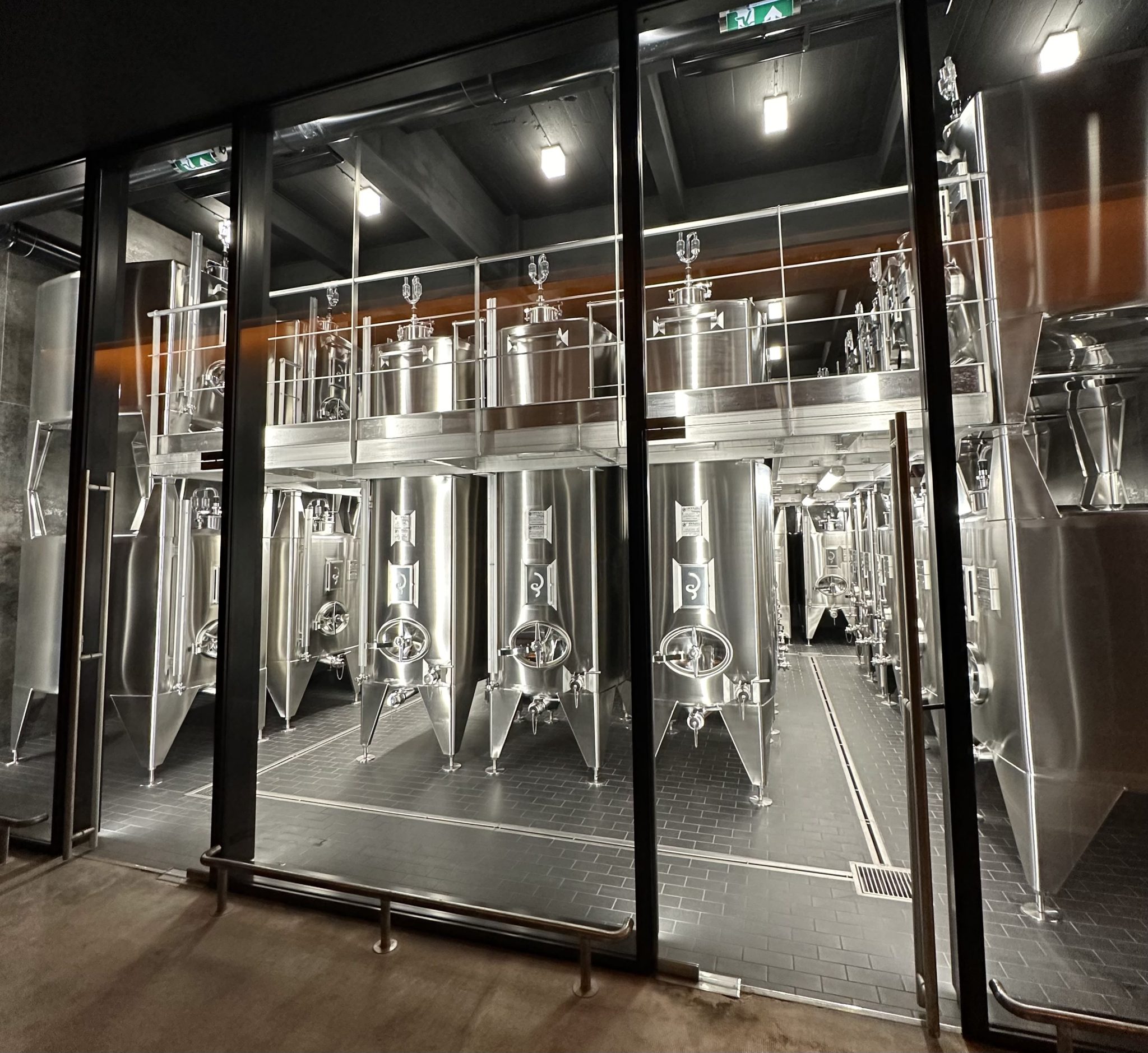
In 2016, Billecart-Salmon constructed a climate-controlled, sterile ‘nursery’ in its cellars containing 51 stainless-steel vats for storing still wines intended for making liqueur de mère/d’expédition tailored to each cuvée and format—the ‘nursery’ even includes liqueur produced from unbottled Clos Saint-Hilaire. These still wines are no longer produced with any old wine; they’re selected, picked and vinified separately for their own distinct characteristics, beginning with a mix of Chardonnay and Pinot Noir from villages ranging from Mareuil-sur-Aÿ to Ambonnay, Avize, and Cramant, the former contributing structure and vinosity, the latter salinity and generous aromatics. In some cases, a still wine from just one of these villages makes up the liqueur de mère; in others, a blend from as many as five villages is carefully composed by cellar master Florent Nys.
Whilst the fruit of each village contributes distinctly to the vin clair, these contributions are further compounded by vintage; ripe, generous years like 2015 and 2018 contrast sharply with the late, cold austerity of 2013 and the chiselled classicism of 2014. Six liqueur de mère tasted at Billecart-Salmon included wines from 2013 to 2018, including every vintage between. Additionally, the liqueurs range from single vintage to four vintages blended. In addition to village and vintage, there are the élevage variables selected for each of these respective still wines, ranging from vessel type to duration. To begin, each variety from these varying villages and vintages can be vinified and aged in either stainless steel vats, oak barrels, which each affect the wine differently according to their own distinct composition, or a mix thereof. After selecting a vessel, each wine can then be aged for varying periods, often for as long as five or more years.
Once the desired still wine has been assembled, the liqueur de mère is created by the addition of sugar. Traditionally, cane sugar was most common, often perceived as a rounder, warmer, and cleaner sweetness. Today, beet sugar is preferred, largely for its neutrality, local production, familiarity, and cost. Some producers, including cult phenom Olivier Collin, forego both, opting instead for the industrial product moût concentré rectifié (MCR), which is a highly purified, neutral grape-sugar concentrate, purportedly for its neutrality and superiority in ‘revealing terroir’—the paradox at the heart of such a decision needn’t be laboured here.
Finally, there is the rarely discussed matter of concentration. Notably, the same dosage (e.g., 3 g/l, which requires 2.25 grams of added sugar per bottle) can be achieved in bottle by making starkly different additions. For example, a maison might produce a highly-concentrated liqueur consisting of 720 g/l of sugar (0.72g per/ml) which would require very little liquid to achieve 3g/l (2.25/0.72 = 3.1ml); alternatively, they may produce a lightly-concentrated liqueur consisting of 300 g/l (0.3g per/ml) which would require twice the total liquid to achieve the same sugar level (2.25/03 = 7.5ml). The former reflects a modest ‘assaisonnement’, the latter makes dosage a more meaningful structural component. Thus, because dosage does not only reflect the total quantity of added sugar but also choices about volume and composition, a wine labelled ‘low dosage’ may in fact be subject to much greater ‘manipulation’ than another with more added sugar. Readers should also note that total finished sugar can differ dramatically to dosage classification, strongly confounding the lowest groupings.
Consequently, during a blind tasting of six liqueurs at Billecart-Salmon, all varying permutations of these variables, it was not only practically impossible to identify which was sweeter, but in many cases liqueur with lower total sugar was perceived as sweeter than another with more. Additionally, each was itself characterful, clearly designed to complement a given wine, not merely add sweetness or hide imperfections.
For too long, dosage—the only intervention added after a wine is finished—has been an easy target, scapegoated by zealous growers and drinkers, and misunderstood by uncritical journalists and sommeliers. Whilst dosage was indeed once executed so grossly that it largely defined champagne, today, generally low sugar additions coupled with the vast plurality of decisions made by growers from vineyard to bottle defies such abject reductionism. This plurality is further exemplified in dosage itself; the most thoughtful houses and growers agonise over an almost infinite array of variables resulting in a staggering range of combinatorial permutations. The resultant liqueur de mère is not just kaleidoscopically complex, but also complementary, binding with perceived acidity, rounding phenolics, increasing mid-palate amplitude, and ultimately completing the finished wine, just as salt does in our most admired foods. The tedious moralising of benign winemaking choices only serves to homogenise wine, depriving drinker and maker alike. In the case of dosage, it is surely time to take numbers with a pinch of sugar and enjoy champagne in its finished amoral glory.