I helped start R U OK? Why we need 2 more questions | Graeme Cowan

Most organisations treat these as three separate issues. Wellbeing owns loneliness. HR owns engagement. Operations owns productivity. Three different reports, three different owners, three different fixes.
I helped to start R U OK? We now need 2 more questions.
Thirteen years ago, I helped Gavin Larkin build something that got Australians asking each other one simple question: are you okay? It worked because it never asked anyone to become a therapist. It asked them to notice, and to ask.
Right now, the people running your teams need three questions, not one. Not because they’re bad at their jobs. Because no one ever taught them the first two.
What a WeCARE movement actually is
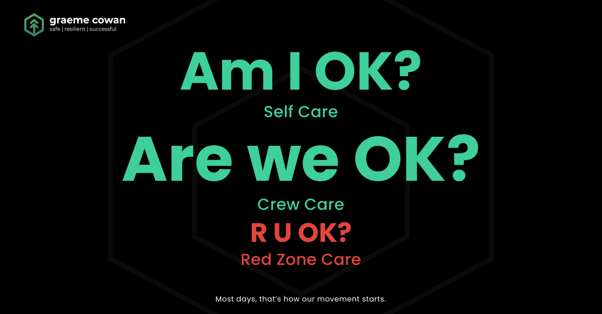
WeCARE is built on the same conviction as R U OK, that noticing, and asking, is something anyone can learn to do well. It just asks the question three times, at three levels.
Am I OK? is Self Care. The one where you embrace the mantra “self-care isn’t selfish”. You can’t notice anyone else’s Red Zone if you don’t know your own.
Are we OK? is Crew Care. Asked of the whole team, together, not one person at a time. It’s the difference between a team that performs and supports each other, and a team that’s quietly dies.
R U OK? is Red Zone Care, the one you already know. Asked of one person, when their behaviour, mood, or circumstances have changed.
Most workplaces only ever ask the third question, and only after something’s already gone wrong. WeCARE asks all three, most days, before it does.
R U OK started the same way, small. A handful of people who believed a single question, asked sincerely, could interrupt a bad day before it became something worse. It became a national day only because enough individuals kept asking it long after the campaign posters came down. A WeCARE movement is built to work the same way: one manager, one team, long before it’s anyone’s official program.
Why this matters right now
Australia now has the highest reported burnout rate of any country surveyed, 62%, against a global average of 48% (Microsoft Work Trend Index). Mental health related workers compensation claims in Australia have risen 97% over the past decade, with almost a fifth of that rise in the last year alone (Beyond Blue and CSIRO, 2025).
Behind both numbers sits the same gap: managers carrying more, with less support, and no daily habit for checking in on themselves or their team before it becomes a claim. And it’s compounding: AI is being asked to make workplaces faster at exactly the moment the people in them have the least capacity left to absorb it.
How the three questions work, day to day
Am I OK? takes thirty seconds, most mornings. Notice your own tank before the first meeting.
Are we OK? takes one real conversation a week. Not a survey. A question, asked of the whole team, with space to actually answer it.
R U OK? takes noticing one person, and asking. Not fixing. Just asking, then listening.
None of the three requires a program, a budget line, or permission from anyone above you. They just require doing it before there’s a reason to.
What it looks like when it works
Dave Banks led a team at NAB with an engagement score of 84%, well above benchmark. By every traditional measure, they were winning. But Dave noticed the energy in the room had changed, so he asked all three questions, in order.
Am I OK? He went first, opening a workshop by sharing his own struggle with work-life balance.
Are we OK? He then had his whole team assessed together. The headline number looked fine, 7.6 out of 10. Underneath it, half the team was still stuck in competition mode, and seven people were quietly in the red zone.
R U OK? I shared my battle with depression. Then one respected team member shared his own past battle with depression, something none of his colleagues had ever guessed. That was the moment it shifted. Four of the seven people in the red zone went on to tell Dave, one on one, what they were struggling with.
Ninety days later, the team’s average mood had risen to 8.1. The language in meetings had changed too. People said “we” instead of “I.” Dave didn’t get there with a bigger budget or a mandate from head office. He got there by asking three questions he already had the standing to ask and doing it before the numbers forced his hand.
Where this leaves you
R U OK? never needed everyone to start at once. It needed one person willing to ask, and then another.
A WeCARE movement just adds two questions before it. It doesn’t need a launch date, a logo, or sign-off from anyone. It needs you, tomorrow morning, asking the first question before you ask anything of anyone else.
When a team embraces these three questions, it becomes a WeCARE movement. When a whole organisation does, that’s WeCARE.
One manager, three questions, most days. That’s where every one of them starts.
Graeme is a keynote speaker who helps leaders build resilient and successful teams, without losing good people to burnout. He is also a founding director of R U OK? and host of The Caring CEO podcast – rated #2 globally in workplace mental health. His new Wiley book is “GREAT LEADER’S CARE: Developing safe, resilient, and successful teams”, and he co-founded WeCARE365 which produces customised and practical eLearning, to help managers have better burnout prevention conversations