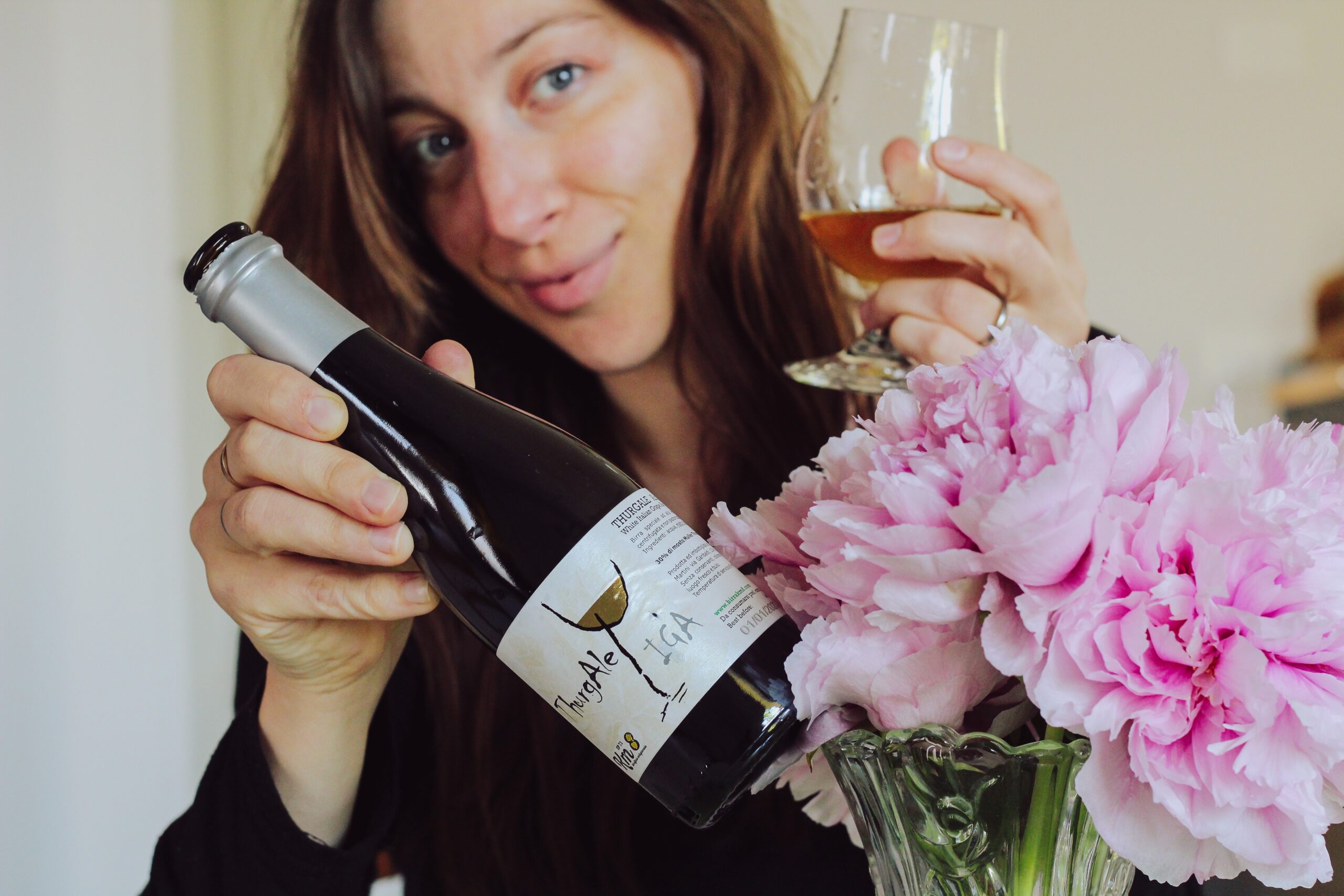
Italian Grape Ales are the emblem of Italianity, at least as much as Monica Vitti is in my mind. Discover everithing you need to know about this beer style.

The History of Grape Ale
The first trace of something between wine and beer can be found in Italy as far back as the 8th-7th century BC. From evidence found in the Museum of Carmignano (Prato) and the Necropolis of Casale Marittimo (Pisa), the Etruscans produced a “grog,” a hybrid fermented product that could contain grapes (already domesticated), honey, cereals, fruit, and spices.
More recently, according to Jean Van Roy, in the Yssche Valley (southeast of Brussels, in the villages of Hoeilaart, Overijse, and Huldenberg), some local Lambic brewers were already mixing grapes and Lambic beer; a practice that nearly disappeared in the 1970s.
In 1973, Jean-Pierre Van Roy bought from a neighbor some grapes Petit Royal, a table red grape coming from Overijse and he filled two 250 liters barrels. Both were very good, so good that workmen tasted too much from the barrel and developed acetic in one of them. The other was bottled and sold (unlabelled) at the bar Falstaff in the city center. In 1987 for the first time, Cantillon used muscat grapes coming from Italy, for the label Neuf Nations de Bruxelles / Negen Naties van Brussel, which I believe is the first labeled Lambic de raisin / Druivenlambik of the modern era. It’s the predecessor of Vigneronne, who was born between 1988 and 1989.
Read here more – the font – Luca Giaccone
Definition of Italian Grape Ale
Let’s give a nice Wiki definition of Italian Grape Ale:
Italian Grape Ale (abbreviated as IGA) is a style of beer flavored with grape must. It is a top-fermented beer, mainly produced by Italian craft breweries. It has been officially recognized as a beer style and included in the 2015 Beer Judge Certification Program style guidelines. The style was also included in the 2019 neologisms list of the Treccani encyclopedia.

Keeping in mind the Wiki definition, let’s briefly touch upon Grape Ale, as a few years ago, the BJCP decided to remove the term “Italian” from the style when the beer is produced outside of Italy, effectively splitting it into:
- Italian Grape Ale in the Local Styles X3 section (BJCP)
- and Grape Ale (produced elsewhere in the world) as a Fruit Beer, in section 29D. (BJCP)
As we’ve read in various articles, the reason and future of this sort of duplication are not entirely clear. So, let’s continue without delay or controversy and delve into some details about the style.
It’s worth noting in the BJCP’s historical notes that from the inception of this style, the centrality of two Italian giants in the development of this eclectic brewing style is recognized, as stated below:
Initially produced at Birrificio Montegioco and Birrificio Barley between 2006 and 2007, Italian Grape Ale (IGA) is now produced by many Italian craft breweries. It is becoming popular in the United States and other wine-producing countries. It represents a communion between beer and wine promoted by the great local availability of different grape varieties throughout the country. They can be an expression of the territory, biodiversity, and creativity of the brewer. They are typically considered a special beer in the breweries’ product range. Breweries call any wild/sour version of the style “Wild IGA” or “Sour IGA.”
However, Luca Giaccone, in his research (of which I have already cited some data), argues that the first Italian IGA is from Teo Musso – Birrificio Baladin:
in 2000, he added 25% of locally grown red grape (Dolcetto) to 500 liters of Nöel beer. The experiment was repeated in 2001 (with Nebbiolo, the famous grape of Barbaresco and Barolo) and in 2002 (again with Dolcetto).
Like many products related to the history of food, there seems to remain doubt about who can actually claim paternity of IGAs.
Raw material in Italian Grape Ale
Continuing to read the BJCP, it is evident that most beers in this style are produced with top-fermenting yeast strains with a neutral aromatic profile, but sometimes robust Belgian strains are used. In the former case, it means brewers mainly choose to keep the yeast profile as neutral as possible to highlight the grape flavors. In the case of Belgian strains, they aim to add an extra touch of aromatic complexity.
Why Belgians? It’s an understandable and creative choice: we’re talking about the country of masters in the art of blending extravagant ingredients, spices, and fruit, and guiding more or less spontaneous fermentations. What better source of inspiration!? However, there could be other inspirations: the first beer from Birrificio Barley that BJCP considers as IGA is, in fact, based on an Imperial Stout (so, an Anglo-Saxon inspiration).
But could there be a German base? It seems so: I recently tasted an incredible Italian Grape Lager (oh, now do we also have to categorize IGLs?) produced by Birrificio Della Granda. A brewery from Cuneo that has started an ambitious project of creation and collaboration specifically on IGAs: Be Grapeful.
In essence, the inspiration and consequent yeast choice do not only depend on the recipe but certainly on the brewer’s creativity and skill in managing various challenges (e.g., fructose metabolism) and utilizing the base fermentable characteristics to the fullest.
Speaking of grapes, usually when brewers choose aromatic grape varieties (e.g., Brachetto, Gewürztraminer, Malvasia, Moscato), they aim for a clean fermentative profile to not overshadow the extraordinary bouquet these grapes can express in the glass. However, as usual, the great freedom of expression that characterizes craft beers can contradict what was just said since the use of grapes in various forms, especially at various stages of the production process and perhaps even together with “alternative” fermentative flora, can instead somewhat downplay the vinous character, spanning complexity, wood, wild aromas.
A thorny issue from this perspective could be the Wild IGAs, also called Sour IGAs. A group of beers produced with the addition of brettanomyces, lactic bacteria, fermented by indigenous strains, and “pied de cuve,” and that can also host the bizarre nuances of acetic elements. Can these still boast the IGA appellation? Or is it better to classify them among fruit-accented sours? Common sense would guide us to place these productions, where “everything else emerges,” in other categories because levels of acidity and wild hints should not be considered typical of this style: a bit of acidity from grapes and that light wild touch are good as expressions of the grape variety, but in terms of balanced recipes. In short, we welcome those slightly bolder or wilder notes, but with moderation and always with an open mind.
We all know that taste and aromatic balance are everything, even in such eccentric productions. Consequently, a rather moderate IBU range of 6-30 is defined (you immediately notice the bitterness, but it never overwhelms you), The hop bitterness, as in many other styles, primarily serves to balance the malt flavor, not to steal the show. IGAs always have a bit of acidity and tend to be rather dry. So, if there were an exuberant bitterness, you would notice it immediately. You would feel it’s too much. And you would complain about it too.
The grist of base malts can be enriched by specialty malts and sometimes even roasted malts, which obviously add complexity and provide notes that are sometimes not easy to match with wine-like flavors.
More often than not, fresh must is preferred over cooked must (known as sapa). Some add it directly during fermentation, but there are also those who age it in barrels. It’s worth mentioning Birrificio Barley’s innovative idea of using a cold concentration method of must in some beers to preserve its organoleptic qualities. These beers can present fruity notes that vary depending on the grape varieties used, with profiles ranging from citrusy to sweet fruity, to more complex notes of dried fruit and honey.
If you’re a big fan of Grape Ale, Italian Grape Ale Wild/Sour Ale, you must be familiar with ItalianGrapeAle.org, which is the website that encompasses products, competitions, and events related to this brewing style and its variations and mutations. So, take a look!

Having said all that, what should you expect in your glass of IGA?
Beers with an alcohol content ranging from 5 to 10% ABV. The colour: ranging from straw yellow to golden, sometimes taking on reddish/ruby hues if red berries are used in their beautiful skins. The aroma and taste of grapes are present but should not dominate vigorously. The beer has a light touch of acidity, refreshing and pleasant, a rather dry finish, with a mild and never intrusive bitterness. If there’s hops in the aroma, you’ll sense herbal and somewhat citrusy notes, but they shouldn’t overshadow the other aromas. In the case you’ve chosen an IGA with exuberant alcohol content, the beer should glide well on the palate, perhaps aided by a fine effervescence.
Or expect something completely different! Because the beauty of craft beer is that it doesn’t care about strict categorizations (or should try not to); and that experimentation, collaborations, winemaker friends, and brewers’ courage will surely bring something absolutely unexpected and extraordinary to your glass.
And if it’s not today, it will be the IGA of tomorrow!