
This week I take a look at the best way to store your hops to maintain their freshness as long as possible. As brewers we are focused on extending the shelf life of hops as long as possible and also retaining critical bittering and aroma compounds in the stored hops.
How Hops Age
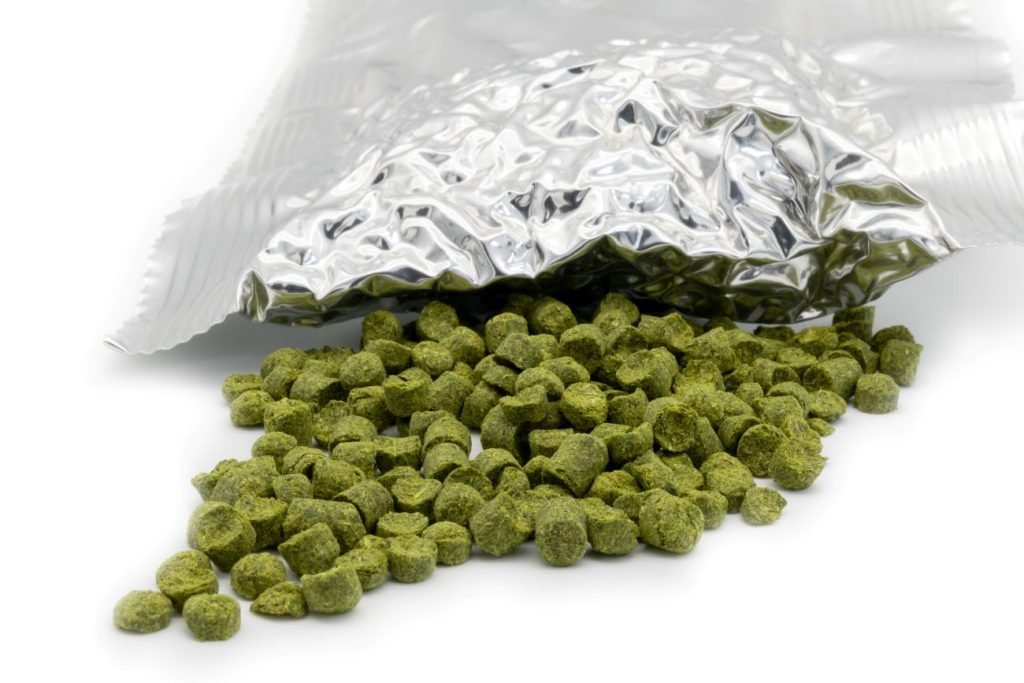
Hops, like malt and yeast, have a limited shelf life. Hops are typically harvested once a year and then rapidly dried, packaged and stored in either pellet or whole leaf format. The vast majority of hops produced in the US are stored in T90 pellet form, though some is still available in a whole leaf format while a portion is also used to make various kind of extracts and advanced hop products.
The majority of dried hop composition is cellulose (about 50%) and water (about 10%). However hops have over 500 flavor compounds including alpha acid (0-22%) which provides most of the bitterness and aroma oils (0.5-4%) which provide the fresh hop aroma. It is these flavor and aroma compounds that are most fragile and likely to break down over time.
The main enemies of hops are:
- Heat: Heat accelerates the chemical decomposition of hop compounds. The relationship between temperature and loss of alpha acid, for example, is exponential. For every 15 degrees C (27F) of additional temperature the rate of decomposition roughly doubles. So hops stored at 75 F (24 C) will degrade four times as fast as hops stored at freezing temperature.
- Light: Hop cones become susceptible to light exposure as soon as they are picked. Light can break down both alpha acids and aroma compounds, so hop growers take care to store picked hops away from light and package hops in light barrier packaging.
- Moisture: Moisture promotes staling, especially combined with heat and oxygen. That is why fresh hops are rapidly dried to approximately a 10% or less moisture content, and wet fresh hops can really only be used for a few days without drying before they will go bad.
- Oxygen: Alpha acids and aroma compounds are both prone to oxidation. Oxidized hops take on a “cheesy”, stale aroma. This is why most hops are stored in foil packaging which also serves as an oxygen barrier. This is also why T90 pellets are the gold standard for storage as they provide less surface area for oxygen exposure.
In general as hops age they will lose their fresh hop aroma first. Aromatic oils are volatile and fragile and will degrade rapidly as the hops are exposed to any of the above accelerators.
Alpha acid also degrades over time reducing the effective alpha acid percentage of the hops as they age. There is an index called the Hop Stability Index (HSI) which measures the alpha acid lost in 6 months when hops are stored at a standard temperature of 20 C (68F). Most hops are considered viable for use as a boil hop until they lose approximately half of their alpha acid. This index is variety specific, but can help to estimate how long hops might last at a given temperature and storage state. BeerSmith has a tool under Tools->Hop Age to help you complete this estimate if you know the approximate HSI.
The Best Way to Store Your Hops
By far the best way to store your hops is sealed in their original packaging in your freezer. Most modern hops use a vacuum packed foil package that provides an oxygen, light and moisture barrier. Storing these packets in your freezer also provides protection against heat for maximum lifespan. Properly stored this way the hops should last you a year or more depending on the variety.
I do recommend in all cases opening and sampling the aroma on your hops before you start brewing on brew day. I’ve found in several cases that even brand new hops can occasionally have a bad aroma or flavor likely due to problems in the harvest or packaging. It is a shame to ruin an entire batch by dropping bad hops into it, so if you find the hops are not up to par, either substitute some good hops you have on hand or stop brewing and procure additional hops up front.
Storing Hops After Opening
If you want to preserve an open package of hops you have a few options. The best option is to use a vacuum sealing system that are commonly sold for packaging frozen foods. This will not only act as an oxygen barrier but will also remove as much of the oxygen as possible. Store these bags in a dark bag or dark corner of the freezer so you don’t risk exposing them to light.
Another option is to put them in a seal-able bag and purge them with CO2 or nitrogen from your kegging system. Of the two nitrogen is a better choice, but CO2 will work in a pinch. Get as much oxygen as you can out and then purge the bag with several rounds of nitrogen or CO2, seal and again freeze in a dark bag.
Obviously it is best if you can use your remaining hops as soon as possible. Even if they are properly resealed, they likely won’t last as long as a commercially packaged pack of hops.
I hope you enjoyed this week’s article on storing hops. Thanks for joining me on the BeerSmith Home Brewing Blog. If you want to take the guesswork out of brewing, please try my BeerSmith 4 recipe software from BeerSmith.com. Be sure to sign up for my newsletter or my podcast (also on itunes and youtube) for more great tips on homebrewing.