Author: Jordan Folks
With rare exception, clarity tends to be viewed as a positive in beer, a sign that a brewer employs certain methods to ensure her product looks just as good as it tastes. While larger outfits often rely on mechanical filtration to accomplish this goal, chemical fining agents are much more accessible to those who brew on the smaller scale, and one such chemical that many have found to be quite effective is gelatin.
Simply put, gelatin has a positive charge, so when it’s added to cool beer, it attracts and binds to negatively charged haze particles, forming clumps that are heavy enough to drop out of solution. In addition to proteins and tannins, yeast also has a negative charge, leaving many convinced that it’s best to forgo fining for beers that are going to be naturally carbonated, as this process relies on remnant yeast post-fermentation.
I keg the vast majority of the beers I brew, though for certain historical styles like Saison, I prefer sticking to tradition bottle conditioning. As much as I enjoy a bright Saison, I’ve refrained from fining them out of concern it might reduce the yeast cell count so much that the beers wouldn’t achieve my desired level of carbonation. Having heard from others who’ve had success fining bottle conditioned beers, I designed an xBmt test it out for myself!
| PURPOSE |
To evaluate the differences between a bottle conditioned Saison that was not fined with gelatin and one that was fined with gelatin.
| METHODS |
For this xBmt, I went with my go-to Saison recipe, which I feel is simple enough to allow any differences to be noticeable. Big thanks to Northern Brewer for hooking me up with the malt for this batch!
I Can See Clear Through
Recipe Details
| Batch Size | Boil Time | IBU | SRM | Est. OG | Est. FG | ABV |
|---|---|---|---|---|---|---|
| 5.5 gal | 60 min | 45.8 | 3.8 SRM | 1.05 | 1.007 | 5.64 % |
| Actuals | 1.05 | 1.007 | 5.64 % | |||
Fermentables
| Name | Amount | % |
|---|---|---|
| Pilsner | 8.5 lbs | 73.91 |
| Spelt Malt | 3 lbs | 26.09 |
Hops
| Name | Amount | Time | Use | Form | Alpha % |
|---|---|---|---|---|---|
| Perle | 35 g | 60 min | Boil | Pellet | 7.1 |
| Saaz | 85 g | 30 min | Boil | Pellet | 2.4 |
| Saphir | 14 g | 5 min | Boil | Pellet | 3.1 |
Yeast
| Name | Lab | Attenuation | Temperature |
|---|---|---|---|
| Belgian Saison (3724) | Wyeast Labs | 80% | 70°F – 95°F |
| Gnome (B45) | Imperial Yeast | 78% | 75.2°F – 64.4°F |
Notes
| Water Profile: Ca 59 | Mg 10 | Na 10 | SO4 99 | Cl 45 |

After collecting the full volume of water for two 5 gallon/19 liter batches, adjusting each to the same mineral profile, and getting them heating up, I milled the grain.

As I like to do with every Saison I make, I did a step-mash with an initial 45 minute rest at 147°F/64°C followed by a 15 minute rest at 158°F/70°C.

During the mash rests, I weighed out the kettle hop additions.

The worts were boiled for 60 minutes with hops added at the times listed in the recipe.

Once the boils were complete, I quickly chilled the worts with my JaDeD Brewing SS Coil Hydra before taking refractometer readings showing they were at my target OG.

After transferring identical volumes of wort from either batch to sanitized fermentation kegs, I pitched a 2-to-1 blend of Wyeast 3724 Belgian Saison and Imperial Yeast B45 Gnome into each batch.

With fermentation activity absent after two weeks 68°F/20°C, I hydrometer measurements confirming FG had been reached.

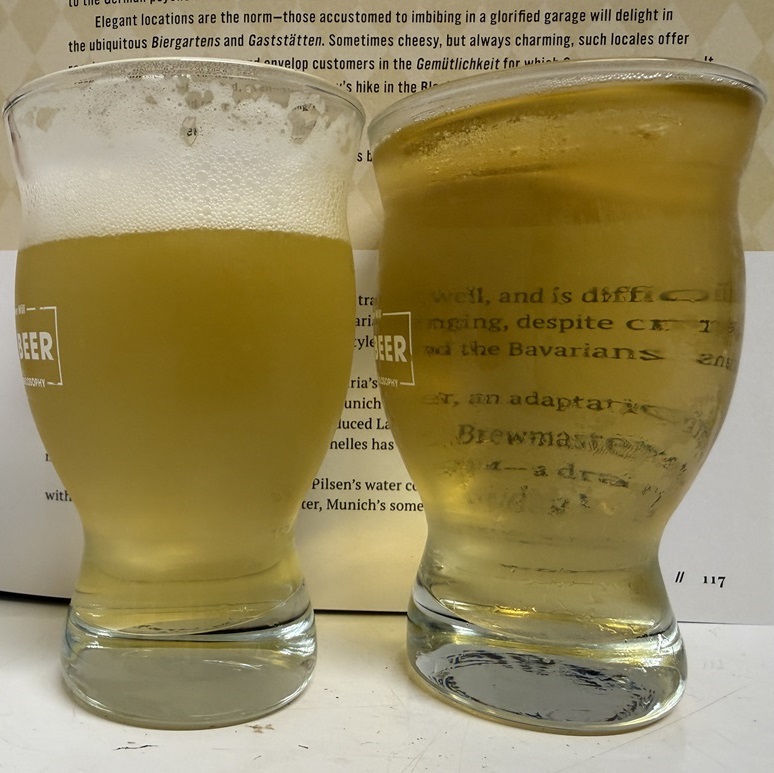
At this point, I cold crashed the beers to 34°F/1°C for two days then, using a closed oxygen-free system I rigged up, added gelatin fining to one of the batches and let them sit for another two days. Next, I bottled the beers from each batch, aiming for 3.2 volumes of CO2, and placed them in my basement to condition. At one week, the non-fined beer was nicely carbonated while the one fined with gelatin was notably less so, though they seemed much more similar a week later. Still, I allowed them to condition for a total of 4 weeks before chilling the bottles. Comparing samples bottled in clear bottles revealed a fairly stark difference in both clarity and bottle trub.

Once in glasses, the differences in appearance became even more noticeable, hence the reason we serve them to tasters in opaque cups.

| RESULTS |
A total of 20 people of varying levels of experience participated in this xBmt. Each participant was served 1 sample of beer not fined with gelatin and 2 samples of the beer fined with gelatin in different colored opaque cups then asked to identify the unique sample. In order to reach statistical significance, 11 tasters (p
My Impressions: Out of the 5 semi-blind triangle tests I attempted, I correctly identified the odd-beer-out every time, but it was not easy. The only way I was able to tell them apart was by focusing on carbonation level – the non-fined beer was fizzier than the one fined with gelatin, but it was far from flat. While the aroma and flavor were perceptibly identical, I preferred the carbonation and foam of the non-fined Saison over the clarity of the fined version.
| DISCUSSION |
Saison is one of those styles that, despite having a thread of notable flavor characteristics, leaves a lot of room for interpretation when it comes to other aspects. Whereas clarity is not a priority for many Saison brewers, others prefer theirs to be crystal clear, and a common chemical means of accomplishing this goal is gelatin fining. Confirming the claims of clarity lovers, tasters in this xBmt were unable to reliably distinguish a Saison that was not fined with gelatin from one that was fined with gelatin.
There are several potential factors in this xBmt that I feel were at play, one of which is that the plastic cups we use for data collection seem to result in more foam with highly carbonated beers; ensuring each sample had similar volumes of beer was a bit tricky and may have reduced the perceptible fizz in the non-fined beer. Regardless, the fact tasters could not reliably tell these beers apart does call into question claims that fining with gelatin has a notable impact on the flavor quality of beer.
It’s always a little awkward when the semi-blind performance of the xBmt brewer doesn’t align with the blind taster data, and when this occurs, we usually chalk it up to some form of bias. However, in this case, I’m confident there was a difference in carbonation and subsequent foam development that happened to get reduced by our method of serving. If that is as true as I believe it to be, it suggests that bottle conditioning gelatin fined beers may result in lower carbonation, which I’m sure can be easily remedied by the addition of a small amount of yeast at bottling, allowing for the best of both worlds.
If you have any thoughts about this xBmt, please do not hesitate to share in the comments section below!
Support Brülosophy In Style!


Follow Brülosophy on:
FACEBOOK | INSTAGRAM

If you enjoy this stuff and feel compelled to support Brulosophy.com, please check out the Support page for details on how you can very easily do so. Thanks!
Related