This article is part of a series of interviews with local foodies. As such, these are not my own restaurant recommendations, but they come from people who have far greater knowledge of their home cities than I do as a foodie abroad!
My first experience of New Orleans was part of a road trip through the Deep South – the same road trip that would eventually lead me to meet my future husband at a tailgate in Baton Rouge. But New Orleans was the stop right before, and I was on a mission to taste my way through the city’s culinary specialities. I tried all the obvious dishes and street food: coffee and beignets from Café du Monde, muffuletta from Central Grocery, gumbo from Dooky Chase, jambalaya from somewhere I’ve long since forgotten. And although it was all perfectly fine, I felt like I was missing something. The true local experience, not just the tourist check boxes.

I’ve been back to New Orleans since, mostly to visit friends of my husband – who lived in Louisiana for 12 years before we met – and I’ve been treated to memorable crawfish boils and meaty cook-outs in their backyards. But I’ve not ventured far into the city’s restaurant scene. To rectify that, I’ve interviewed Megan Douglas – a Nola native and a HUGE ambassador for her home town – about her favourite restaurants. From jazz brunches to upscale dinners, and from oysters Rockefeller to trout amandine, these are the best restaurants in New Orleans, according to one very enthusiastic local.
Classic New Orleans restaurants
“Like many cities since the covid pandemic, New Orleans has seen a lot of turnover in terms of restaurants,” Megan explains; “but there are some old classics that are still going strong. For me, what makes a restaurant a New Orleans staple is not just the quality of the food but also that charismatic, attentive service.” [Editor’s note: I believe this is what we’d call Southern Hospitality!] “That’s become harder to find in recent years, but a few places are still doing it really well: restaurants where the wait staff genuinely see hospitality as a career, and where you have these world-renowned chefs at the same time.”
Commander’s Palace
“Commander’s Palace should be on every New Orleans list: it’s the birthplace of the jazz brunch, and it should be part of every visit to the city.” So says Megan, and who am I to disagree? The restaurant was founded by the legendary Ella Brennan (subject of the Netflix documentary Commanding the Table), and it was here that a young Emeril Lagasse learned his craft. On the food, Megan recommends the chicken and andouille gumbo, the trout amandine (a New Orleans classic: delicate white fish with shaved pecans and a butter sauce), and the celebrated turtle soup with its sherry drizzle. “If strawberries are in season, start with the strawberry salad,” Megan advises; “Ponchatoula, just 45 minutes outside the city, is the strawberry capital of the world.”

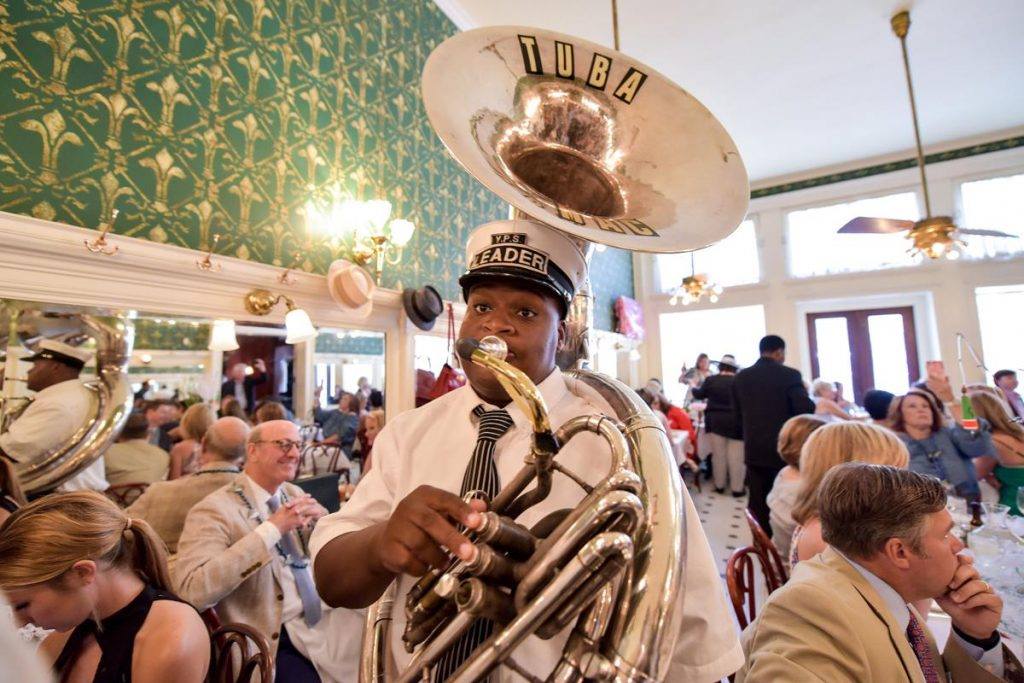
Megan recommends going specifically for the Friday, Saturday or Sunday jazz brunch, when the restaurant’s legendary service standard is at its peak. “You literally have three waiters per table: one for your water, one to run the food, one to take your order and make sure you’re taken care of.” The music is provided by a roaming three- or four-piece brass band of remarkable range: “they’ll ask a table of visitors from Bordeaux to name a jazz song, and you can choose the most obscure thing – I have literally never seen them stumped.” At some point in the meal, the room breaks into a second line, with guests waving napkins and following the band through the restaurant. “And the owners walk around and talk to every single table. That is New Orleans service right there.”
GW Fins
Just inside the French Quarter – walkable from most hotels in the area, or a short streetcar ride away – GW Fins is less theatrical than Commander’s but no less attentive. “It’s more classic, less schticky. Their whole aim is to make your dining experience an amazing one.” She brought her father-in-law there for a visit, and he (not easily impressed) declared it one of the finest dining experiences of his life. The menu is almost exclusively upscale seafood, and Megan’s top recommendation is the BBQ shrimp, a Louisiana classic. Beyond that, she highlights the lobster dumplings, lobster bisque, scallops and whatever the market catch brings in. “Anything you order there is going to be great. It’s really all about the food and the service.”

Antoine’s
Antoine’s lays claim to being one of the oldest continuously operating restaurants in the United States, and the history here is extraordinary: this is the restaurant that invented oysters Rockefeller, and the menu still features bananas Foster, flambéed tableside with brandy, and baked Alaska. “You can get a flight of oysters: Rockefeller, char-broiled and raw,” says Megan. “And the 14 dining rooms include the Rex room, which has genuine Mardi Gras artefacts from the Krewe of Rex going back decades.” If you land a charismatic waiter, ask for the tour of the private rooms after dinner (it’s free, though a tip is expected). Friday lunch is also the time to experience the old-school quarter-martini tradition, a New Orleans custom where martinis are served for 25 cents apiece.
Arnaud’s / French 75 Bar
Making an equally strong claim to New Orleans dining heritage, Arnaud’s also has a dress code, a Mardi Gras museum and a certain grandeur. But Megan’s local tip for Arnaud’s is to bypass the full dining room altogether and head instead for the French 75 Bar, the cocktail bar attached to the main restaurant. “If I’m out in the French Quarter and I need air conditioning for 20 minutes, I’ll duck into the French 75 Bar. You can get these amazing soufflé potatoes with Bearnaise sauce plus a cocktail, without sitting down for a whole dinner. The French 75 Bar is named after the classic Champagne cocktail, and it’s really what Arnaud’s is known for.”

Galatoire’s
Galatoire’s is a New Orleans institution, but it’s the Friday lunch service that defines it. “Judges, lawyers and diplomats still pay people to queue for them here,” says Megan. No reservations are taken at lunch; the dress code skews smart (“wear your cute little dress, sometimes a hat”); and the atmosphere lies somewhere between a grand brasserie and a party. “You’re going to see bachelorette parties, hear a brass band, and at some point the waiters are going to be second-lining alongside the customers. It’s an experience.” The restaurant occupies an atmospheric 1940s building right at the entrance to Bourbon Street, its historic façade a striking contrast to the neon-lit bars that flank it. Megan tends to save Galatoire’s for particular occasions – it’s where she holds her annual Mardi Gras captain’s dinner.
Editor’s note: after publishing, Galatoire’s got in touch to say that reservations are now required, so no more queuing, but there are no guarantees on being seated in the main dining room. Usually, I’d update the listing, but I so loved Megan’s description of the judges, lawyers and diplomats paying people to queue for them that I decided to leave it in for posterity!

Chapter IV
Leah Chase – the legendary “Queen of Creole Cuisine” – may no longer be with us, but her culinary legacy lives on at Chapter IV, run by her grandsons and named for the fourth generation of the Chase family. Located in the CBD and walkable from the French Quarter, its menu is built around modern takes on the classic Creole dishes Leah passed down. “I went with my sister and oh my, everything was amazing,” says Megan. “The gumbo is Leah’s own recipe, apparently. And the grits, holy hell, the grits! I had to ask the waitress how much butter and cheese was actually in them. She just laughed and said ‘I know, right?’” The chicken and waffles, crab claws and biscuits also come highly recommended.
Local neighbourhood restaurants in New Orleans
“Sure, New Orleans has Michelin-starred chefs like Emeril Lagasse,” explains Megan, “but his restaurants are not where I go to meet friends or take visitors. I’m looking for local, neighbourhood places that are really serving and representing their communities. Most of my picks are in the French Quarter, Downtown, Uptown and CBD neighbourhood (because I live uptown near Magazine Street) but of course it’s worth venturing further afield as well to Bywater and Mid-city.”
La Petite Grocery
“La Petite Grocery is my local,” says Megan. “Whenever a friend who grew up here comes back home, it’s always the first place they want to go.” The restaurant is probably best known for its hamburger, which sounds understated until you eat it. On Friday afternoons, Megan’s routine is to pull up at the bar with a glass of champagne and an order of frites. A reliable uptown staple.

Domilise’s
For a proper New Orleans po’boy, Domilise’s is Megan’s first port of call. Open since 1918, it’s a no-frills institution: around six diner tables, a counter where you order, a short menu of po’boys and not a lot else. “You’re going to get alligator, fried shrimp or roast beef debris,” says Megan, “and the lady behind the counter is going to ask you: ‘honey, you want it dressed?’ [Dressed means lettuce, tomato, pickles and mayo – the correct answer is yes.] Wash it down with a PBR and a bag of Zapp’s chips.”
Herbsaint
Herbsaint occupies a sweet spot between neighbourhood restaurant and destination dining. “The food is really high quality – interesting, modern takes on traditional New Orleans dishes – and the cocktail menu is excellent,” says Megan. The menu changes regularly, which keeps it feeling current: you can get a bowl of gumbo, but you can also order rabbit leg schnitzel or bluefin tuna tartare. “It’s the kind of place locals gravitate towards when they want something a cut above the everyday without committing to a full tasting-menu occasion.”

Cochon
Cochon is best described as upscale BBQ: a restaurant that takes the type of food typically eaten from paper plates and elevates it into a proper dining room with real technique. “The chef is always doing interesting things with traditional, low-end food,” says Megan. “Something inventive with a rack of ribs. Gourmet cracklin’s. Things you didn’t know could be elevated – but still in a relaxed, unpretentious setting.” The kitchen has a Michelin Bib Gourmand, even if the spirit of the place remains firmly rooted in Southern BBQ tradition.

Elizabeth’s Nola
In the Bywater neighbourhood (a short bike or taxi ride away from Downtown), Elizabeth’s is Megan’s brunch destination of choice. The menu is classic Southern brunch, but the standout is the praline bacon: candied bacon coated in praline, a traditional New Orleans sweet treat. “I have it every time. If the duck waffle is on the menu, get that too – it’s like chicken and waffles, but better.” There are also biscuits and gravy, fried chicken livers with pepper jelly, fried green tomatoes, and shrimp and grits. A favourite with locals and tourists alike, and one of those places that repays the effort to get there.
International restaurants in New Orleans
Of course, Nola is not only about po’boys and Southern BBQ. It’s a cosmopolitan city with a burgeoning international cuisine scene, from Asian fusion to Middle Eastern. These are just a few of Megan’s favourites.
Luvi
“I can guarantee you this one is not going to be on anybody else’s list,” says Megan, “and that’s exactly why I love it.” Luvi is tiny: 15 tables at most, on a stretch of Tchoupitoulas Street well off the tourist circuit. The food is Asian fusion, drawing on Shanghai and Japanese influences, served as small, shareable dishes. “The chef walks around and talks to every table. The menu is compact, but literally everything on it is good. I was picking off everyone else’s plates, including things I wouldn’t normally eat.” Highlights include the Dragon Boat (seared tuna with flying fish roe and smoked soy sauce) and the Monkey Snack (salmon with sesame-crusted banana in a sweet and spicy sauce).

Acamaya
“This is not Tex-Mex,” Megan is keen to clarify. “Acamaya is contemporary Mexican seafood: creative, carefully executed, and currently one of the hottest tickets among New Orleans locals.” Dishes include aguachile verde (with Gulf shrimp and tomatillo) or arroz negro (black rice with huitlacoche, Bangs Island mussels and squid). It’s a little further out of town than some of her other picks (in the Bywater), but the food justifies the journey.
Saffron
“The first time I went to Saffron,” says Megan, “was the first time in probably two years that I walked into a restaurant and thought: service and quality are back on the table. Like, actually back.” Saffron is upscale Indian with strong Asian fusion leanings – think pani puri filled with potato and garbanzo – and the standard of service is the kind that used to be taken for granted in New Orleans but is now the exception. It’s on the pricier side, but Megan is unequivocal: “I want to send everyone I know to Saffron.”

Saj
If you’re heading uptown to Saffron, Saj is right around the corner and could not be more different in terms of profile. “Nobody would think this place would end up on a New Orleans restaurant list,” says Megan, “but once you’ve been, you understand.” It’s a small, family-run Middle Eastern restaurant known for its saj bread – a large, thin flatbread baked on a domed griddle – and salads so generously portioned that one is comfortably a meal for two. It’s BYOB, which keeps the bill refreshingly low. “Tourists walk past it a thousand times a day without knowing what it is. But ask any local who’s been, and they’ll tell you it’s one of the best things they’ve eaten in the city.” A genuine hidden gem.
Pomelo
Pomelo is, in essence, a one-woman show. The chef and owner Aom Srisuk cooks on a domestic stove in a tiny kitchen, and the menu is a direct expression of Thai home cooking – featuring zippy Thai salads, aromatic herbal soups, street-style pok-pok noodles and mii kiew (dishes rarely found on menus outside of Thailand). “She markets herself almost entirely through social media, and anyone local who has been is evangelical about it,” says Megan. “I literally stopped her on the street one day to tell her I wanted her to succeed – the quality is just superb. She’s doing it the right way.”

Planning your trip to New Orleans
Nola, Nawlins, the Big Easy – whatever you call New Orleans, here are a few trip essentials to get you started:
- Getting there: Louis Armstrong New Orleans International Airport (MSY) has direct connections from Europe, with flights operated by Air France from Paris and British Airways from London Heathrow. For the widest comparison of times and prices, try Expedia or Omio.
- Getting from the airport: Unlike many US cities, New Orleans has no direct rail link from the airport to the city centre, so most visitors take a taxi (around 20–30 minutes to the French Quarter or CBD) or the official airport shuttle, which runs every 30 minutes to hotels across the city. The RTA 202 Airport Express bus is the budget option, though the journey takes around 50 minutes.
- Getting around: The French Quarter, CBD and Warehouse District are walkable, and most of the restaurants in this guide cluster in those areas or Uptown. For the latter, the St. Charles streetcar is as scenic as it is useful – and crazy cheap by European public transport standards.
- Where to stay: The French Quarter puts you within walking distance of many of the restaurants in this guide and is the classic base for first-time visitors; the CBD and Warehouse District are equally well-placed and tend to offer more modern hotels. Browse hotels and apartments on Booking.com.
- Tours & experiences: New Orleans has a particularly strong offering of food tours, culinary walks and cooking classes – a great way to get your bearings and eat a lot of things at once. Browse options on Viator or GetYourGuide.
- Further reading: Planning a wider US food trip? I’ve also written guides to Chicago’s essential eats, the best places to eat in St Augustine, Florida, and my favourite restaurants in Knoxville and East Tennessee. And for more from my local foodie interview series, check out Michael’s guide to the best restaurants in Denver, Colorado.